
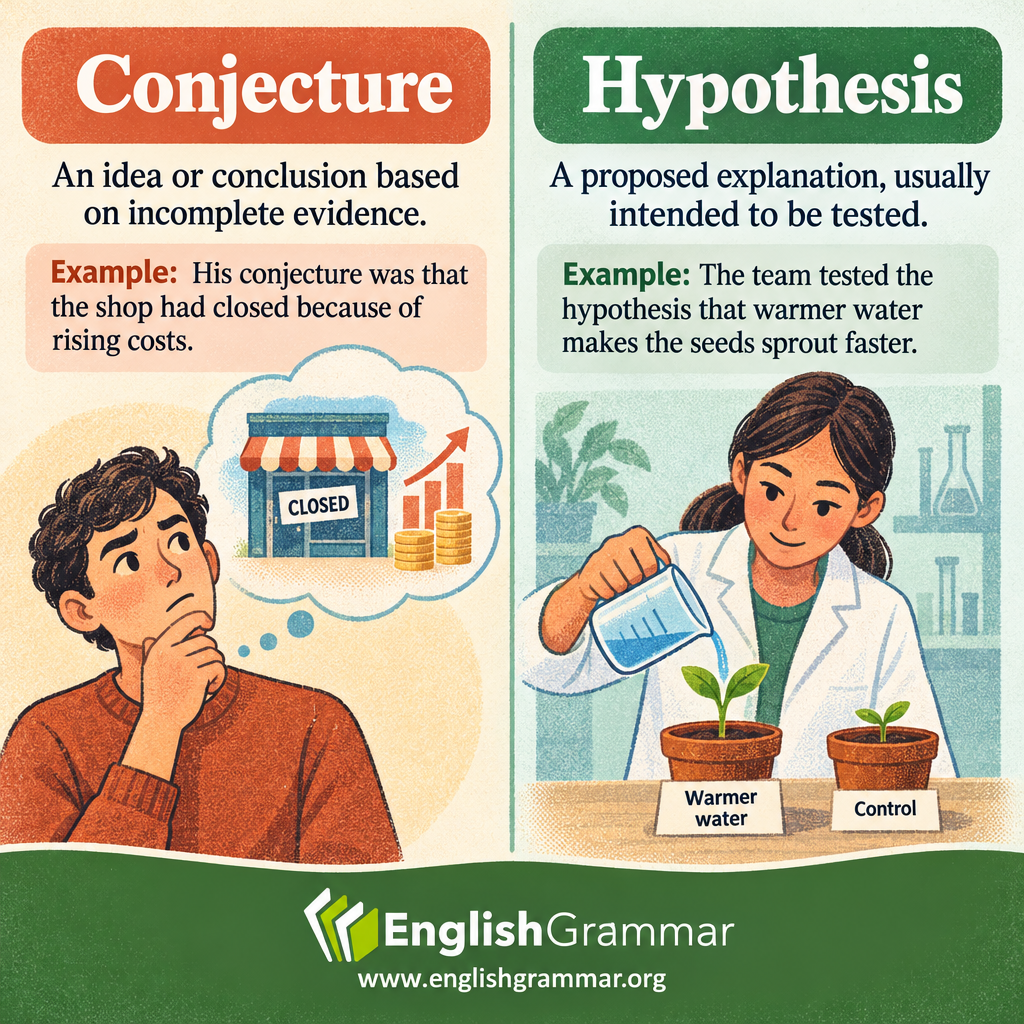
Conjecture and hypothesis both describe ideas that are not yet established as true. The main difference is what you want to emphasize: an uncertain conclusion or a proposed explanation to investigate.
A conjecture is an idea or conclusion based on incomplete evidence. Use it when someone draws a possible conclusion without enough information to be sure.
- Her conjecture was that the empty house had been sold.
- Without the missing records, any explanation is just conjecture.
A hypothesis is a proposed explanation, usually intended to be tested. In science, it must be possible to test it against evidence. A hypothesis may be well informed, but calling it a hypothesis does not mean it has been confirmed.
- The researchers tested the hypothesis that noise reduces concentration.
- Our hypothesis is that the leak comes from a damaged pipe.
The meanings overlap. An uncertain idea about a broken machine could be called either word. Conjecture emphasizes the limited evidence; hypothesis presents the idea as a possible explanation to investigate.
There is also an important mathematical use: a conjecture is a statement believed to be true but not yet proved. It may have strong supporting evidence, so it is not necessarily a casual guess. In mathematics, a hypothesis can instead be an assumption used in an argument. Context matters more than a strict “guess versus science” rule.