
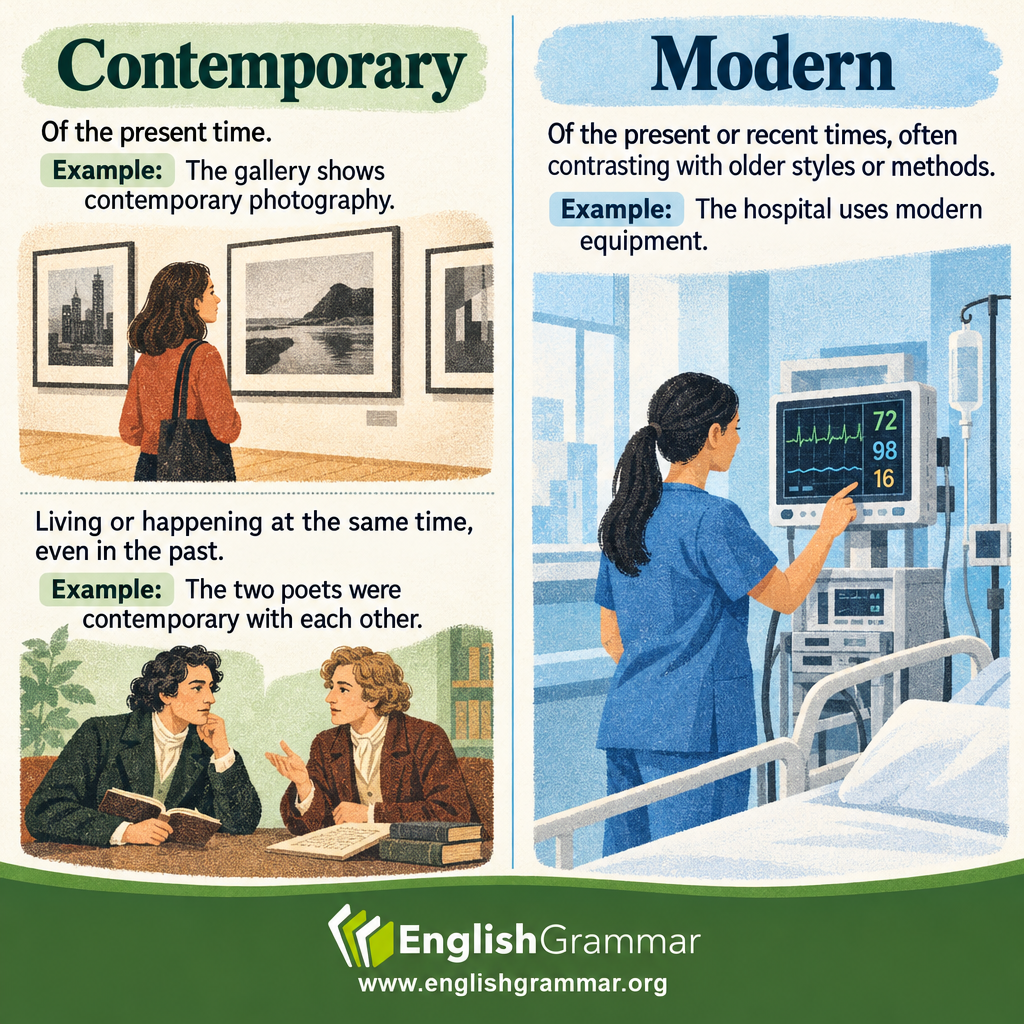
Contemporary and modern often overlap when describing the present, but they are not always interchangeable. The best choice depends on whether you mean a time period or a contrast with older ways.
Contemporary can mean belonging to the present time. It is common when discussing culture, society, and creative work. For example, The course explores contemporary British literature. The emphasis is on literature from our time, not necessarily literature with an innovative style.
It can also mean living or happening at the same time as someone or something else, including in the past. For example, The letter is contemporary with the events it describes. Here, the letter and the events belong to the same period; neither needs to be recent.
Modern usually means relating to the present or recent times, often with an emphasis on newer ideas, designs, or methods rather than traditional ones. For example, Modern farming methods can reduce water use.
- They study contemporary life in rural communities. This focuses on life today.
- They want a kitchen with modern appliances. This highlights newer equipment rather than older alternatives.
Be especially careful with art terminology. Modern art commonly names an established historical period or set of movements, not simply art made today. Contemporary art generally refers to more recent work. These specialist uses mean that an artwork can look new without being classified as modern art.