
• Skip to primary navigation
  • Skip to main content
  • Skip to primary sidebar
Home of English Grammar
  • Home
  • Course
  • Exercises
  • Grammar Rules
  • Matches
  • Posts
  • Tools
    • Grammar Checker
    • Very Replacer
    • Word Counter
  • Vocabulary Lists
  • Archives
    • Social Media Posts
    • Writing Guides
  • Sign in
  • Join free

Creepy, spooky, eerie, sinister, macabre, and bloodcurdling: What’s the difference?

November 2, 2026

Creepy vs. Spooky vs. Eerie vs. Sinister vs. Macabre vs. Bloodcurdling

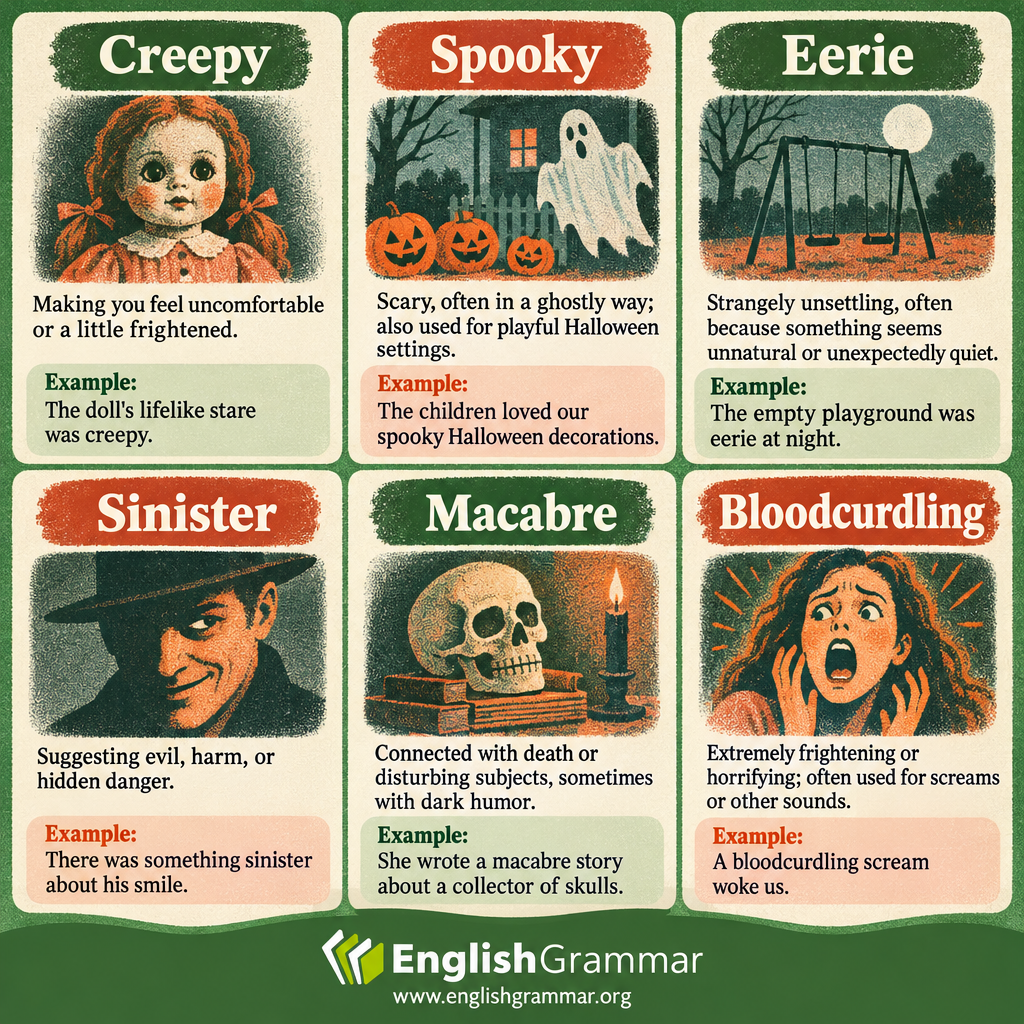
These six adjectives describe different kinds of fear or unease. They overlap, but they are not simply steps on a scale from slightly scary to terrifying. Choose according to what makes something frightening.

  • Creepy describes something that makes you uncomfortable or a little frightened. It can describe people, behavior, places, or objects. It was creepy that the stranger knew my address. No ghost or obvious danger is necessary.
  • Spooky suggests a frightening, often ghostly atmosphere. It also works for playful Halloween settings. We decorated the hallway to look like a spooky castle.
  • Eerie describes something strangely unsettling, often because it feels unnatural or unexpectedly empty or quiet. An eerie silence settled over the usually busy station. It need not involve anything supernatural.
  • Sinister suggests evil, harm, or danger, sometimes hidden beneath an ordinary appearance. His friendly invitation began to seem sinister. This word points toward a threat, not just an uncomfortable mood.
  • Macabre concerns death or other disturbing subjects, sometimes with dark humor. The film mixes romance with macabre jokes about funerals. It does not necessarily mean intensely frightening.
  • Bloodcurdling means extremely frightening or horrifying. It commonly describes screams and other terrifying sounds. A bloodcurdling howl came from the forest.

The same scene can fit several words: an abandoned hospital might feel eerie, while evidence of deliberate harm makes it seem sinister. The adjective highlights the feature you want your reader to notice.

Improve your English grammar, vocabulary and writing

We take you step by step from beginner to advanced, even if you struggled with English at school or have always had trouble remembering the rules.

  • 10 modules, 112 lessons and 730 questions
  • Just log in and learn anytime and anywhere
  • Your progress is saved in your account
  • Download the 2027 Grammar Guide (PDF)
Join free

Already have an account? Sign in

See what’s in the course

Primary Sidebar

2.4M760.9K165.9K

Free 2027 Grammar Guide

  • Download Grammar Guide (PDF)
  • Online grammar course, A1 to C2
  • Weekly exercises and vocabulary
  • Join over 3 million English learners

We respect your privacy. Unsubscribe anytime.

Already have an account? Sign in

Grammar Checker - Try Now

Latest Posts

  • Creepy, spooky, eerie, sinister, macabre, and bloodcurdling: What’s the difference? November 2, 2026
  • 100 Best Synonyms for “Improvement” November 2, 2026
  • 100 Best Synonyms for “Understood” November 2, 2026
  • Perspicacious vs. perspicuous: understanding the difference November 2, 2026
  • 100 Best Synonyms for “Heavenly” November 2, 2026
  • 100 Best Synonyms for “Underpinned” November 2, 2026
  • 100 Best Synonyms for “Improved” November 2, 2026
  • Where does “out of kilter” come from? November 2, 2026
  • Giving Personal Advice Exercise November 2, 2026
  • 100 Best Synonyms for “Repulsion” November 2, 2026
Home of English Grammar

Free English grammar exercises, rules and vocabulary lists, with new exercises every week. Join the leading English grammar site with over 3 million followers.

Join free

Learn

  • Exercises
  • Matches
  • Grammar rules
  • Vocabulary lists
  • Writing guides
  • Online tools

More

  • Top social media posts
  • Various posts
  • Contact

Account

  • Join free
  • Grammar Course
  • Free grammar guide (PDF)

Copyright © 2026 EnglishGrammar.org

  • Disclaimer
  • Privacy policy
  • Terms
  • Sitemap