
• Skip to primary navigation
  • Skip to main content
  • Skip to primary sidebar
Home of English Grammar
  • Home
  • Course
  • Exercises
  • Grammar Rules
  • Matches
  • Posts
  • Tools
    • Grammar Checker
    • Very Replacer
    • Word Counter
  • Vocabulary Lists
  • Archives
    • Social Media Posts
    • Writing Guides
  • Join free

Curious, inquisitive, intrigued, nosy, prying, or meddlesome?

October 29, 2026

Curious vs. Inquisitive vs. Intrigued vs. Nosy vs. Prying vs. Meddlesome

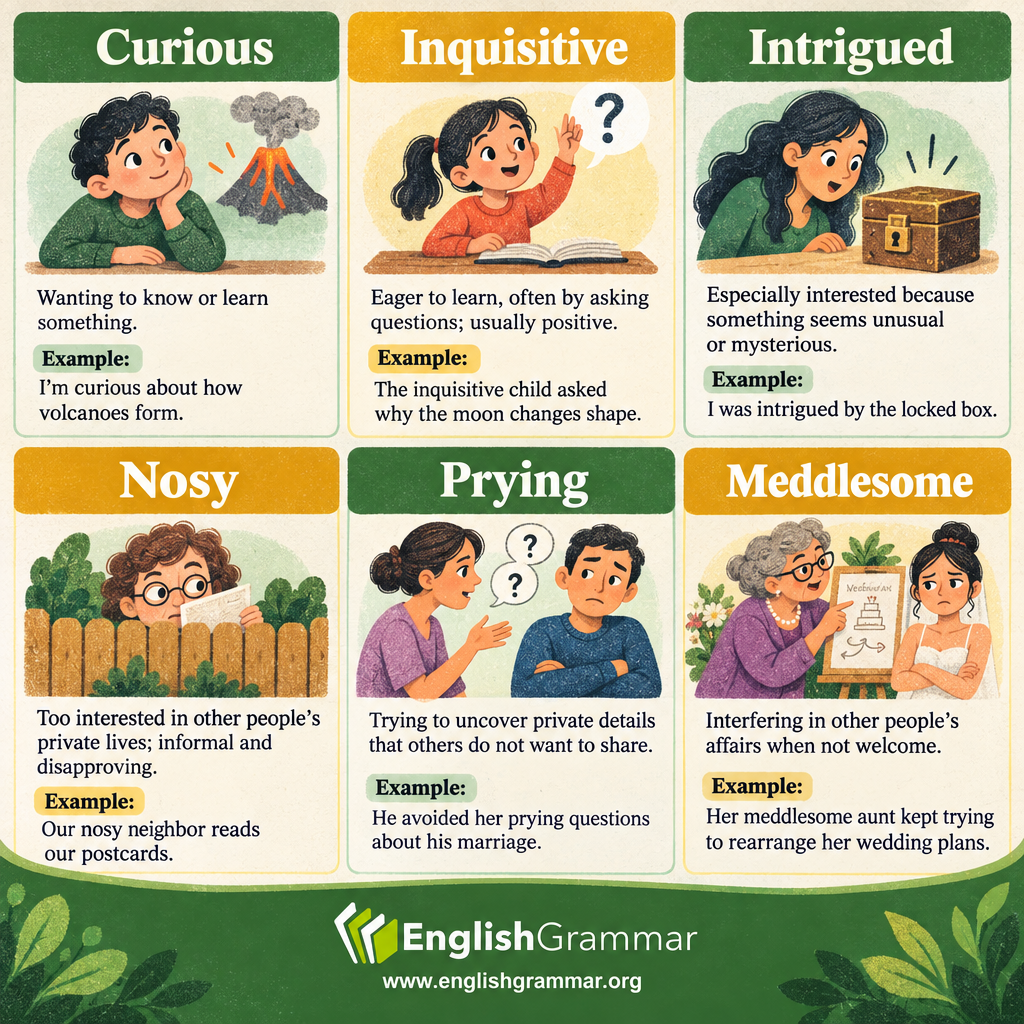
These six adjectives describe different kinds of interest and involvement. Some usually sound neutral or positive; others criticize someone’s behavior. The key questions are: Does the person want to learn, seek private information, or interfere?

  • Curious means wanting to know or learn something. It is a broad, everyday choice: I’m curious about how bees communicate. It does not necessarily suggest asking questions.
  • Inquisitive describes someone who wants to learn and often asks questions: The inquisitive student asked how the engine worked. It often sounds positive, though it can suggest unwelcome questioning in context.
  • Intrigued means especially interested because something seems unusual or mysterious: I was intrigued by the unsigned letter. It often describes a reaction to a particular thing.
  • Nosy criticizes someone for taking too much interest in other people’s private lives: My nosy neighbor wanted to know my salary. It is informal.
  • Prying emphasizes trying to uncover private details: She refused to answer his prying questions about her divorce. It suggests unwanted attempts to obtain information.
  • Meddlesome describes someone who interferes in other people’s affairs without being welcome: His meddlesome uncle kept trying to choose his career. The problem is involvement, not simply interest.

These meanings can overlap. Asking about someone’s weekend may be friendly; pressing for details they do not want to share can seem intrusive. Choose according to the situation and the attitude you want to express, rather than treating the words as exact synonyms.

Improve your English grammar, vocabulary and writing

We take you step by step from beginner to advanced, even if you struggled with English at school or have always had trouble remembering the rules.

  • 10 modules, 112 lessons and 730 questions
  • Just log in and learn anytime and anywhere
  • Your progress is saved in your account
  • Download the 2027 Grammar Guide (PDF)
Join free

Already have an account? Sign in

See what’s in the course

Primary Sidebar

2.4M761.4K165.8K

Free 2027 Grammar Guide

  • Download Grammar Guide (PDF)
  • Online grammar course, A1 to C2
  • Weekly exercises and vocabulary
  • Join over 3 million English learners

We respect your privacy. Unsubscribe anytime.

Already have an account? Sign in

Grammar Checker - Try Now

Latest Posts

  • Curious, inquisitive, intrigued, nosy, prying, or meddlesome? October 29, 2026
  • 100 Best Synonyms for “Tenacity” October 29, 2026
  • 100 Best Synonyms for “Greatly” October 29, 2026
  • Questionable vs. dubious: doubt, trust, and uncertainty October 29, 2026
  • 100 Best Synonyms for “Recognise” October 29, 2026
  • 100 Best Synonyms for “Recognize” October 29, 2026
  • 100 Best Synonyms for “Crummy” October 29, 2026
  • 100 Best Synonyms for “Affectionate” October 29, 2026
  • 100 Best Synonyms for “Goals” October 29, 2026
  • 100 Best Synonyms for “Tell” October 29, 2026
Home of English Grammar

Free English grammar exercises, rules and vocabulary lists, with new exercises every week. Join the leading English grammar site with over 3 million followers.

Join free

Learn

  • Exercises
  • Matches
  • Grammar rules
  • Vocabulary lists
  • Writing guides
  • Online tools

More

  • Top social media posts
  • Various posts
  • Contact

Account

  • Join free
  • Grammar Course
  • Free grammar guide (PDF)

Copyright © 2026 EnglishGrammar.org

  • Disclaimer
  • Privacy policy
  • Terms
  • Sitemap