
• Skip to primary navigation
  • Skip to main content
  • Skip to primary sidebar
Home of English Grammar
  • Home
  • Course
  • Exercises
  • Grammar Rules
  • Matches
  • Posts
  • Tools
    • Grammar Checker
    • Very Replacer
    • Word Counter
  • Vocabulary Lists
  • Archives
    • Social Media Posts
    • Writing Guides
  • Join free

What “to cut some slack” means and how to use it

August 14, 2026

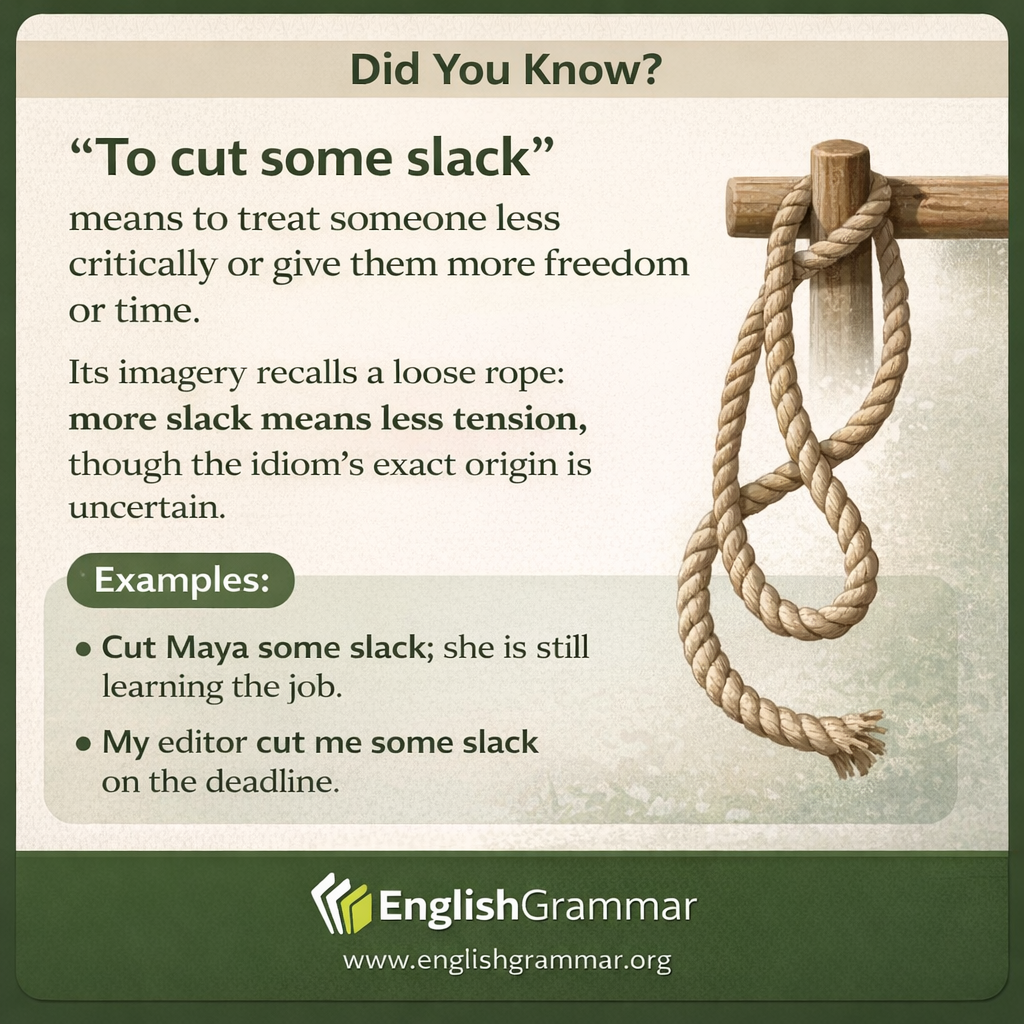
"To cut some slack"

To cut someone some slack is an informal way to ask for leniency, patience, or flexibility. It often means criticizing a person less because their situation is difficult, but it can also mean allowing extra time, freedom, or room for error.

The expression uses the image of slack in a rope. A slack rope is loose rather than pulled tight, so adding slack reduces tension and allows movement. This image helps explain the modern sense of easing pressure on someone. The exact route by which the full idiom developed is uncertain, so it is safer to treat the rope connection as an underlying metaphor rather than a proven origin story.

The usual pattern is cut + person + some slack. The person can be named or represented by an object pronoun such as me, him, her, us, or them. Cut has the same base and past forms, while cuts is used with he, she, or it in the simple present.

  • Please cut Amir some slack because he has been caring for a sick parent.
  • The coach cut the new players some slack during their first practice.
  • Can you cut us some slack and extend the deadline until Friday?

The phrase is usually sympathetic, but tone matters. Said sharply, it can sound defensive. In formal writing, alternatives such as allow more time, show leniency, or be less critical may fit better. A close synonym is give someone a break, although that expression can also mean to stop bothering or criticizing someone.

Improve your English grammar, vocabulary and writing

We take you step by step from beginner to advanced, even if you struggled with English at school or have always had trouble remembering the rules.

  • 10 modules, 105 lessons and 688 questions
  • Just log in and learn anytime and anywhere
  • Your progress is saved in your account
  • Download the 2027 Grammar Guide (PDF)
Join free

Already have an account? Sign in

See what’s in the course

Primary Sidebar

2.4M761.4K165.8K

Free 2027 Grammar Guide

  • Download Grammar Guide (PDF)
  • Online grammar course, A1 to C2
  • Weekly exercises and vocabulary
  • Join over 3 million English learners

We respect your privacy. Unsubscribe anytime.

Already have an account? Sign in

Grammar Checker - Try Now

Latest Posts

  • Clefting for Information Focus Exercise October 20, 2026
  • 100 Best Synonyms for “Deepened” October 20, 2026
  • 100 Best Synonyms for “Shocking” October 20, 2026
  • Feeling, emotion, mood, sentiment, vibe, and aura: How to choose October 20, 2026
  • 100 Best Synonyms for “Prevail” October 20, 2026
  • 100 Words Every Speech Therapist Should Know October 20, 2026
  • 100 Best Synonyms for “Amusing” October 20, 2026
  • This, That, These, Those Exercise October 20, 2026
  • 100 Best Synonyms for “Cute” October 20, 2026
  • 100 Words Every Pathologist Should Know October 20, 2026
Home of English Grammar

Free English grammar exercises, rules and vocabulary lists, with new exercises every week. Join the leading English grammar site with over 3 million followers.

Join free

Learn

  • Exercises
  • Matches
  • Grammar rules
  • Vocabulary lists
  • Writing guides
  • Online tools

More

  • Top social media posts
  • Various posts
  • Contact

Account

  • Join free
  • Grammar Course
  • Free grammar guide (PDF)

Copyright © 2026 EnglishGrammar.org

  • Disclaimer
  • Privacy policy
  • Terms
  • Sitemap