
• Skip to primary navigation
  • Skip to main content
  • Skip to primary sidebar
Home of English Grammar
  • Home
  • Course
  • Exercises
  • Grammar Rules
  • Matches
  • Posts
  • Tools
    • Grammar Checker
    • Very Replacer
    • Word Counter
  • Vocabulary Lists
  • Archives
    • Social Media Posts
    • Writing Guides
  • Sign in
  • Join free

Differ vs. vary: how to choose the right verb

November 1, 2026

Differ vs. Vary

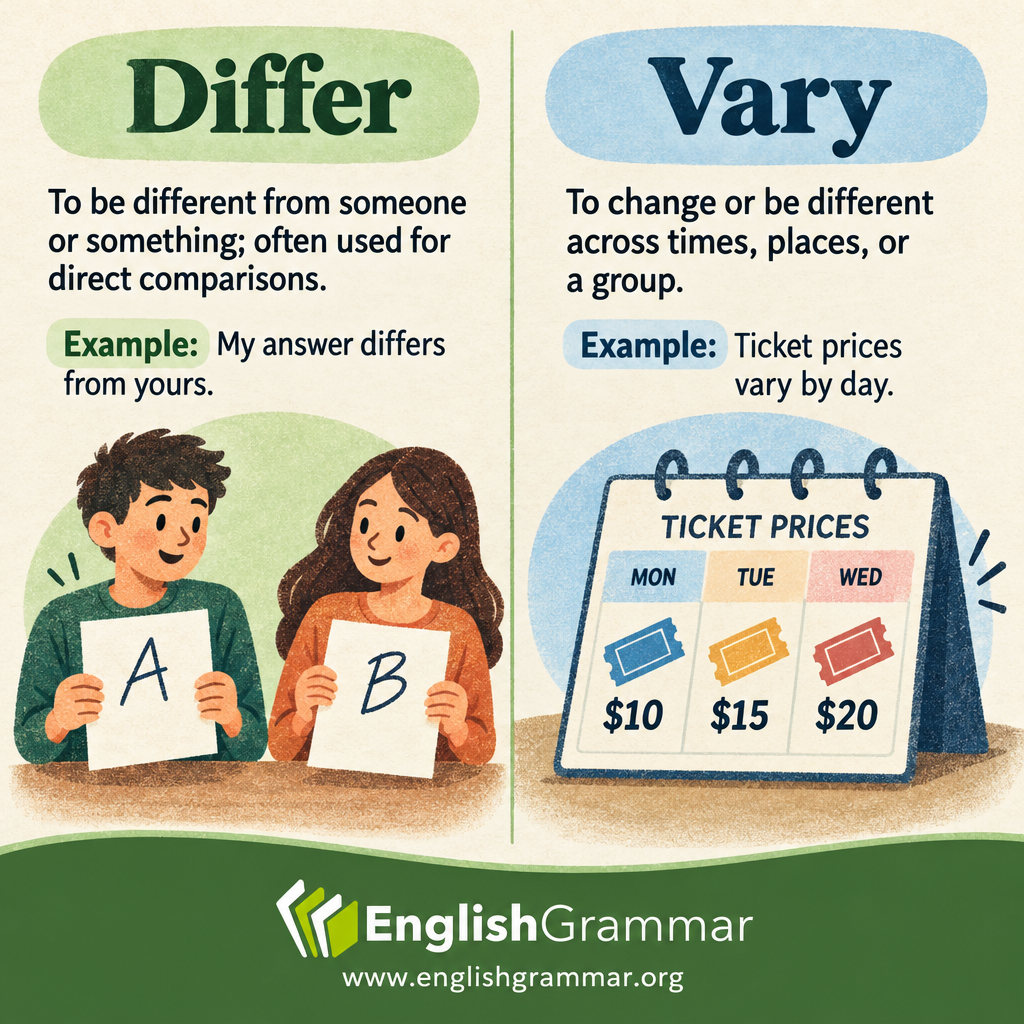
Differ and vary both describe differences, so their meanings overlap. The best choice often depends on what you want to emphasize: a comparison or a pattern of change.

Differ means to be different from someone or something. Use it when comparing people, things, or situations. The pattern differ from introduces what you are comparing something with.

  • This year’s schedule differs from last year’s.
  • The two bags differ in size.

The second example uses differ in to name the feature that is different. You can compare more than two things, too: “The five apartments differ in layout.”

Vary often describes change or differences across times, places, or members of a group. It is useful when something is not the same in every case.

  • The temperature varies throughout the day.
  • Delivery times vary from two to five days.

Common patterns include vary by, vary with, and vary from … to …. For example, “Hotel rates vary by season” explains what the differences depend on.

Sometimes either verb works: “The rooms differ in size” and “The rooms vary in size” are both natural. The first emphasizes comparison; the second suggests a range of sizes. This is not a strict rule about two things versus many, or fixed differences versus changes over time. Choose the verb that best matches your focus and the sentence pattern you need.

Improve your English grammar, vocabulary and writing

We take you step by step from beginner to advanced, even if you struggled with English at school or have always had trouble remembering the rules.

  • 10 modules, 112 lessons and 730 questions
  • Just log in and learn anytime and anywhere
  • Your progress is saved in your account
  • Download the 2027 Grammar Guide (PDF)
Join free

Already have an account? Sign in

See what’s in the course

Primary Sidebar

2.4M760.9K165.9K

Free 2027 Grammar Guide

  • Download Grammar Guide (PDF)
  • Online grammar course, A1 to C2
  • Weekly exercises and vocabulary
  • Join over 3 million English learners

We respect your privacy. Unsubscribe anytime.

Already have an account? Sign in

Grammar Checker - Try Now

Latest Posts

  • Differ vs. vary: how to choose the right verb November 1, 2026
  • 100 Best Synonyms for “Immersive” November 1, 2026
  • 100 Words Every Foley Artist Should Know November 1, 2026
  • 100 Best Synonyms for “Remnants” November 1, 2026
  • 100 Best Synonyms for “Table” November 1, 2026
  • 100 Email Subject Lines for Requests for Approval November 1, 2026
  • 100 Best Synonyms for “Ultimate” November 1, 2026
  • Understatement Exercise November 1, 2026
  • 100 Best Synonyms for “Established” November 1, 2026
  • Feelings and Health Vocabulary Exercise November 1, 2026
Home of English Grammar

Free English grammar exercises, rules and vocabulary lists, with new exercises every week. Join the leading English grammar site with over 3 million followers.

Join free

Learn

  • Exercises
  • Matches
  • Grammar rules
  • Vocabulary lists
  • Writing guides
  • Online tools

More

  • Top social media posts
  • Various posts
  • Contact

Account

  • Join free
  • Grammar Course
  • Free grammar guide (PDF)

Copyright © 2026 EnglishGrammar.org

  • Disclaimer
  • Privacy policy
  • Terms
  • Sitemap