
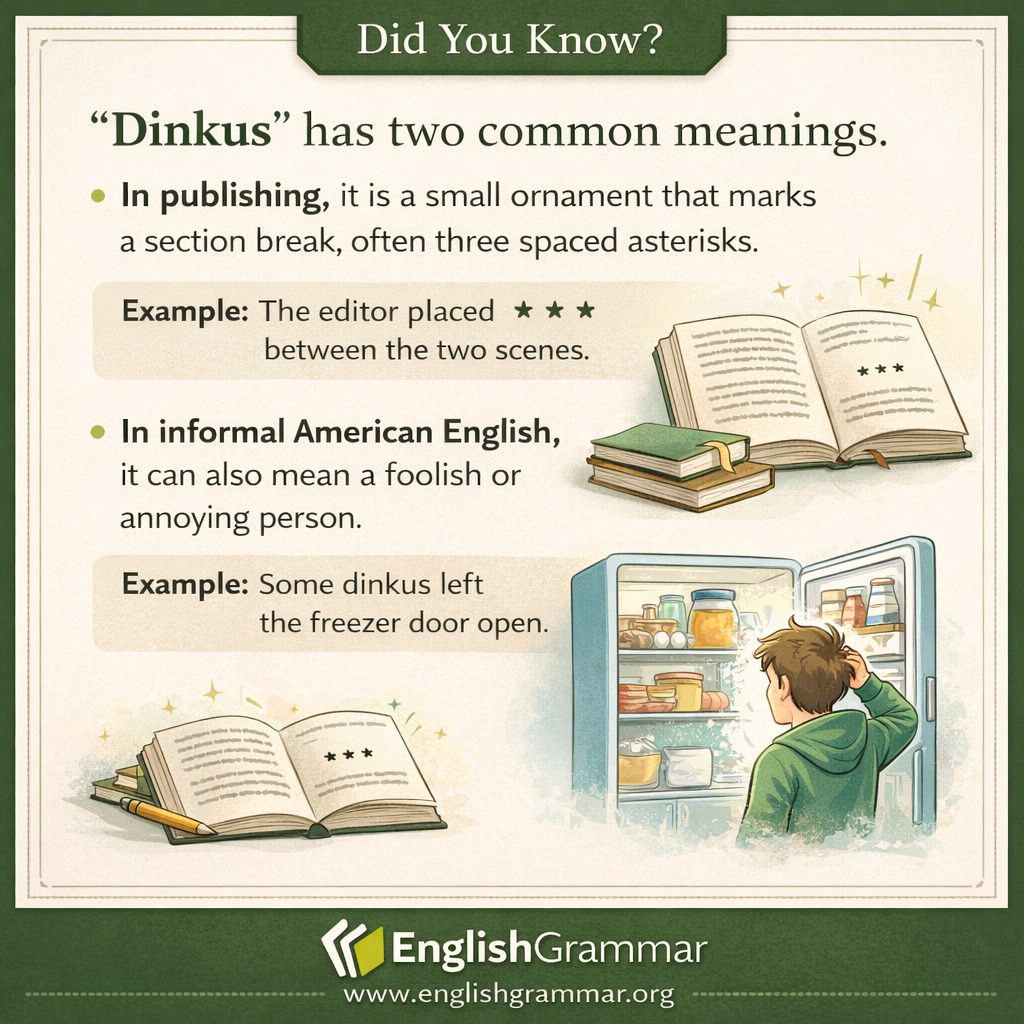
A dinkus is a small typographic ornament placed between sections of a text. It marks an internal break without requiring a new chapter. In fiction, the break often signals a change in scene, time, location, viewpoint, or focus.
The mark has no single required design. Three spaced asterisks are common, but publishers may use dots, a small illustration, an ornament shaped like a leaf, or another centered symbol. The choice is visual, while the function is structural.
A dinkus can do more than a blank line. Near the top or bottom of a page, extra white space may be easy to miss or look accidental. A visible ornament makes the intended division clear even when the text flows across pages.
Example: A novel ends one scene with a character boarding a train, places * * * on its own line, and begins the next scene the following morning. The ornament tells the reader that the story has moved forward.
It should not be confused with an asterisk used for a footnote or omission. In those cases, the symbol points to missing or additional information. As a dinkus, the ornament separates larger units of thought or narrative.
In informal English, the same word can also be a dismissive label for a foolish person or an unimportant thing. That meaning is separate from typography and depends on conversational context.