
• Skip to primary navigation
  • Skip to main content
  • Skip to primary sidebar
Home of English Grammar
  • Home
  • Course
  • Exercises
  • Grammar Rules
  • Matches
  • Posts
  • Tools
    • Grammar Checker
    • Very Replacer
    • Word Counter
  • Vocabulary Lists
  • Archives
    • Social Media Posts
    • Writing Guides
  • Join free

“Disinterested” and “uninterested” have overlapped for centuries

October 22, 2026

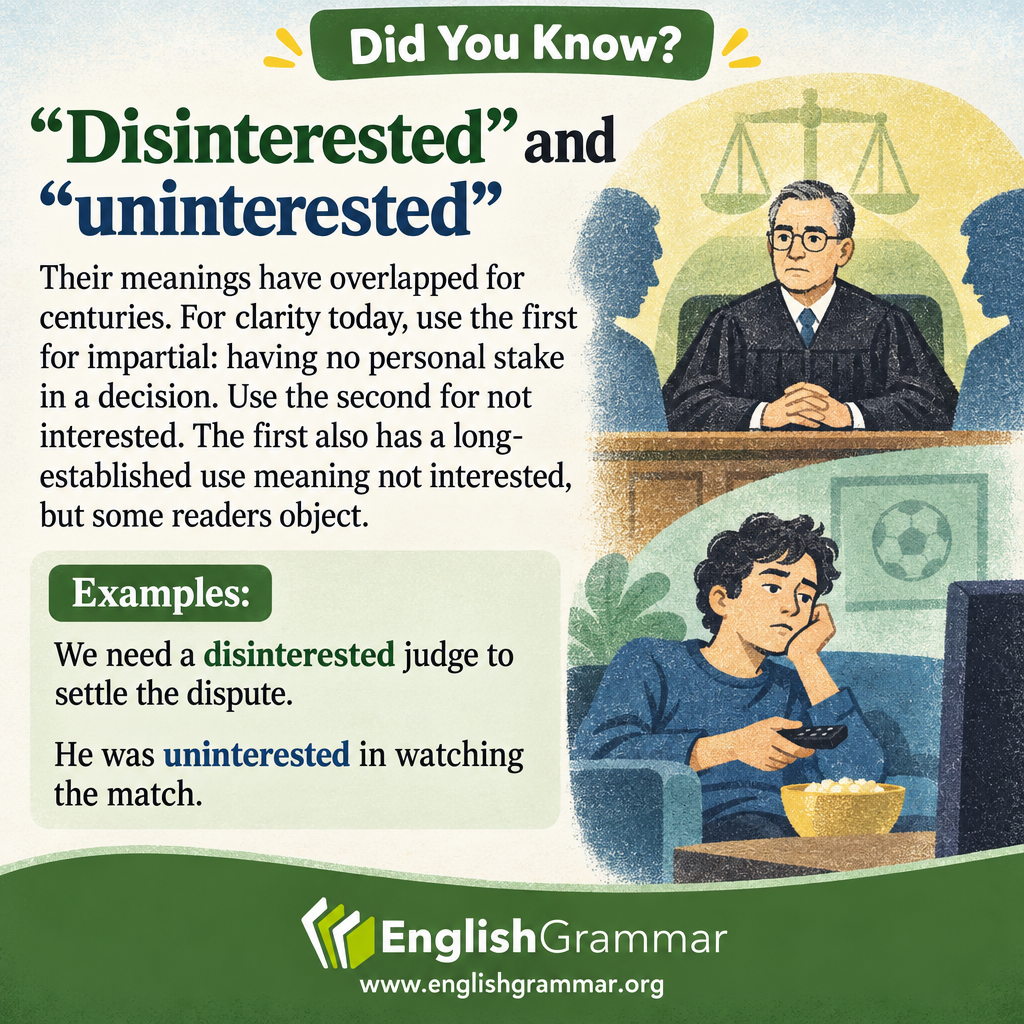
"Disinterested" and "uninterested" have overlapped for a long time.

Disinterested and uninterested are often taught as words with completely separate meanings. That distinction is useful today, but it does not tell the whole historical story.

For clear modern writing, use disinterested to mean impartial: someone has no personal stake in the outcome and can judge fairly. Use uninterested to mean not interested: someone does not feel curious about or engaged in something.

  • A disinterested adviser can help us choose between the two offers.
  • Maya was uninterested in the discussion about football.

In the first example, the adviser has nothing to gain from either choice. The sentence does not suggest that the adviser is bored. In the second, Maya simply does not find the topic interesting.

The history is less tidy than this modern distinction suggests. Both words have been used for lack of interest and for impartiality. Earlier usage even included uninterested meaning impartial. The use of disinterested to mean not interested also has a long history; it is not merely a recent confusion.

However, some readers object to that last use, especially in formal writing. A sentence such as “The students were disinterested in the lecture” may therefore distract readers or leave your meaning unclear.

If you mean the students were bored or did not care about the topic, uninterested is the clearer choice. Historical overlap explains the variation, while the modern distinction helps you avoid ambiguity.

Improve your English grammar, vocabulary and writing

We take you step by step from beginner to advanced, even if you struggled with English at school or have always had trouble remembering the rules.

  • 10 modules, 105 lessons and 688 questions
  • Just log in and learn anytime and anywhere
  • Your progress is saved in your account
  • Download the 2027 Grammar Guide (PDF)
Join free

Already have an account? Sign in

See what’s in the course

Primary Sidebar

2.4M761.4K165.8K

Free 2027 Grammar Guide

  • Download Grammar Guide (PDF)
  • Online grammar course, A1 to C2
  • Weekly exercises and vocabulary
  • Join over 3 million English learners

We respect your privacy. Unsubscribe anytime.

Already have an account? Sign in

Grammar Checker - Try Now

Latest Posts

  • “Disinterested” and “uninterested” have overlapped for centuries October 22, 2026
  • 100 Best Synonyms for “Spontaneous” October 22, 2026
  • Critical Discussion Error Correction Exercise October 22, 2026
  • 100 Best Synonyms for “Cheerless” October 22, 2026
  • 100 Best Synonyms for “Prophecy” October 22, 2026
  • 100 Best Synonyms for “Spirit” October 22, 2026
  • 100 Best Synonyms for “Distinct” October 22, 2026
  • Comprise, consist of, include, compose, constitute, and make up: How to choose October 22, 2026
  • Describing People Vocabulary Exercise October 22, 2026
  • 100 Best Synonyms for “Properties” October 22, 2026
Home of English Grammar

Free English grammar exercises, rules and vocabulary lists, with new exercises every week. Join the leading English grammar site with over 3 million followers.

Join free

Learn

  • Exercises
  • Matches
  • Grammar rules
  • Vocabulary lists
  • Writing guides
  • Online tools

More

  • Top social media posts
  • Various posts
  • Contact

Account

  • Join free
  • Grammar Course
  • Free grammar guide (PDF)

Copyright © 2026 EnglishGrammar.org

  • Disclaimer
  • Privacy policy
  • Terms
  • Sitemap