
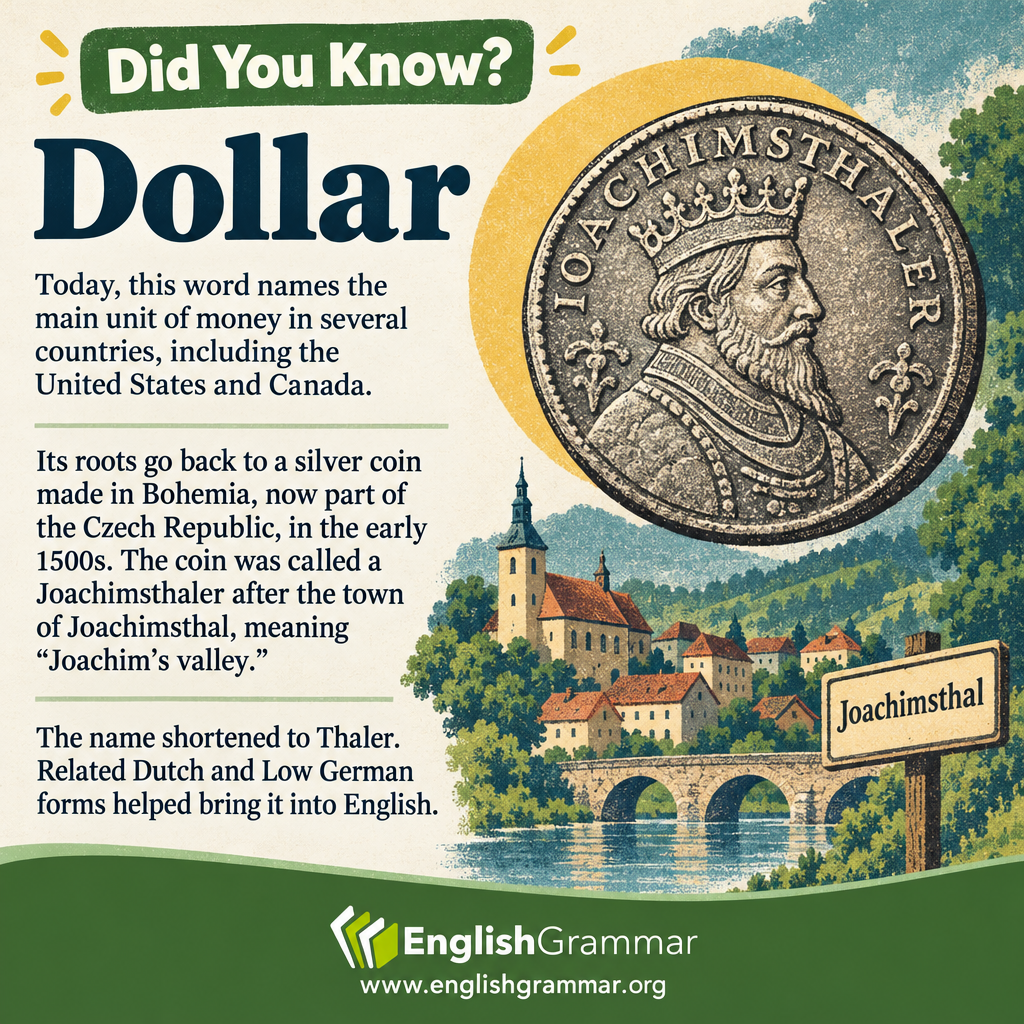
“Dollar” is the name of the main unit of money in several countries, including the United States, Canada, and Australia. Its history, however, begins with a silver coin from Bohemia, a historical region now part of the Czech Republic.
In the early 1500s, silver coins were made in a mining town known in German as Joachimsthal, now called Jáchymov. The German name meant “Joachim’s valley.” The coins became known as Joachimsthaler, meaning that they came from that place.
That long coin name was shortened to Thaler. Similar names spread as large silver coins circulated across Europe. Through forms such as Dutch daler and Low German daler, the name entered English.
English speakers later used it for other large silver coins, including the Spanish dollar, which circulated widely in the Americas. This helps explain why a name with Central European roots eventually became attached to American money.
Modern examples:
- “This notebook costs three US dollars.”
- “The hotel charges 150 Canadian dollars per night.”
These examples name different currencies, not different names for the same money. A Canadian dollar and a US dollar can have different values. When the country is not clear from context, adding US, Canadian, or Australian helps readers understand which currency you mean.