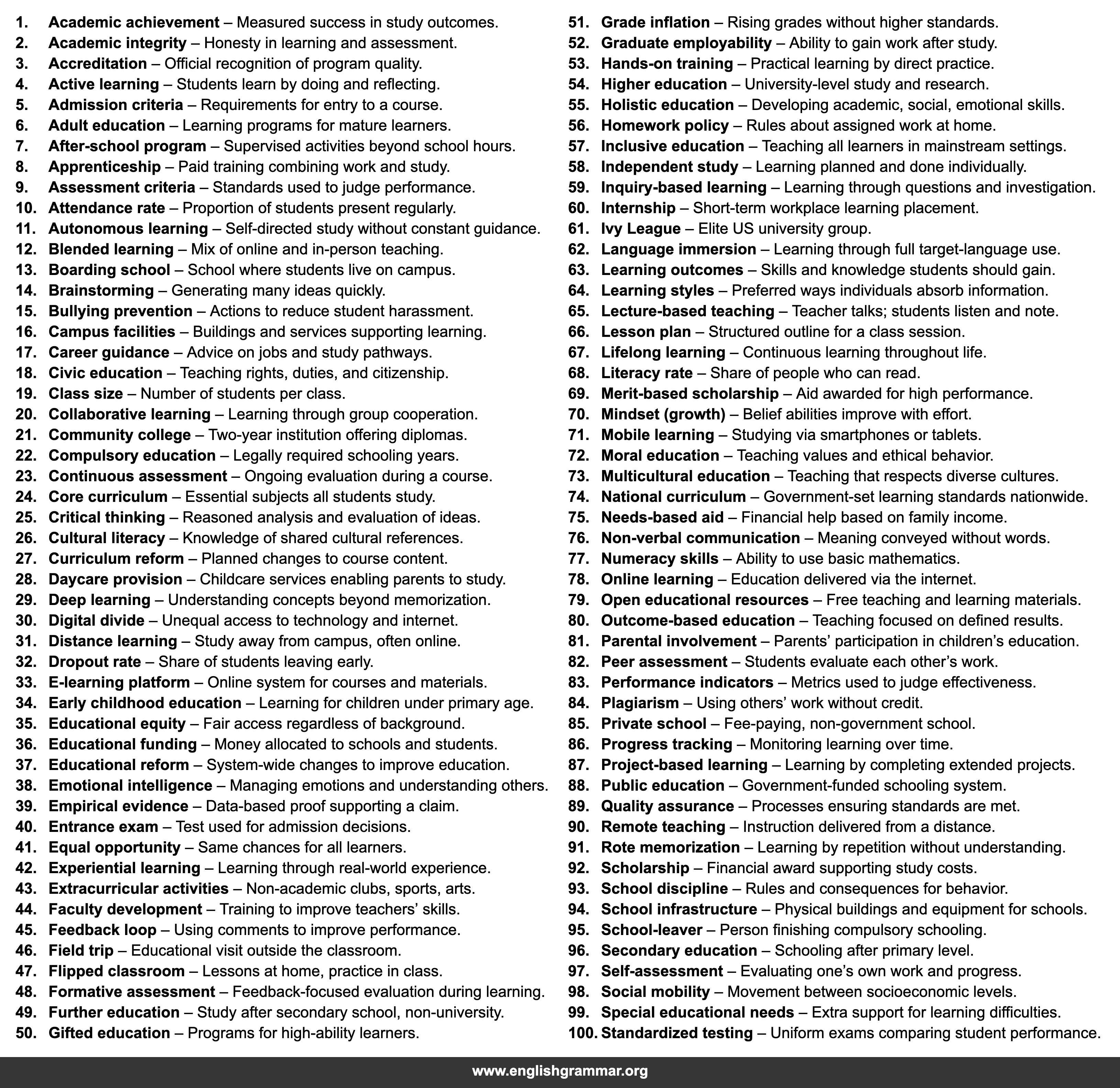
| No. | Term | Definition |
|---|---|---|
| 1. | Academic achievement | Measured success in study outcomes. |
| 2. | Academic integrity | Honesty in learning and assessment. |
| 3. | Accreditation | Official recognition of program quality. |
| 4. | Active learning | Students learn by doing and reflecting. |
| 5. | Admission criteria | Requirements for entry to a course. |
| 6. | Adult education | Learning programs for mature learners. |
| 7. | After-school program | Supervised activities beyond school hours. |
| 8. | Apprenticeship | Paid training combining work and study. |
| 9. | Assessment criteria | Standards used to judge performance. |
| 10. | Attendance rate | Proportion of students present regularly. |
| 11. | Autonomous learning | Self-directed study without constant guidance. |
| 12. | Blended learning | Mix of online and in-person teaching. |
| 13. | Boarding school | School where students live on campus. |
| 14. | Brainstorming | Generating many ideas quickly. |
| 15. | Bullying prevention | Actions to reduce student harassment. |
| 16. | Campus facilities | Buildings and services supporting learning. |
| 17. | Career guidance | Advice on jobs and study pathways. |
| 18. | Civic education | Teaching rights, duties, and citizenship. |
| 19. | Class size | Number of students per class. |
| 20. | Collaborative learning | Learning through group cooperation. |
| 21. | Community college | Two-year institution offering diplomas. |
| 22. | Compulsory education | Legally required schooling years. |
| 23. | Continuous assessment | Ongoing evaluation during a course. |
| 24. | Core curriculum | Essential subjects all students study. |
| 25. | Critical thinking | Reasoned analysis and evaluation of ideas. |
| 26. | Cultural literacy | Knowledge of shared cultural references. |
| 27. | Curriculum reform | Planned changes to course content. |
| 28. | Daycare provision | Childcare services enabling parents to study. |
| 29. | Deep learning | Understanding concepts beyond memorization. |
| 30. | Digital divide | Unequal access to technology and internet. |
| 31. | Distance learning | Study away from campus, often online. |
| 32. | Dropout rate | Share of students leaving early. |
| 33. | E-learning platform | Online system for courses and materials. |
| 34. | Early childhood education | Learning for children under primary age. |
| 35. | Educational equity | Fair access regardless of background. |
| 36. | Educational funding | Money allocated to schools and students. |
| 37. | Educational reform | System-wide changes to improve education. |
| 38. | Emotional intelligence | Managing emotions and understanding others. |
| 39. | Empirical evidence | Data-based proof supporting a claim. |
| 40. | Entrance exam | Test used for admission decisions. |
| 41. | Equal opportunity | Same chances for all learners. |
| 42. | Experiential learning | Learning through real-world experience. |
| 43. | Extracurricular activities | Non-academic clubs, sports, arts. |
| 44. | Faculty development | Training to improve teachers’ skills. |
| 45. | Feedback loop | Using comments to improve performance. |
| 46. | Field trip | Educational visit outside the classroom. |
| 47. | Flipped classroom | Lessons at home, practice in class. |
| 48. | Formative assessment | Feedback-focused evaluation during learning. |
| 49. | Further education | Study after secondary school, non-university. |
| 50. | Gifted education | Programs for high-ability learners. |
| 51. | Grade inflation | Rising grades without higher standards. |
| 52. | Graduate employability | Ability to gain work after study. |
| 53. | Hands-on training | Practical learning by direct practice. |
| 54. | Higher education | University-level study and research. |
| 55. | Holistic education | Developing academic, social, emotional skills. |
| 56. | Homework policy | Rules about assigned work at home. |
| 57. | Inclusive education | Teaching all learners in mainstream settings. |
| 58. | Independent study | Learning planned and done individually. |
| 59. | Inquiry-based learning | Learning through questions and investigation. |
| 60. | Internship | Short-term workplace learning placement. |
| 61. | Ivy League | Elite US university group. |
| 62. | Language immersion | Learning through full target-language use. |
| 63. | Learning outcomes | Skills and knowledge students should gain. |
| 64. | Learning styles | Preferred ways individuals absorb information. |
| 65. | Lecture-based teaching | Teacher talks; students listen and note. |
| 66. | Lesson plan | Structured outline for a class session. |
| 67. | Lifelong learning | Continuous learning throughout life. |
| 68. | Literacy rate | Share of people who can read. |
| 69. | Merit-based scholarship | Aid awarded for high performance. |
| 70. | Mindset (growth) | Belief abilities improve with effort. |
| 71. | Mobile learning | Studying via smartphones or tablets. |
| 72. | Moral education | Teaching values and ethical behavior. |
| 73. | Multicultural education | Teaching that respects diverse cultures. |
| 74. | National curriculum | Government-set learning standards nationwide. |
| 75. | Needs-based aid | Financial help based on family income. |
| 76. | Non-verbal communication | Meaning conveyed without words. |
| 77. | Numeracy skills | Ability to use basic mathematics. |
| 78. | Online learning | Education delivered via the internet. |
| 79. | Open educational resources | Free teaching and learning materials. |
| 80. | Outcome-based education | Teaching focused on defined results. |
| 81. | Parental involvement | Parents’ participation in children’s education. |
| 82. | Peer assessment | Students evaluate each other’s work. |
| 83. | Performance indicators | Metrics used to judge effectiveness. |
| 84. | Plagiarism | Using others’ work without credit. |
| 85. | Private school | Fee-paying, non-government school. |
| 86. | Progress tracking | Monitoring learning over time. |
| 87. | Project-based learning | Learning by completing extended projects. |
| 88. | Public education | Government-funded schooling system. |
| 89. | Quality assurance | Processes ensuring standards are met. |
| 90. | Remote teaching | Instruction delivered from a distance. |
| 91. | Rote memorization | Learning by repetition without understanding. |
| 92. | Scholarship | Financial award supporting study costs. |
| 93. | School discipline | Rules and consequences for behavior. |
| 94. | School infrastructure | Physical buildings and equipment for schools. |
| 95. | School-leaver | Person finishing compulsory schooling. |
| 96. | Secondary education | Schooling after primary level. |
| 97. | Self-assessment | Evaluating one’s own work and progress. |
| 98. | Social mobility | Movement between socioeconomic levels. |
| 99. | Special educational needs | Extra support for learning difficulties. |
| 100. | Standardized testing | Uniform exams comparing student performance. |
