
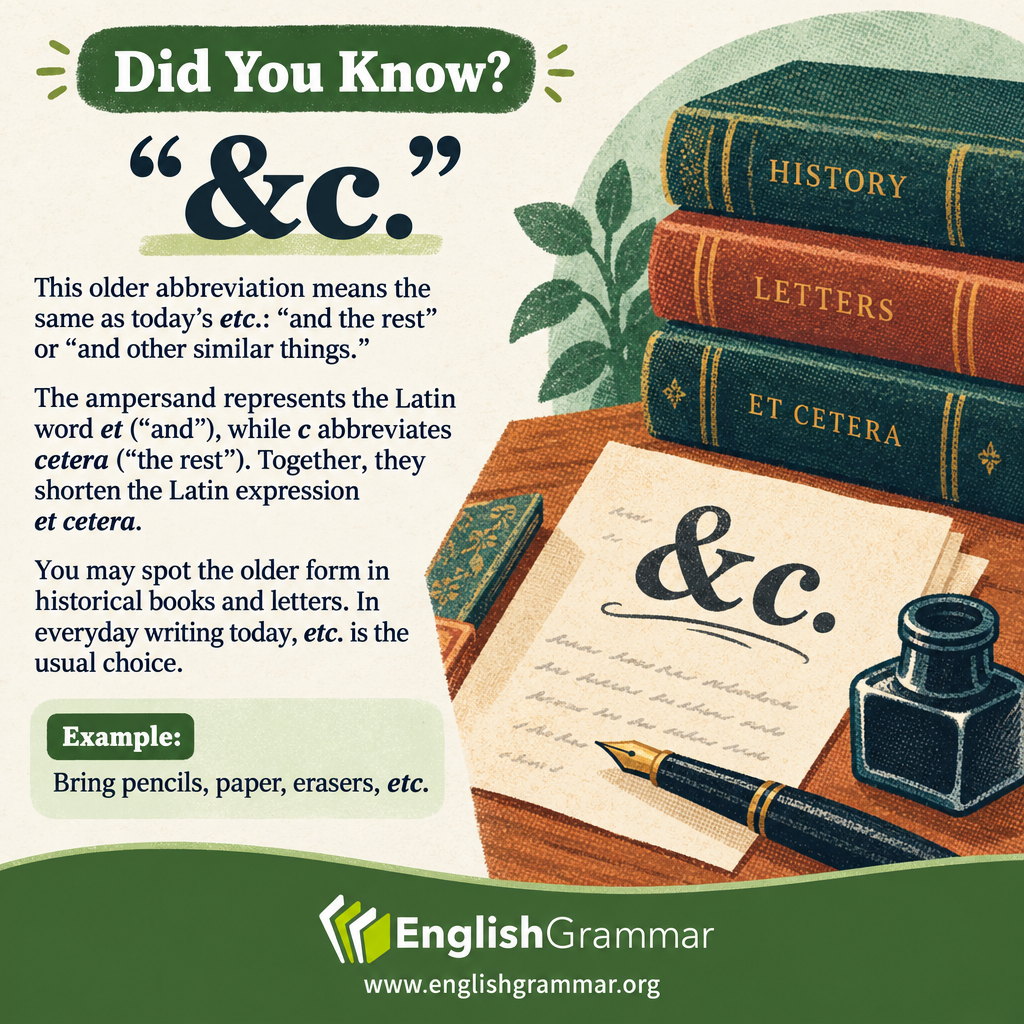
If you read an older English book or letter, you may come across &c. at the end of a list. It is an older way of writing etc., the familiar abbreviation for the Latin expression et cetera.
The expression means “and the rest” or “and other similar things.” It tells the reader that a list could continue, but the writer does not need to name every item.
The spelling makes sense when you look at its parts. The ampersand (&) represents the Latin word et, meaning “and.” The letter c abbreviates cetera, meaning “the rest.” The ampersand itself developed from a joined form of the letters in et.
These examples show how the two abbreviations serve the same purpose:
- Older-style spelling: The shop sold paper, ink, envelopes, &c.
- Modern spelling: We packed towels, sunscreen, swimsuits, etc.
In both sentences, the abbreviation points to more items of the same general kind: writing supplies in the first and things for a beach trip in the second.
For everyday writing today, etc. is the usual choice. The older form is mainly useful to recognize when reading historical texts. Neither abbreviation names the missing items, so use a complete list when the reader needs exact information, such as required documents or ingredients.