
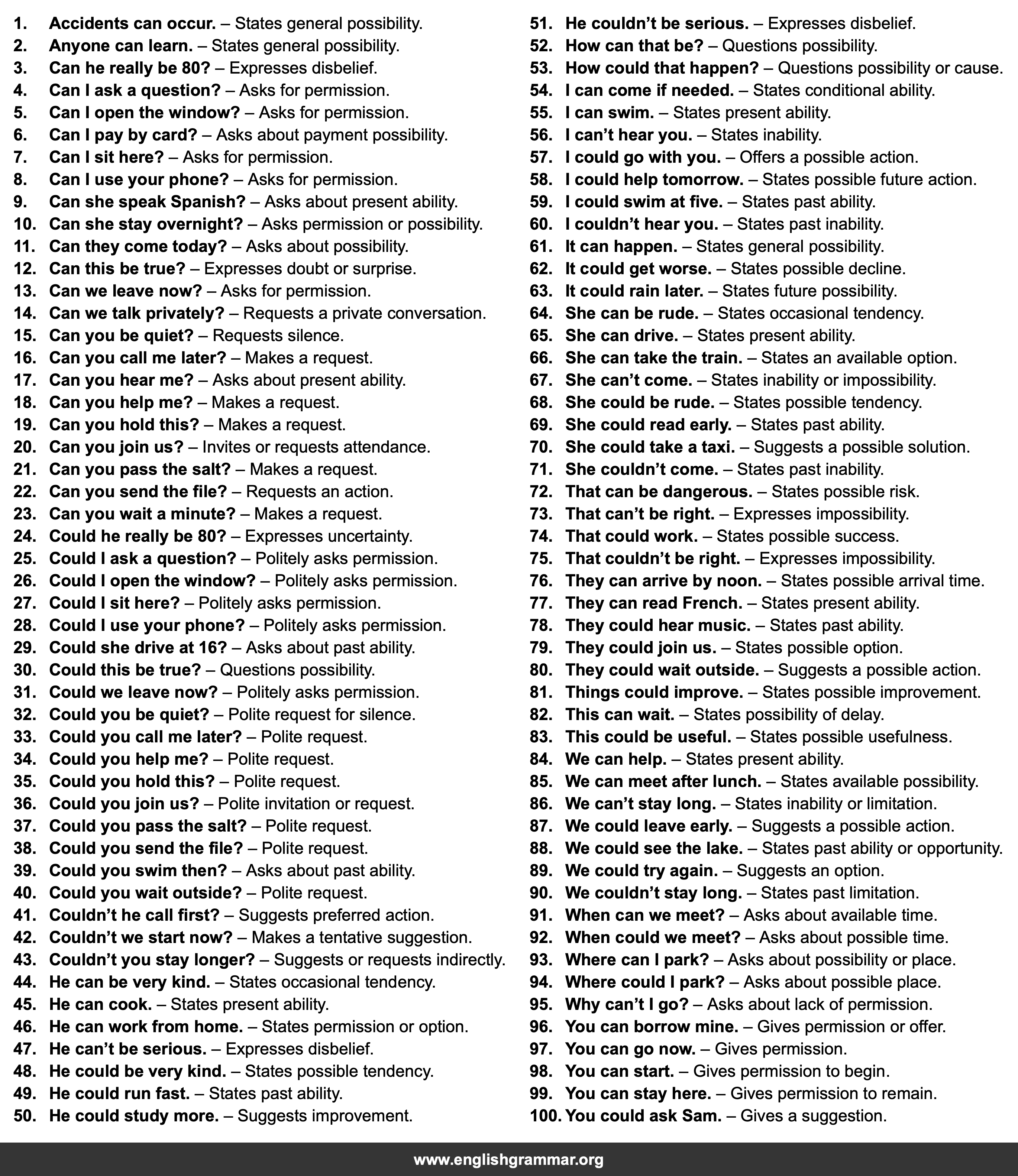
| No. | Item | Definition |
|---|---|---|
| 1. | Accidents can occur. | States general possibility. |
| 2. | Anyone can learn. | States general possibility. |
| 3. | Can he really be 80? | Expresses disbelief. |
| 4. | Can I ask a question? | Asks for permission. |
| 5. | Can I open the window? | Asks for permission. |
| 6. | Can I pay by card? | Asks about payment possibility. |
| 7. | Can I sit here? | Asks for permission. |
| 8. | Can I use your phone? | Asks for permission. |
| 9. | Can she speak Spanish? | Asks about present ability. |
| 10. | Can she stay overnight? | Asks permission or possibility. |
| 11. | Can they come today? | Asks about possibility. |
| 12. | Can this be true? | Expresses doubt or surprise. |
| 13. | Can we leave now? | Asks for permission. |
| 14. | Can we talk privately? | Requests a private conversation. |
| 15. | Can you be quiet? | Requests silence. |
| 16. | Can you call me later? | Makes a request. |
| 17. | Can you hear me? | Asks about present ability. |
| 18. | Can you help me? | Makes a request. |
| 19. | Can you hold this? | Makes a request. |
| 20. | Can you join us? | Invites or requests attendance. |
| 21. | Can you pass the salt? | Makes a request. |
| 22. | Can you send the file? | Requests an action. |
| 23. | Can you wait a minute? | Makes a request. |
| 24. | Could he really be 80? | Expresses uncertainty. |
| 25. | Could I ask a question? | Politely asks permission. |
| 26. | Could I open the window? | Politely asks permission. |
| 27. | Could I sit here? | Politely asks permission. |
| 28. | Could I use your phone? | Politely asks permission. |
| 29. | Could she drive at 16? | Asks about past ability. |
| 30. | Could this be true? | Questions possibility. |
| 31. | Could we leave now? | Politely asks permission. |
| 32. | Could you be quiet? | Polite request for silence. |
| 33. | Could you call me later? | Polite request. |
| 34. | Could you help me? | Polite request. |
| 35. | Could you hold this? | Polite request. |
| 36. | Could you join us? | Polite invitation or request. |
| 37. | Could you pass the salt? | Polite request. |
| 38. | Could you send the file? | Polite request. |
| 39. | Could you swim then? | Asks about past ability. |
| 40. | Could you wait outside? | Polite request. |
| 41. | Couldn’t he call first? | Suggests preferred action. |
| 42. | Couldn’t we start now? | Makes a tentative suggestion. |
| 43. | Couldn’t you stay longer? | Suggests or requests indirectly. |
| 44. | He can be very kind. | States occasional tendency. |
| 45. | He can cook. | States present ability. |
| 46. | He can work from home. | States permission or option. |
| 47. | He can’t be serious. | Expresses disbelief. |
| 48. | He could be very kind. | States possible tendency. |
| 49. | He could run fast. | States past ability. |
| 50. | He could study more. | Suggests improvement. |
| 51. | He couldn’t be serious. | Expresses disbelief. |
| 52. | How can that be? | Questions possibility. |
| 53. | How could that happen? | Questions possibility or cause. |
| 54. | I can come if needed. | States conditional ability. |
| 55. | I can swim. | States present ability. |
| 56. | I can’t hear you. | States inability. |
| 57. | I could go with you. | Offers a possible action. |
| 58. | I could help tomorrow. | States possible future action. |
| 59. | I could swim at five. | States past ability. |
| 60. | I couldn’t hear you. | States past inability. |
| 61. | It can happen. | States general possibility. |
| 62. | It could get worse. | States possible decline. |
| 63. | It could rain later. | States future possibility. |
| 64. | She can be rude. | States occasional tendency. |
| 65. | She can drive. | States present ability. |
| 66. | She can take the train. | States an available option. |
| 67. | She can’t come. | States inability or impossibility. |
| 68. | She could be rude. | States possible tendency. |
| 69. | She could read early. | States past ability. |
| 70. | She could take a taxi. | Suggests a possible solution. |
| 71. | She couldn’t come. | States past inability. |
| 72. | That can be dangerous. | States possible risk. |
| 73. | That can’t be right. | Expresses impossibility. |
| 74. | That could work. | States possible success. |
| 75. | That couldn’t be right. | Expresses impossibility. |
| 76. | They can arrive by noon. | States possible arrival time. |
| 77. | They can read French. | States present ability. |
| 78. | They could hear music. | States past ability. |
| 79. | They could join us. | States possible option. |
| 80. | They could wait outside. | Suggests a possible action. |
| 81. | Things could improve. | States possible improvement. |
| 82. | This can wait. | States possibility of delay. |
| 83. | This could be useful. | States possible usefulness. |
| 84. | We can help. | States present ability. |
| 85. | We can meet after lunch. | States available possibility. |
| 86. | We can’t stay long. | States inability or limitation. |
| 87. | We could leave early. | Suggests a possible action. |
| 88. | We could see the lake. | States past ability or opportunity. |
| 89. | We could try again. | Suggests an option. |
| 90. | We couldn’t stay long. | States past limitation. |
| 91. | When can we meet? | Asks about available time. |
| 92. | When could we meet? | Asks about possible time. |
| 93. | Where can I park? | Asks about possibility or place. |
| 94. | Where could I park? | Asks about possible place. |
| 95. | Why can’t I go? | Asks about lack of permission. |
| 96. | You can borrow mine. | Gives permission or offer. |
| 97. | You can go now. | Gives permission. |
| 98. | You can start. | Gives permission to begin. |
| 99. | You can stay here. | Gives permission to remain. |
| 100. | You could ask Sam. | Gives a suggestion. |