
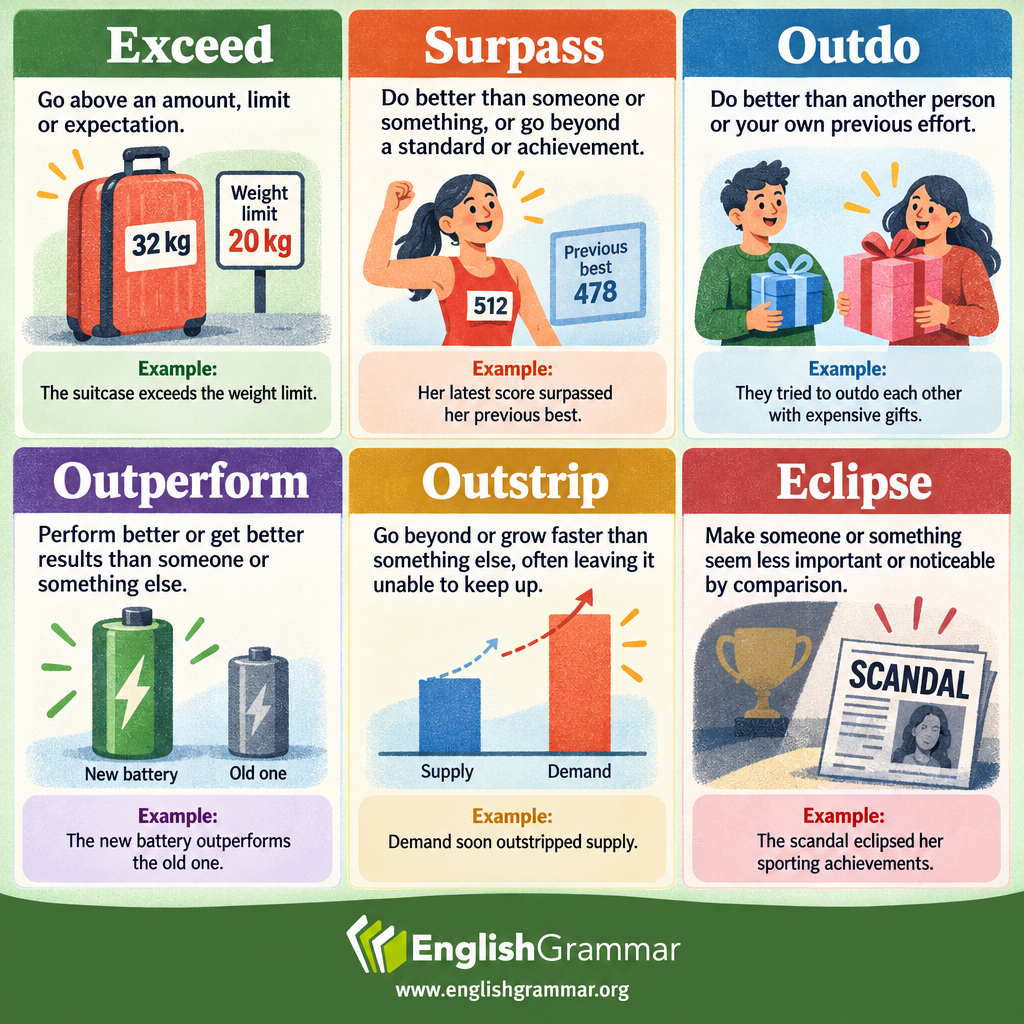
These six verbs can describe going beyond something, but they emphasize different kinds of comparison. Their meanings overlap, so context matters more than a rigid rule.
- Exceed usually means going above an amount, limit or expectation. It does not always describe something positive: The repair costs exceeded our budget. Choose it when the main idea is crossing a measurable or expected level.
- Surpass means doing better than someone or something, or going beyond an achievement or standard: Her latest novel surpassed her earlier work in popularity. It often highlights an impressive achievement.
- Outdo emphasizes doing better than another person or than your own previous effort: He outdid himself with this year’s birthday cake. It is useful for personal competition and praise.
- Outperform focuses on better results or performance: The cheaper laptop outperformed the expensive model in our tests. It commonly compares people, products, teams or investments.
- Outstrip often suggests growing faster than something else or leaving it behind: Demand for apartments has outstripped construction. It is especially useful when one side cannot keep up.
- Eclipse, in this figurative use, means making something else seem less important or noticeable: The announcement eclipsed every other story that day. The focus is relative attention or importance, not simply a higher score.
Compare Sales exceeded the target with Our team outperformed its rivals. The first compares a result with a target; the second compares how well competitors performed.