
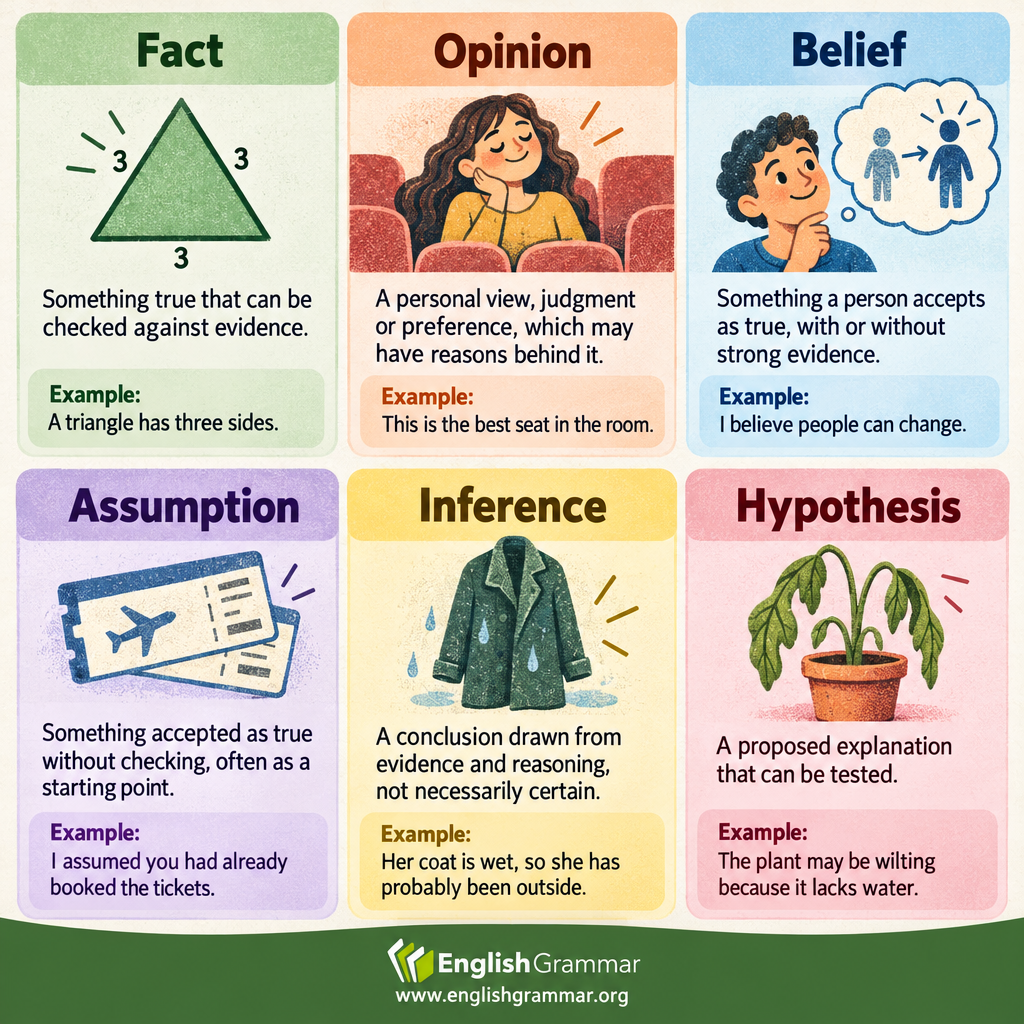
These six words describe different kinds of statements and thinking. Choose the word that shows what supports an idea and how you are using it.
- Fact: Something true that can be checked against evidence. For example, a square has four sides. Calling a statement a fact does not make it true; the evidence must support it.
- Opinion: A personal view, judgment or preference. For example, someone might say that winter is the most enjoyable season. Opinions can have reasons behind them without being true for everyone.
- Belief: Something a person accepts as true, with or without strong evidence. For example, someone may believe that life exists elsewhere in the universe. A belief is not necessarily religious or unsupported.
- Assumption: Something accepted as true without checking, often as a starting point. For example, you might plan dinner assuming that all your guests eat meat.
- Inference: A conclusion drawn from evidence and reasoning. For example, seeing muddy shoes by the door might lead you to conclude that someone has walked through mud.
- Hypothesis: A proposed explanation that can be tested. For example, you might suggest that a phone battery drains quickly because an app keeps running, then test this by closing the app.
The categories can overlap. A belief may concern a fact, and evidence may support an opinion. An inference can also suggest a hypothesis. The key difference is the idea’s role: accepted starting point, reasoned conclusion or explanation to investigate.