
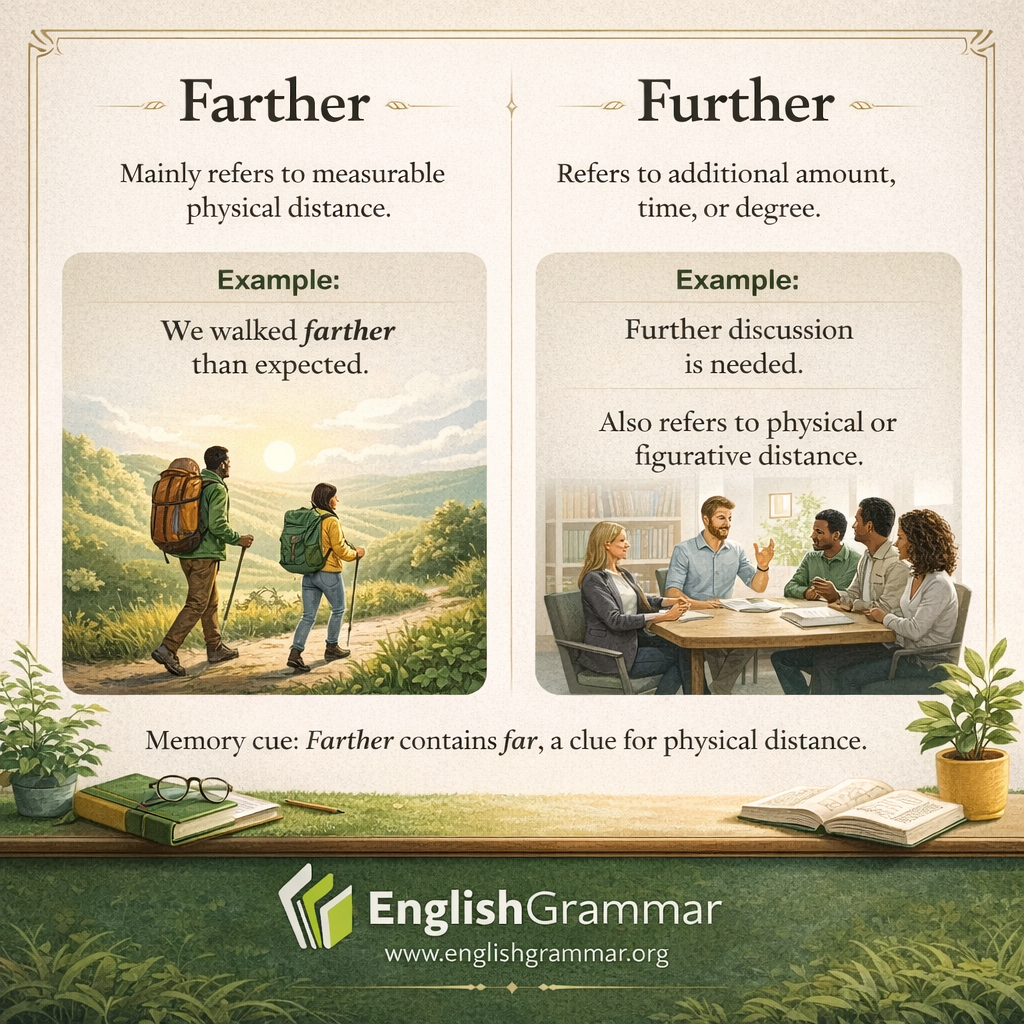
Farther and further both developed as comparative forms related to distance, so their meanings overlap. In careful modern usage, however, a practical distinction makes most choices easy.
Use farther mainly for measurable physical distance. It works well when you could measure the difference in miles, meters, blocks, or another unit: We drove farther than we had planned. You might also say, The library is farther from my house than the station.
Use further for something additional or for a greater degree, extent, or stage. It often appears with abstract ideas: We need further information before deciding. In She investigated the issue further, the word means to a greater extent, not to a more distant physical location.
Further can also refer to distance, including physical distance. Many dictionaries and style guides accept uses such as We walked further along the trail. Using further for literal distance is therefore not automatically wrong. Still, farther can make measurable distance especially clear, while further is the usual choice for figurative distance.
Use this quick decision process:
- If the distance is literal and measurable, choose farther for the clearest traditional distinction.
- If you mean additional, more advanced, or to a greater degree, choose further.
- If you are describing distance, further may also be standard, especially in figurative contexts.
The contrast is a usage preference, not an absolute rule. Context and house style can affect the final choice.