
• Skip to primary navigation
  • Skip to main content
  • Skip to primary sidebar
Home of English Grammar
  • Home
  • Course
  • Exercises
  • Grammar Rules
  • Matches
  • Posts
  • Tools
    • Grammar Checker
    • Very Replacer
    • Word Counter
  • Vocabulary Lists
  • Archives
    • Social Media Posts
    • Writing Guides
  • Join free

Feeling, emotion, mood, sentiment, vibe, and aura: How to choose

October 20, 2026

Feeling vs. Emotion vs. Mood vs. Sentiment vs. Vibe vs. Aura

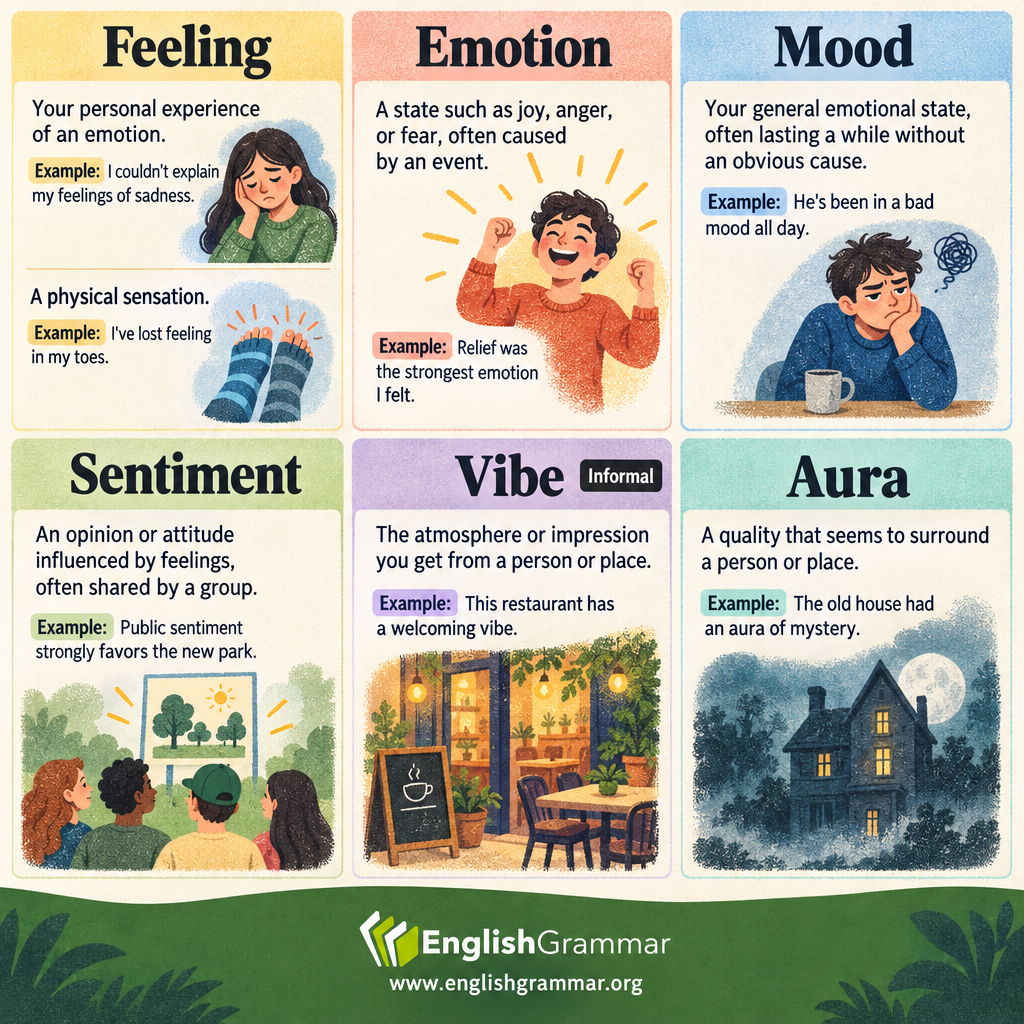
These six words overlap, but they draw attention to different things: an inner experience, an attitude, or an impression.

  • Feeling often describes your personal experience of an emotion: “I couldn’t hide my feelings of disappointment.” It can also describe a physical sensation: “I have a tingling feeling in my hand.”
  • Emotion names a state such as happiness, sadness, anger, or fear. It often has an identifiable cause: “His voice shook with emotion when he thanked us.” It overlaps strongly with emotional uses of feeling; there is no strict everyday boundary.
  • Mood describes your general emotional state over a period of time. It may have no obvious cause: “I’ve been in a cheerful mood all morning.” It usually lasts longer than a brief emotional reaction.
  • Sentiment often means an opinion or attitude influenced by feelings, especially one shared by a group: “Public sentiment has turned against the proposal.” It sounds more formal than simply saying what people think.
  • Vibe is informal. It describes the atmosphere or impression you get from someone or somewhere: “The new café has a relaxed vibe.”
  • Aura describes a quality that seems to surround a person or place: “She has an aura of quiet authority.” It often sounds more literary than vibe.

A room can have both a friendly vibe and an aura of elegance. The choice changes the emphasis, not necessarily the situation.

Improve your English grammar, vocabulary and writing

We take you step by step from beginner to advanced, even if you struggled with English at school or have always had trouble remembering the rules.

  • 10 modules, 105 lessons and 688 questions
  • Just log in and learn anytime and anywhere
  • Your progress is saved in your account
  • Download the 2027 Grammar Guide (PDF)
Join free

Already have an account? Sign in

See what’s in the course

Primary Sidebar

2.4M761.4K165.8K

Free 2027 Grammar Guide

  • Download Grammar Guide (PDF)
  • Online grammar course, A1 to C2
  • Weekly exercises and vocabulary
  • Join over 3 million English learners

We respect your privacy. Unsubscribe anytime.

Already have an account? Sign in

Grammar Checker - Try Now

Latest Posts

  • Feeling, emotion, mood, sentiment, vibe, and aura: How to choose October 20, 2026
  • 100 Best Synonyms for “Prevail” October 20, 2026
  • 100 Words Every Speech Therapist Should Know October 20, 2026
  • 100 Best Synonyms for “Amusing” October 20, 2026
  • This, That, These, Those Exercise October 20, 2026
  • 100 Best Synonyms for “Cute” October 20, 2026
  • 100 Words Every Pathologist Should Know October 20, 2026
  • 100 Best Synonyms for “Shared” October 20, 2026
  • 100 Best Synonyms for “Predecessor” October 20, 2026
  • 100 Best Synonyms for “Shaping” October 20, 2026
Home of English Grammar

Free English grammar exercises, rules and vocabulary lists, with new exercises every week. Join the leading English grammar site with over 3 million followers.

Join free

Learn

  • Exercises
  • Matches
  • Grammar rules
  • Vocabulary lists
  • Writing guides
  • Online tools

More

  • Top social media posts
  • Various posts
  • Contact

Account

  • Join free
  • Grammar Course
  • Free grammar guide (PDF)

Copyright © 2026 EnglishGrammar.org

  • Disclaimer
  • Privacy policy
  • Terms
  • Sitemap