
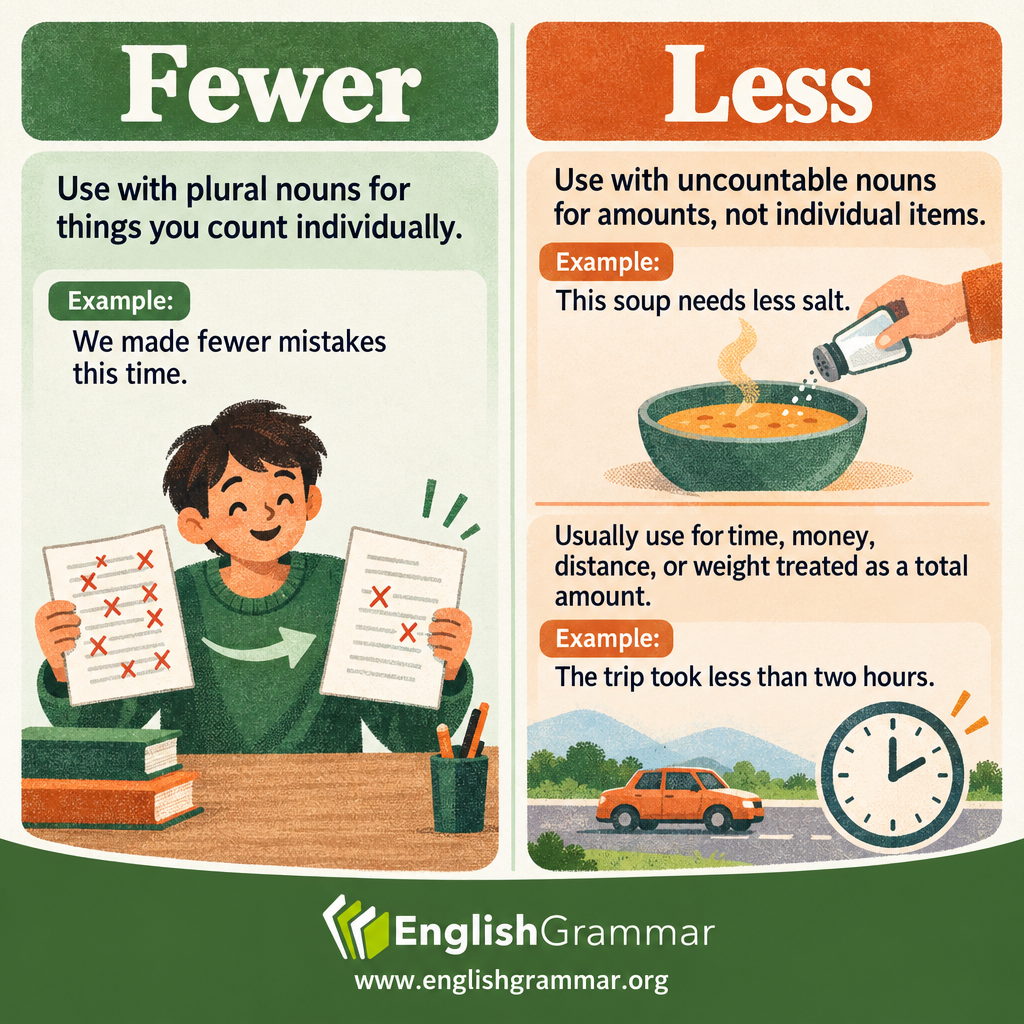
Fewer and less both describe a smaller quantity. The usual choice depends on whether you mean individual things or an amount.
Use fewer with plural countable nouns: things you can count separately, such as chairs, emails, or mistakes. Use less with uncountable nouns: things you describe as an amount, such as water, traffic, or information.
- We need fewer chairs for this meeting.
- There is less traffic on Sundays.
The same situation can involve either form, depending on the noun you choose:
- I received fewer emails today.
- I received less information today.
Emails are separate messages you can count. Information is treated as an amount, so the noun does not normally take a plural ending.
Measurements need extra care. Time, money, distance, and weight usually take less when they express a total amount, even if the unit is plural.
- The walk takes less than twenty minutes.
- The ticket costs less than ten dollars.
Compare that with “Fewer than twenty students attended.” Here, you are counting individual people rather than measuring a total amount.
You may also hear less with plural countable nouns in everyday conversation, especially on checkout signs. This usage is common, but fewer is generally the safer choice for individual countable items in formal writing and schoolwork.