
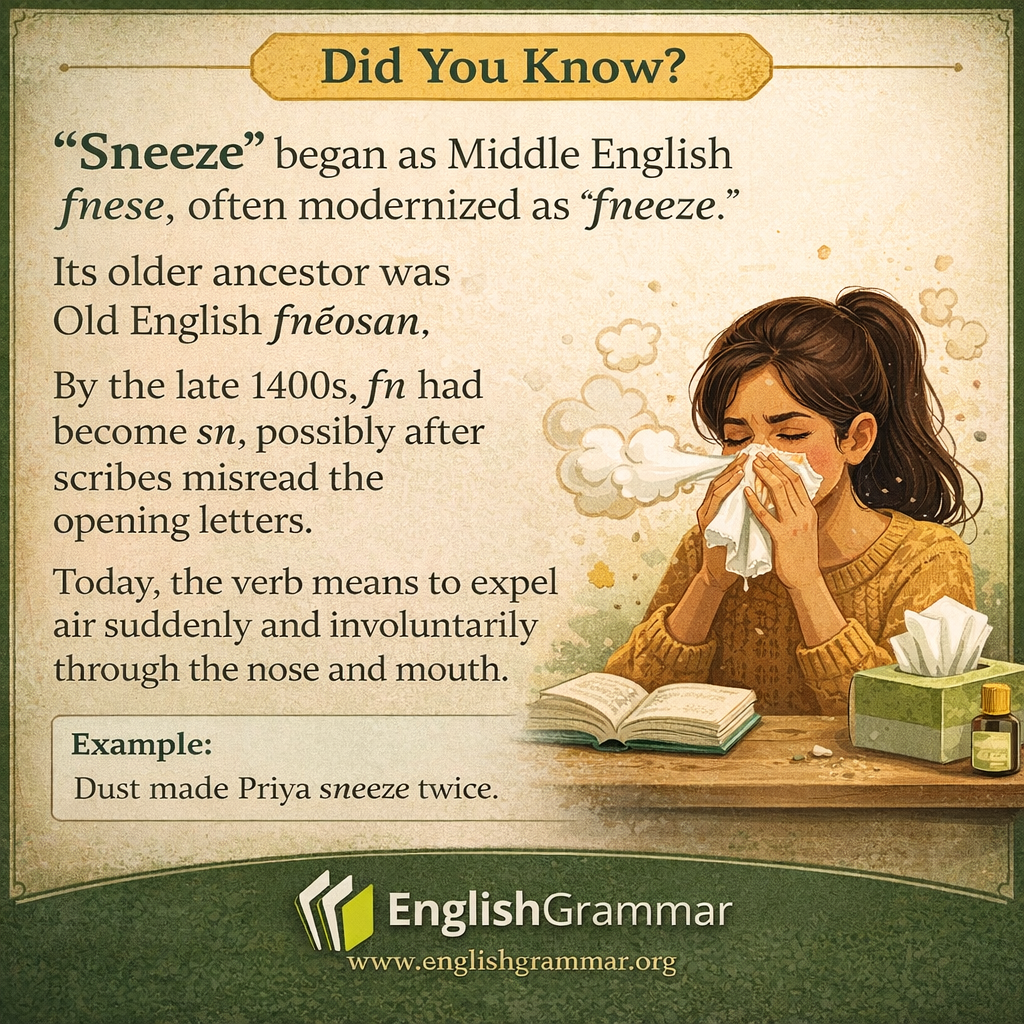
The familiar verb sneeze once began with the unusual consonant combination fn. Its Middle English form was fnese or fnesen, sometimes written as “fneeze” in modern explanations to make the old pronunciation easier to recognize. It came from the Old English verb fnēosan.
By the late 1400s, English texts began showing forms with sn instead. One proposed explanation involves medieval handwriting. A letter f could be confused with the long form of s, a character that looked somewhat like an f. A reader or scribe may therefore have interpreted the opening fn as sn. This explanation is plausible and widely repeated, although the precise reason for the change cannot be proved with certainty.
In modern English, sneeze can be a verb or a noun. As a verb, it means to expel air suddenly and involuntarily from the lungs through the nose and mouth. As a noun, it names that action or its sound.
- Dust made Priya sneeze twice.
- He covered his mouth before a loud sneeze.
The word also appears in the expression nothing to sneeze at. This describes something important or valuable that should not be dismissed. For example, a substantial prize is nothing to sneeze at.
The spelling changed, but the word has continued to describe the same familiar bodily reflex for centuries.