
• Skip to primary navigation
  • Skip to main content
  • Skip to primary sidebar
Home of English Grammar
  • Home
  • Course
  • Exercises
  • Grammar Rules
  • Matches
  • Posts
  • Tools
    • Grammar Checker
    • Very Replacer
    • Word Counter
  • Vocabulary Lists
  • Archives
    • Social Media Posts
    • Writing Guides
  • Join free

Fudgel, goldbrick, sham, shirk, skive and slack: choosing the right verb

October 28, 2026

Fudgel vs. Goldbrick vs. Sham vs. Shirk vs. Skive vs. Slack

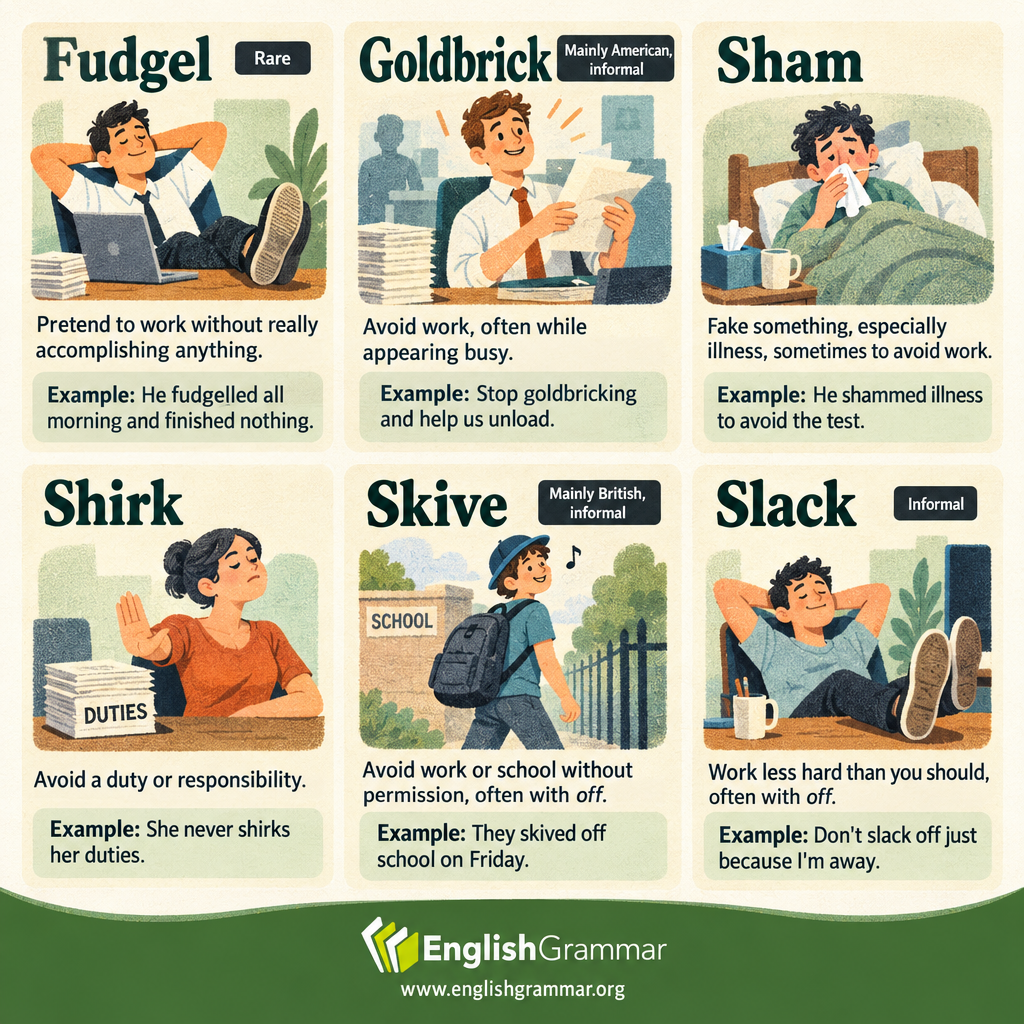
These verbs can describe avoiding work or responsibility, but they are not interchangeable. Some focus on pretending, others on avoiding duties or making too little effort.

  • Fudgel is rare and means pretending to work without really accomplishing anything. Most readers will find pretend to be busy clearer. For example: “He fudgelled at his desk until lunchtime.”
  • Goldbrick is informal and mainly American. It means avoiding work, often while appearing busy: “The supervisor caught him goldbricking behind the warehouse.” It overlaps with fudgel, but is more established in American usage.
  • Sham means pretending or faking something, especially illness. It does not itself mean avoiding work: “She shammed a headache to leave early.” The excuse is fake; avoiding work may be the purpose.
  • Shirk means avoiding a duty or responsibility. It commonly takes an object: “He shirked his share of the cleaning.” Unlike several other choices here, it is not slang.
  • Skive is informal and mainly British. It means avoiding work or school without permission, often as skive off: “We skived off lessons and went to the park.”
  • Slack, often slack off, informally means working less hard than you should: “Our team started slacking off after the deadline changed.” Someone can remain at work but reduce their effort.

Choose according to the situation, not just the idea of laziness. Faking an illness, missing school and neglecting a responsibility describe different actions, even when they share the same motive.

Improve your English grammar, vocabulary and writing

We take you step by step from beginner to advanced, even if you struggled with English at school or have always had trouble remembering the rules.

  • 10 modules, 112 lessons and 730 questions
  • Just log in and learn anytime and anywhere
  • Your progress is saved in your account
  • Download the 2027 Grammar Guide (PDF)
Join free

Already have an account? Sign in

See what’s in the course

Primary Sidebar

2.4M761.4K165.8K

Free 2027 Grammar Guide

  • Download Grammar Guide (PDF)
  • Online grammar course, A1 to C2
  • Weekly exercises and vocabulary
  • Join over 3 million English learners

We respect your privacy. Unsubscribe anytime.

Already have an account? Sign in

Grammar Checker - Try Now

Latest Posts

  • Fudgel, goldbrick, sham, shirk, skive and slack: choosing the right verb October 28, 2026
  • 100 Best Synonyms for “Reading” October 28, 2026
  • Practical vs. practicable: useful or possible? October 28, 2026
  • 100 Best Synonyms for “Tasks” October 28, 2026
  • 100 Best Synonyms for “Overwrought” October 28, 2026
  • 100 Best Synonyms for “Fostering” October 28, 2026
  • Modal Verbs of Possibility Exercise October 28, 2026
  • 100 Best Synonyms for “Creepy” October 28, 2026
  • 100 Words Every Van Lifer Should Know October 28, 2026
  • Past Modals Exercise October 28, 2026
Home of English Grammar

Free English grammar exercises, rules and vocabulary lists, with new exercises every week. Join the leading English grammar site with over 3 million followers.

Join free

Learn

  • Exercises
  • Matches
  • Grammar rules
  • Vocabulary lists
  • Writing guides
  • Online tools

More

  • Top social media posts
  • Various posts
  • Contact

Account

  • Join free
  • Grammar Course
  • Free grammar guide (PDF)

Copyright © 2026 EnglishGrammar.org

  • Disclaimer
  • Privacy policy
  • Terms
  • Sitemap