
• Skip to primary navigation
  • Skip to main content
  • Skip to primary sidebar
Home of English Grammar
  • Home
  • Course
  • Exercises
  • Grammar Rules
  • Matches
  • Posts
  • Tools
    • Grammar Checker
    • Very Replacer
    • Word Counter
  • Vocabulary Lists
  • Archives
    • Social Media Posts
    • Writing Guides
  • Join free

Full, filled, packed, crowded, crammed, and overflowing: What’s the difference?

October 26, 2026

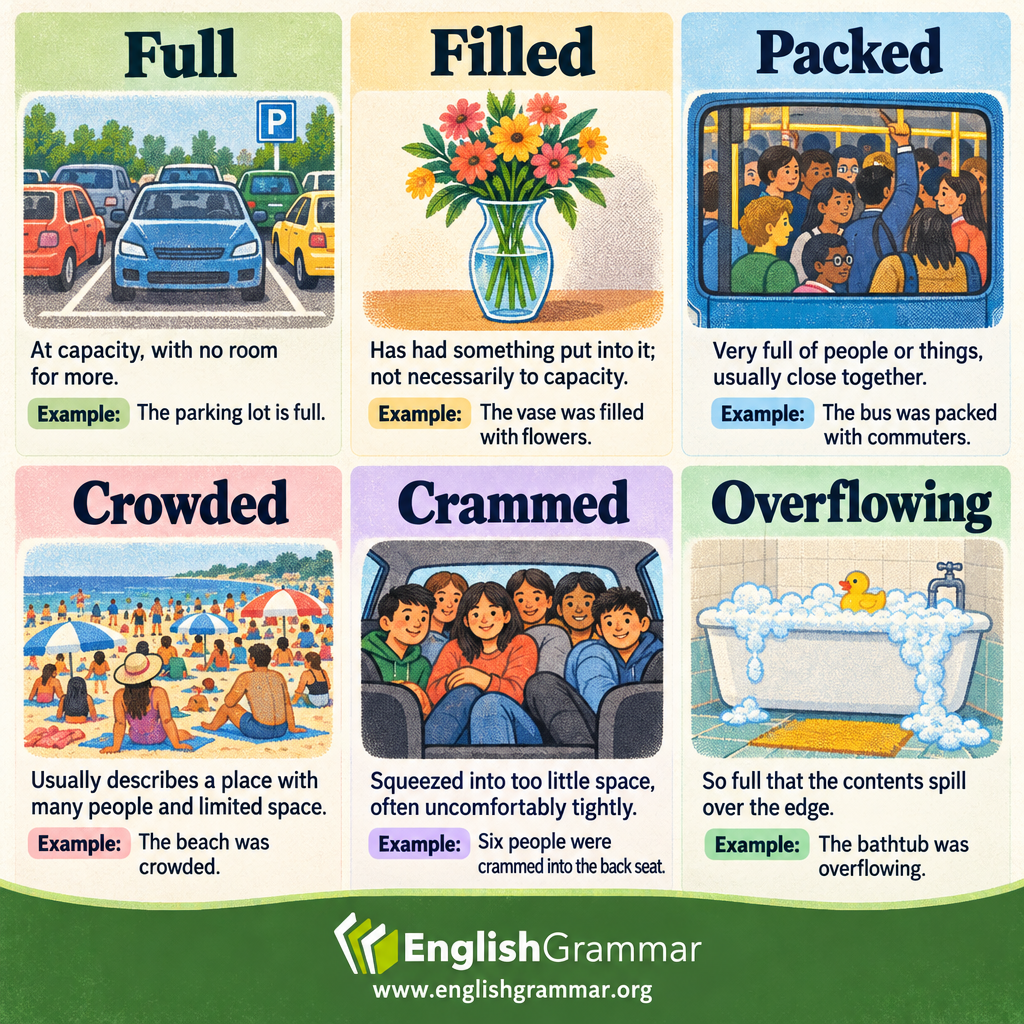
Full vs. Filled vs. Packed vs. Crowded vs. Crammed vs. Overflowing

These words overlap, but they draw attention to different details: available space, contents, tightness, or something going beyond a limit.

  • Full means something has reached its capacity. The hotel is full tonight. There are no rooms available. The word does not necessarily suggest discomfort or tight packing.
  • Filled describes something that has had contents put into it, often using with: The basket was filled with apples. It draws attention to the contents or the action. It does not always mean completely full: She filled the glass halfway with juice.
  • Packed means very full of people or things, usually close together. The stadium was packed with fans. This is stronger than simply saying there were many people.
  • Crowded usually describes a place with many people and limited space. The market gets crowded at lunchtime. It need not be completely full, but moving around may be difficult.
  • Crammed suggests people or things squeezed into a space that is too small. Five adults were crammed into the tiny kitchen. It emphasizes tightness, often with discomfort or too little room.
  • Overflowing literally means contents are spilling over the edge. The sink was overflowing. It goes beyond being full: the contents are no longer staying inside.

A train can be crowded without reaching capacity. Calling it packed emphasizes how full it is; saying passengers are crammed inside emphasizes how tightly they are squeezed together.

Improve your English grammar, vocabulary and writing

We take you step by step from beginner to advanced, even if you struggled with English at school or have always had trouble remembering the rules.

  • 10 modules, 112 lessons and 730 questions
  • Just log in and learn anytime and anywhere
  • Your progress is saved in your account
  • Download the 2027 Grammar Guide (PDF)
Join free

Already have an account? Sign in

See what’s in the course

Primary Sidebar

2.4M761.4K165.8K

Free 2027 Grammar Guide

  • Download Grammar Guide (PDF)
  • Online grammar course, A1 to C2
  • Weekly exercises and vocabulary
  • Join over 3 million English learners

We respect your privacy. Unsubscribe anytime.

Already have an account? Sign in

Grammar Checker - Try Now

Latest Posts

  • Full, filled, packed, crowded, crammed, and overflowing: What’s the difference? October 26, 2026
  • 100 Best Synonyms for “Fascination” October 26, 2026
  • 100 Words Every Choreographer Should Know October 26, 2026
  • 100 Best Synonyms for “Convoluted” October 26, 2026
  • 100 Best Synonyms for “Racism” October 26, 2026
  • 100 Best Synonyms for “Superiority” October 26, 2026
  • Will, must, should, may, might and could: choosing the right modal October 26, 2026
  • 100 Best Synonyms for “Quoted” October 26, 2026
  • 100 Best Synonyms for “Fairness” October 26, 2026
  • Grub, chow, food, fare, cuisine, and gastronomy: how to choose October 26, 2026
Home of English Grammar

Free English grammar exercises, rules and vocabulary lists, with new exercises every week. Join the leading English grammar site with over 3 million followers.

Join free

Learn

  • Exercises
  • Matches
  • Grammar rules
  • Vocabulary lists
  • Writing guides
  • Online tools

More

  • Top social media posts
  • Various posts
  • Contact

Account

  • Join free
  • Grammar Course
  • Free grammar guide (PDF)

Copyright © 2026 EnglishGrammar.org

  • Disclaimer
  • Privacy policy
  • Terms
  • Sitemap