
• Skip to primary navigation
  • Skip to main content
  • Skip to primary sidebar
Home of English Grammar
  • Home
  • Course
  • Exercises
  • Grammar Rules
  • Matches
  • Posts
  • Tools
    • Grammar Checker
    • Very Replacer
    • Word Counter
  • Vocabulary Lists
  • Archives
    • Social Media Posts
    • Writing Guides
  • Join free

What “give a wide berth” means, and where it comes from

July 21, 2026

The origin of "give a wide berth"

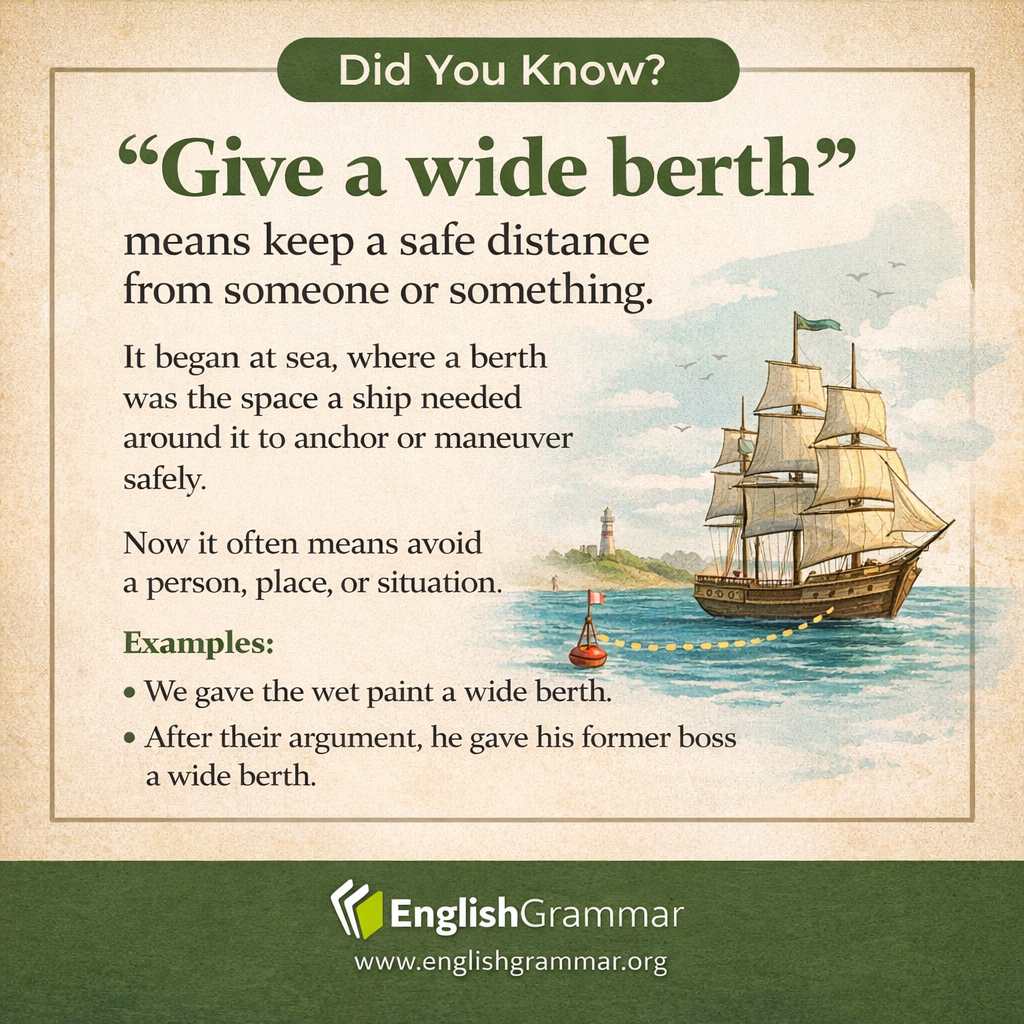
Give a wide berth means to keep a safe distance from someone or something. In modern English, people use it both literally and figuratively. You might keep away from a physical hazard, or you might avoid a person, place, or situation that could cause trouble.

The phrase comes from sailing. A berth was the space a ship needed when anchored or when moving near other ships, rocks, or shore. Giving a vessel a wide berth meant leaving plenty of room so it could maneuver safely and avoid collision.

That physical idea became a general idiom for staying well clear.

  • We gave the flooded road a wide berth after the storm.
  • She gives office gossip a wide berth.

The first example is close to the original sense of avoiding danger by keeping distance. The second shows the figurative use, avoiding something likely to bring problems. In both cases, the idea is not just “stay away,” but “stay far enough away to be safe.”

This is why the phrase often suggests caution, not just dislike. If you give something a wide berth, you are deliberately leaving room between yourself and a possible risk.

Improve your English grammar, vocabulary and writing

We take you step by step from beginner to advanced, even if you struggled with English at school or have always had trouble remembering the rules.

  • 10 modules, 112 lessons and 730 questions
  • Just log in and learn anytime and anywhere
  • Your progress is saved in your account
  • Download the 2027 Grammar Guide (PDF)
Join free

Already have an account? Sign in

See what’s in the course

Primary Sidebar

2.4M761.4K165.8K

Free 2027 Grammar Guide

  • Download Grammar Guide (PDF)
  • Online grammar course, A1 to C2
  • Weekly exercises and vocabulary
  • Join over 3 million English learners

We respect your privacy. Unsubscribe anytime.

Already have an account? Sign in

Grammar Checker - Try Now

Latest Posts

  • 100 Best Synonyms for “Communicative” October 23, 2026
  • Icky vs. gross vs. nasty vs. disgusting vs. revolting vs. vile October 23, 2026
  • Comparatives Exercise October 23, 2026
  • 100 Best Synonyms for “Proposition” October 23, 2026
  • 100 Best Synonyms for “Stagnation” October 23, 2026
  • 100 Best Synonyms for “Dumb” October 23, 2026
  • The origin and meaning of “off the cuff” October 23, 2026
  • 100 Phrases for Declining Requests at Work Politely October 23, 2026
  • 100 Best Synonyms for “Plausible” October 23, 2026
  • Maybe, perhaps, possibly, conceivably, probably and definitely: How to choose October 23, 2026
Home of English Grammar

Free English grammar exercises, rules and vocabulary lists, with new exercises every week. Join the leading English grammar site with over 3 million followers.

Join free

Learn

  • Exercises
  • Matches
  • Grammar rules
  • Vocabulary lists
  • Writing guides
  • Online tools

More

  • Top social media posts
  • Various posts
  • Contact

Account

  • Join free
  • Grammar Course
  • Free grammar guide (PDF)

Copyright © 2026 EnglishGrammar.org

  • Disclaimer
  • Privacy policy
  • Terms
  • Sitemap