
• Skip to primary navigation
  • Skip to main content
  • Skip to primary sidebar
Home of English Grammar
  • Home
  • Course
  • Exercises
  • Grammar Rules
  • Matches
  • Posts
  • Tools
    • Grammar Checker
    • Very Replacer
    • Word Counter
  • Vocabulary Lists
  • Archives
    • Social Media Posts
    • Writing Guides
  • Join free

What “go through the wringer” means, and where it comes from

July 27, 2026

The origin of "go through the wringer"

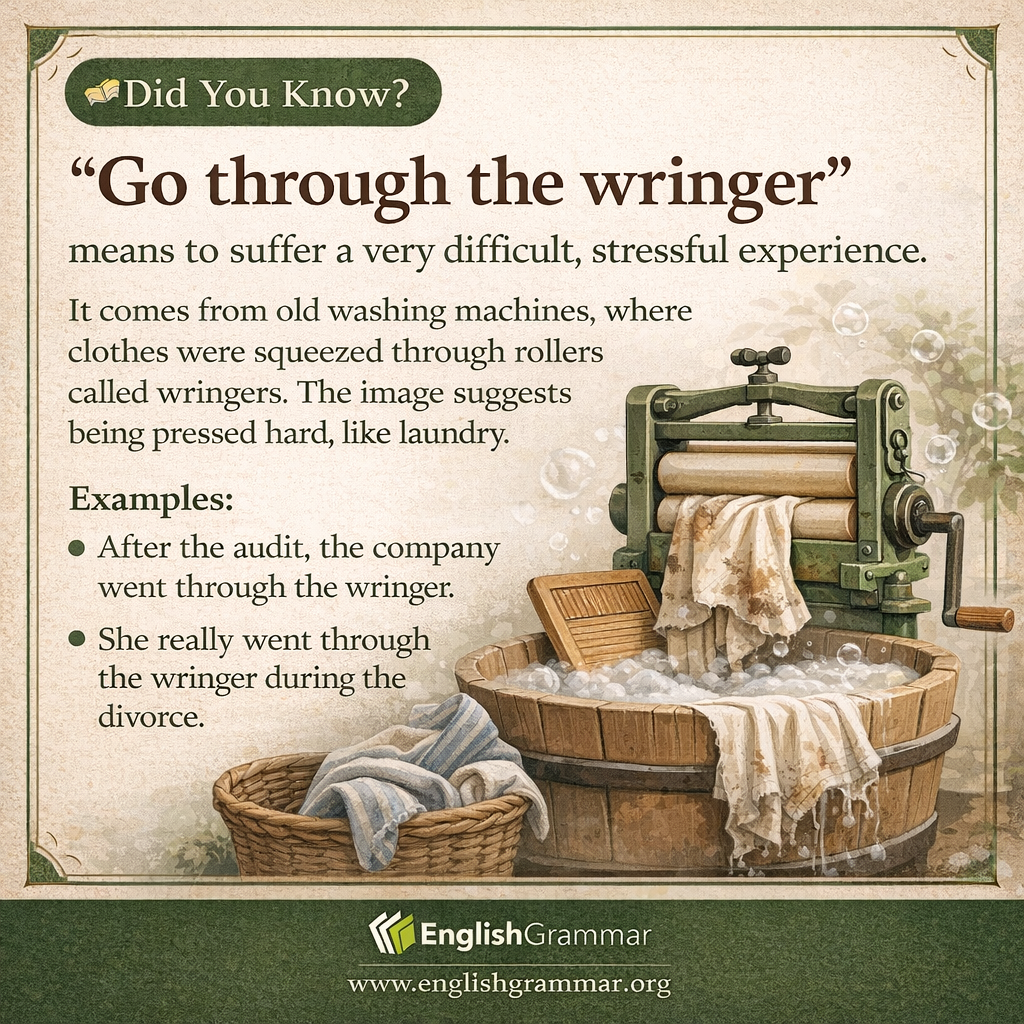
Go through the wringer means to experience a very difficult, stressful, or exhausting time. People use it for emotional strain, hard treatment, or a series of problems that leave someone feeling worn out.

The expression comes from older washing machines. After clothes were washed, they were fed through a wringer, a pair of rollers that squeezed out the water. The clothes were pressed tightly as they passed through. That physical image helps explain the modern meaning: a person feels as if life has squeezed them hard.

Today, the phrase is usually figurative. It often describes pressure over time, not one tiny inconvenience. If someone says they went through the wringer, they usually mean they faced serious stress, criticism, loss, conflict, or repeated challenges.

  • After the lawsuit, the small business went through the wringer.
  • He went through the wringer caring for his father during a long illness.

You can use it for work, health, family problems, public criticism, or any situation that feels intense and draining. The tone is informal but common in everyday English.

Improve your English grammar, vocabulary and writing

We take you step by step from beginner to advanced, even if you struggled with English at school or have always had trouble remembering the rules.

  • 10 modules, 105 lessons and 688 questions
  • Just log in and learn anytime and anywhere
  • Your progress is saved in your account
  • Download the 2027 Grammar Guide (PDF)
Join free

Already have an account? Sign in

See what’s in the course

Primary Sidebar

2.4M761.4K165.8K

Free 2027 Grammar Guide

  • Download Grammar Guide (PDF)
  • Online grammar course, A1 to C2
  • Weekly exercises and vocabulary
  • Join over 3 million English learners

We respect your privacy. Unsubscribe anytime.

Already have an account? Sign in

Grammar Checker - Try Now

Latest Posts

  • “Disinterested” and “uninterested” have overlapped for centuries October 22, 2026
  • 100 Best Synonyms for “Spontaneous” October 22, 2026
  • Critical Discussion Error Correction Exercise October 22, 2026
  • 100 Best Synonyms for “Cheerless” October 22, 2026
  • 100 Best Synonyms for “Prophecy” October 22, 2026
  • 100 Best Synonyms for “Spirit” October 22, 2026
  • 100 Best Synonyms for “Distinct” October 22, 2026
  • Comprise, consist of, include, compose, constitute, and make up: How to choose October 22, 2026
  • Describing People Vocabulary Exercise October 22, 2026
  • 100 Best Synonyms for “Properties” October 22, 2026
Home of English Grammar

Free English grammar exercises, rules and vocabulary lists, with new exercises every week. Join the leading English grammar site with over 3 million followers.

Join free

Learn

  • Exercises
  • Matches
  • Grammar rules
  • Vocabulary lists
  • Writing guides
  • Online tools

More

  • Top social media posts
  • Various posts
  • Contact

Account

  • Join free
  • Grammar Course
  • Free grammar guide (PDF)

Copyright © 2026 EnglishGrammar.org

  • Disclaimer
  • Privacy policy
  • Terms
  • Sitemap