
• Skip to primary navigation
  • Skip to main content
  • Skip to primary sidebar
Home of English Grammar
  • Home
  • Exercises
  • Matches
  • Posts
  • Rules
  • Social Media Archive
  • Tools
    • Grammar Checker
    • Very Replacer
    • Word Counter
  • Vocabulary
  • Writing Guides
  • Pro

Goodbye: from a blessing to a simple farewell

April 6, 2026 pdf

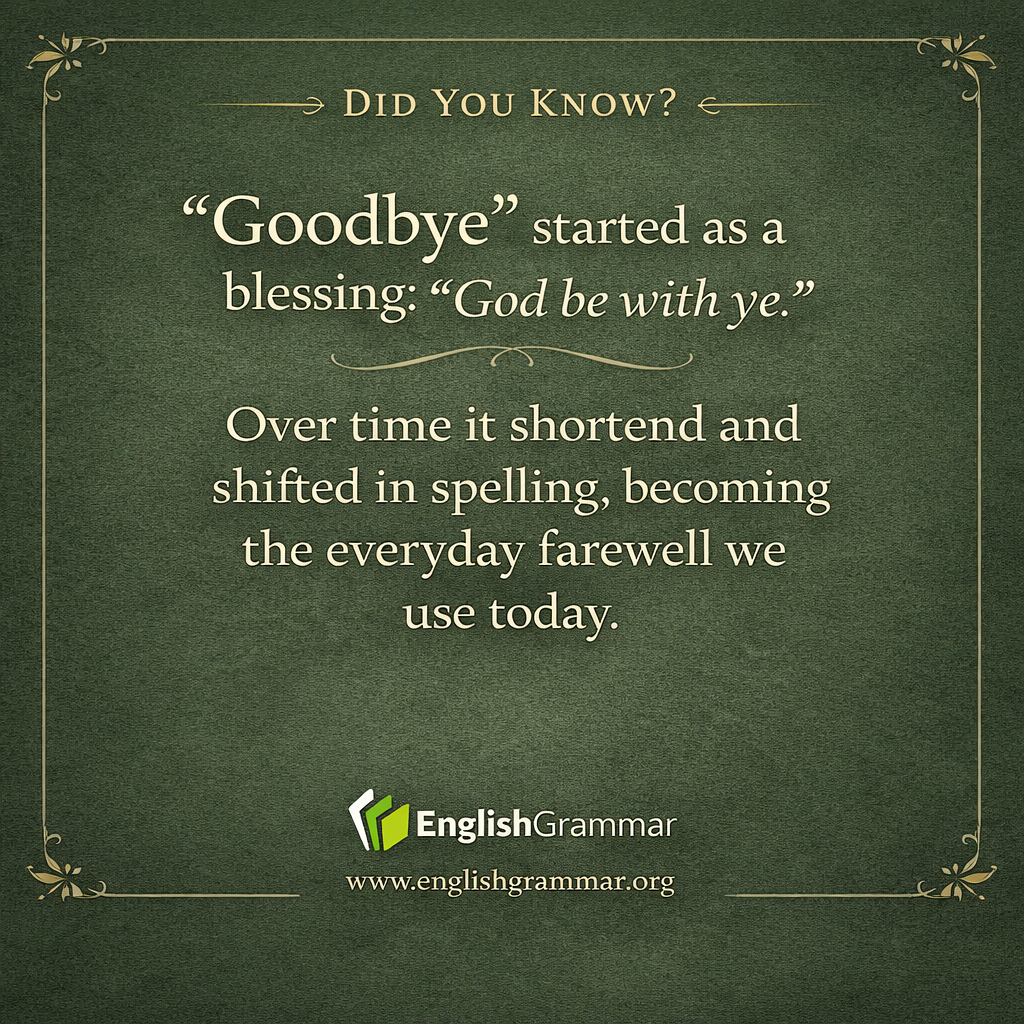
"Goodbye" began as "God be with ye."

Goodbye feels like a plain, neutral farewell today, but it began as a much more specific phrase: God be with ye. In earlier English, people often used longer parting wishes and blessings. Over time, frequent expressions tend to get said faster, shortened, and reshaped into new forms.

As God be with ye was repeated, it contracted in pronunciation and writing into forms like God b’wye and eventually goodbye. The modern spelling can make it look related to good, but historically it is tied to that older blessing, not a comment that your goodbye is “good.”

This is a classic example of language change: common phrases can fuse into a single word when speakers treat them as one unit.

  • Older style: “God be with ye till we meet again.”
  • Modern style: “Goodbye, I will call you tomorrow.”
  • Contrast: “Good night” is still two words, but “goodbye” became one because it came from a different original phrase.

Knowing the history can also explain why goodbye does not need to sound religious now. Many words keep their old roots even after their everyday meaning shifts.

  • Share
  • Post
  • Post
  • Reddit
  • Email
  • WhatsApp
NEW: Try Matches, our daily vocabulary challenge. Pick a topic and level and match words with definitions to boost your vocabulary.

Primary Sidebar

2,485,429 
761,532 
Improve Your English
  • Download 2026 Grammar Guide (PDF)
  • Free Weekly Exercises & Vocabulary
  • Join over 3 Million English Learners
We respect your privacy. Unsubscribe anytime.
Grammar Checker - Try Now

Latest Posts

  • 100 Best Synonyms for “Purity” October 12, 2026
  • Strategic Recommendation Language Exercise October 12, 2026
  • 100 Best Synonyms for “Attempt” October 12, 2026
  • Should have vs. should of: which is correct? October 12, 2026
  • Appointments Vocabulary Exercise October 12, 2026
  • 100 Best Synonyms for “Provoked” October 12, 2026
  • 100 Best Synonyms for “Stranded” October 12, 2026
  • The surprisingly old roots of “newfangled” October 12, 2026
  • 100 Best Synonyms for “Answer” October 12, 2026
  • 100 Best Synonyms for “Prove” October 12, 2026
Home of English Grammar

Free English grammar exercises, rules and vocabulary lists, with new exercises every week. Join the leading English grammar site with over 3 million followers.

Pro

Learn

  • Exercises
  • Matches
  • Grammar rules
  • Vocabulary lists
  • Writing guides
  • Online tools

More

  • Top social media posts
  • Various posts
  • Free grammar guide (PDF)
  • Contact

Pro

  • What is Pro?
  • Pro account
  • Pro exercises

Copyright © 2026 EnglishGrammar.org

  • Disclaimer
  • Privacy policy
  • Refund policy
  • Terms
  • Sitemap
Improve Your English
  • Download 2026 Grammar Guide (PDF)
  • Free Weekly Exercises & Vocabulary
  • Join over 3 Million English Learners
We respect your privacy. Unsubscribe anytime.