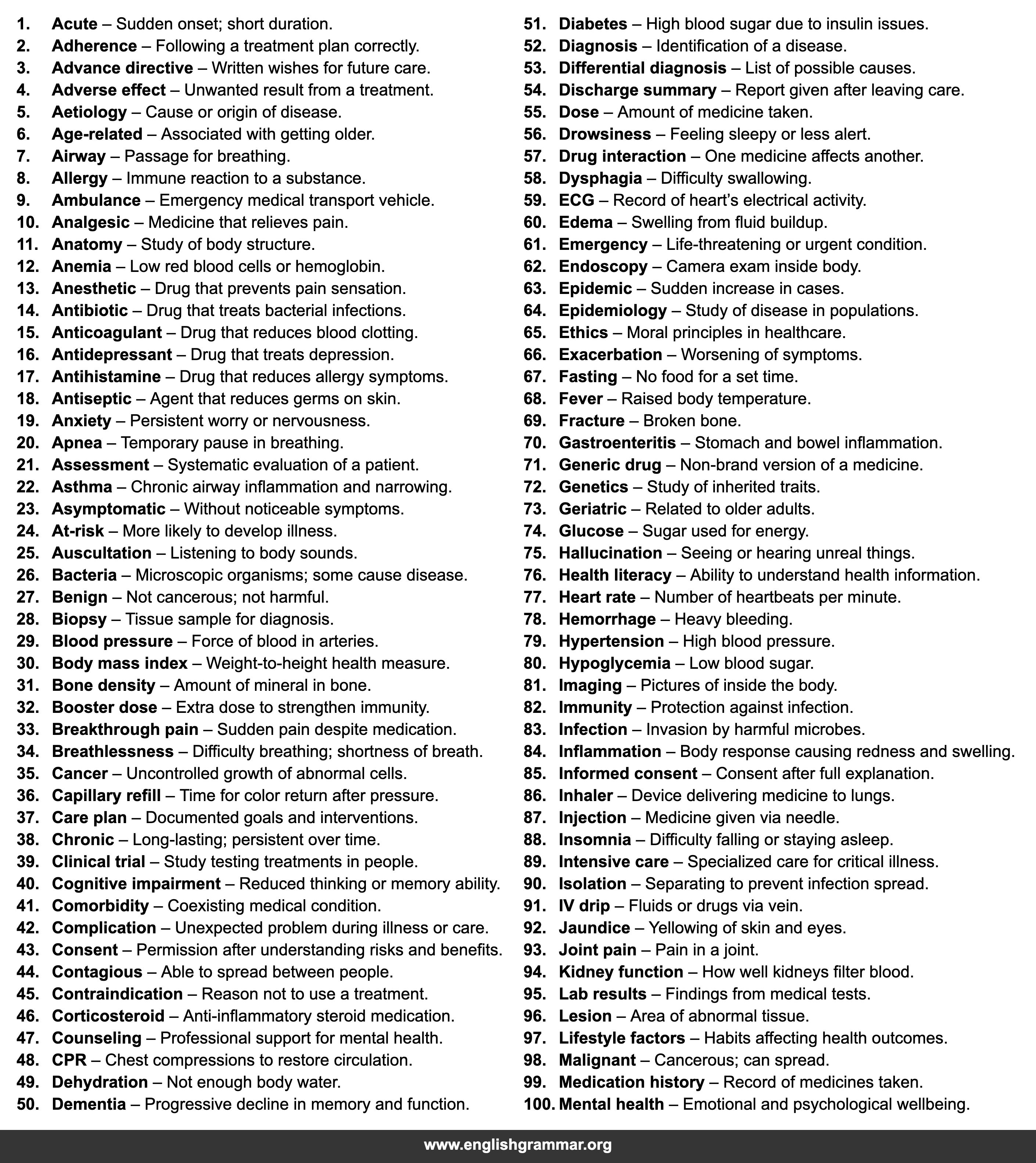
| No. | Term | Definition |
|---|---|---|
| 1. | Acute | Sudden onset; short duration. |
| 2. | Adherence | Following a treatment plan correctly. |
| 3. | Advance directive | Written wishes for future care. |
| 4. | Adverse effect | Unwanted result from a treatment. |
| 5. | Aetiology | Cause or origin of disease. |
| 6. | Age-related | Associated with getting older. |
| 7. | Airway | Passage for breathing. |
| 8. | Allergy | Immune reaction to a substance. |
| 9. | Ambulance | Emergency medical transport vehicle. |
| 10. | Analgesic | Medicine that relieves pain. |
| 11. | Anatomy | Study of body structure. |
| 12. | Anemia | Low red blood cells or hemoglobin. |
| 13. | Anesthetic | Drug that prevents pain sensation. |
| 14. | Antibiotic | Drug that treats bacterial infections. |
| 15. | Anticoagulant | Drug that reduces blood clotting. |
| 16. | Antidepressant | Drug that treats depression. |
| 17. | Antihistamine | Drug that reduces allergy symptoms. |
| 18. | Antiseptic | Agent that reduces germs on skin. |
| 19. | Anxiety | Persistent worry or nervousness. |
| 20. | Apnea | Temporary pause in breathing. |
| 21. | Assessment | Systematic evaluation of a patient. |
| 22. | Asthma | Chronic airway inflammation and narrowing. |
| 23. | Asymptomatic | Without noticeable symptoms. |
| 24. | At-risk | More likely to develop illness. |
| 25. | Auscultation | Listening to body sounds. |
| 26. | Bacteria | Microscopic organisms; some cause disease. |
| 27. | Benign | Not cancerous; not harmful. |
| 28. | Biopsy | Tissue sample for diagnosis. |
| 29. | Blood pressure | Force of blood in arteries. |
| 30. | Body mass index | Weight-to-height health measure. |
| 31. | Bone density | Amount of mineral in bone. |
| 32. | Booster dose | Extra dose to strengthen immunity. |
| 33. | Breakthrough pain | Sudden pain despite medication. |
| 34. | Breathlessness | Difficulty breathing; shortness of breath. |
| 35. | Cancer | Uncontrolled growth of abnormal cells. |
| 36. | Capillary refill | Time for color return after pressure. |
| 37. | Care plan | Documented goals and interventions. |
| 38. | Chronic | Long-lasting; persistent over time. |
| 39. | Clinical trial | Study testing treatments in people. |
| 40. | Cognitive impairment | Reduced thinking or memory ability. |
| 41. | Comorbidity | Coexisting medical condition. |
| 42. | Complication | Unexpected problem during illness or care. |
| 43. | Consent | Permission after understanding risks and benefits. |
| 44. | Contagious | Able to spread between people. |
| 45. | Contraindication | Reason not to use a treatment. |
| 46. | Corticosteroid | Anti-inflammatory steroid medication. |
| 47. | Counseling | Professional support for mental health. |
| 48. | CPR | Chest compressions to restore circulation. |
| 49. | Dehydration | Not enough body water. |
| 50. | Dementia | Progressive decline in memory and function. |
| 51. | Diabetes | High blood sugar due to insulin issues. |
| 52. | Diagnosis | Identification of a disease. |
| 53. | Differential diagnosis | List of possible causes. |
| 54. | Discharge summary | Report given after leaving care. |
| 55. | Dose | Amount of medicine taken. |
| 56. | Drowsiness | Feeling sleepy or less alert. |
| 57. | Drug interaction | One medicine affects another. |
| 58. | Dysphagia | Difficulty swallowing. |
| 59. | ECG | Record of heart’s electrical activity. |
| 60. | Edema | Swelling from fluid buildup. |
| 61. | Emergency | Life-threatening or urgent condition. |
| 62. | Endoscopy | Camera exam inside body. |
| 63. | Epidemic | Sudden increase in cases. |
| 64. | Epidemiology | Study of disease in populations. |
| 65. | Ethics | Moral principles in healthcare. |
| 66. | Exacerbation | Worsening of symptoms. |
| 67. | Fasting | No food for a set time. |
| 68. | Fever | Raised body temperature. |
| 69. | Fracture | Broken bone. |
| 70. | Gastroenteritis | Stomach and bowel inflammation. |
| 71. | Generic drug | Non-brand version of a medicine. |
| 72. | Genetics | Study of inherited traits. |
| 73. | Geriatric | Related to older adults. |
| 74. | Glucose | Sugar used for energy. |
| 75. | Hallucination | Seeing or hearing unreal things. |
| 76. | Health literacy | Ability to understand health information. |
| 77. | Heart rate | Number of heartbeats per minute. |
| 78. | Hemorrhage | Heavy bleeding. |
| 79. | Hypertension | High blood pressure. |
| 80. | Hypoglycemia | Low blood sugar. |
| 81. | Imaging | Pictures of inside the body. |
| 82. | Immunity | Protection against infection. |
| 83. | Infection | Invasion by harmful microbes. |
| 84. | Inflammation | Body response causing redness and swelling. |
| 85. | Informed consent | Consent after full explanation. |
| 86. | Inhaler | Device delivering medicine to lungs. |
| 87. | Injection | Medicine given via needle. |
| 88. | Insomnia | Difficulty falling or staying asleep. |
| 89. | Intensive care | Specialized care for critical illness. |
| 90. | Isolation | Separating to prevent infection spread. |
| 91. | IV drip | Fluids or drugs via vein. |
| 92. | Jaundice | Yellowing of skin and eyes. |
| 93. | Joint pain | Pain in a joint. |
| 94. | Kidney function | How well kidneys filter blood. |
| 95. | Lab results | Findings from medical tests. |
| 96. | Lesion | Area of abnormal tissue. |
| 97. | Lifestyle factors | Habits affecting health outcomes. |
| 98. | Malignant | Cancerous; can spread. |
| 99. | Medication history | Record of medicines taken. |
| 100. | Mental health | Emotional and psychological wellbeing. |
