
• Skip to primary navigation
  • Skip to main content
  • Skip to primary sidebar
Home of English Grammar
  • Home
  • Course
  • Exercises
  • Grammar Rules
  • Matches
  • Posts
  • Tools
    • Grammar Checker
    • Very Replacer
    • Word Counter
  • Vocabulary Lists
  • Archives
    • Social Media Posts
    • Writing Guides
  • Join free

Help, assist, aid, support, and facilitate: how to choose

October 16, 2026

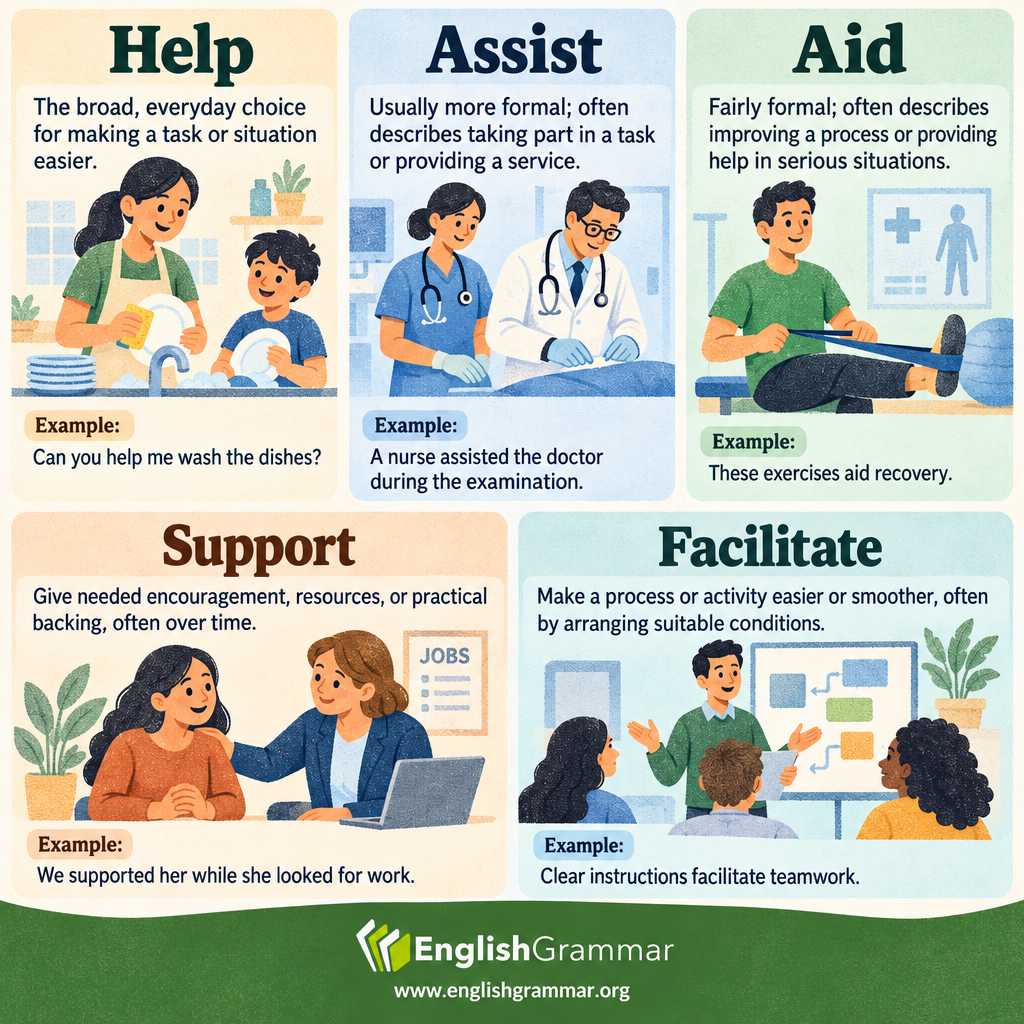
Help vs. Assist vs. Aid vs. Support vs. Facilitate

These five verbs all describe making something easier or more successful, but they emphasize different kinds of action. They often overlap: the best choice depends on the situation, not a strict rule.

  • Help is the broadest, most natural everyday choice. It can describe practical action or anything that makes a situation better. Could you help me carry this box?
  • Assist usually sounds more formal. It often describes taking part in a task or providing a service. A staff member assisted us with the booking. In casual conversation, a simpler word may sound friendlier.
  • Aid is also fairly formal. It often describes improving recovery, learning, or another process, or providing help in serious situations. Regular practice aids language learning. It is not limited to emergencies.
  • Support often emphasizes giving someone the resources, encouragement, or practical backing they need, sometimes over time. Her family supported her during her training. This does not necessarily mean doing her tasks for her.
  • Facilitate means making a process or activity easier or smoother, often by arranging suitable conditions. The teacher facilitated the discussion by giving everyone a turn. The teacher enabled participation rather than supplying every answer.

Notice the grammar, too: you can help someone do something, assist someone with something, or facilitate something. Avoid treating every verb as a direct replacement in the same sentence pattern.

Improve your English grammar, vocabulary and writing

We take you step by step from beginner to advanced, even if you struggled with English at school or have always had trouble remembering the rules.

  • 10 modules, 105 lessons and 688 questions
  • Just log in and learn anytime and anywhere
  • Your progress is saved in your account
  • Download the 2026 Grammar Guide (PDF)
Join free

Already have an account? Sign in

See what’s in the course

Primary Sidebar

2.4M761.4K165.8K

Free 2026 Grammar Guide

  • Download Grammar Guide (PDF)
  • Online grammar course, A1 to C2
  • Weekly exercises and vocabulary
  • Join over 3 million English learners

We respect your privacy. Unsubscribe anytime.

Already have an account? Sign in

Grammar Checker - Try Now

Latest Posts

  • Help, assist, aid, support, and facilitate: how to choose October 16, 2026
  • 100 Best Synonyms for “Characteristics” October 16, 2026
  • 100 Best Synonyms for “Plenty” October 16, 2026
  • Crash blossoms: when headlines suggest the wrong meaning October 16, 2026
  • 100 Best Synonyms for “Remind” October 16, 2026
  • 100 Best Synonyms for “Unkind” October 16, 2026
  • 100 Best Synonyms for “Changing” October 16, 2026
  • 100 Best Synonyms for “Platitude” October 15, 2026
  • 100 Best Synonyms for “Reluctant” October 15, 2026
  • “&c.”: an older abbreviation for “et cetera” October 15, 2026
Home of English Grammar

Free English grammar exercises, rules and vocabulary lists, with new exercises every week. Join the leading English grammar site with over 3 million followers.

Join free

Learn

  • Exercises
  • Matches
  • Grammar rules
  • Vocabulary lists
  • Writing guides
  • Online tools

More

  • Top social media posts
  • Various posts
  • Contact

Account

  • Join free
  • Grammar Course
  • Free grammar guide (PDF)

Copyright © 2026 EnglishGrammar.org

  • Disclaimer
  • Privacy policy
  • Terms
  • Sitemap