
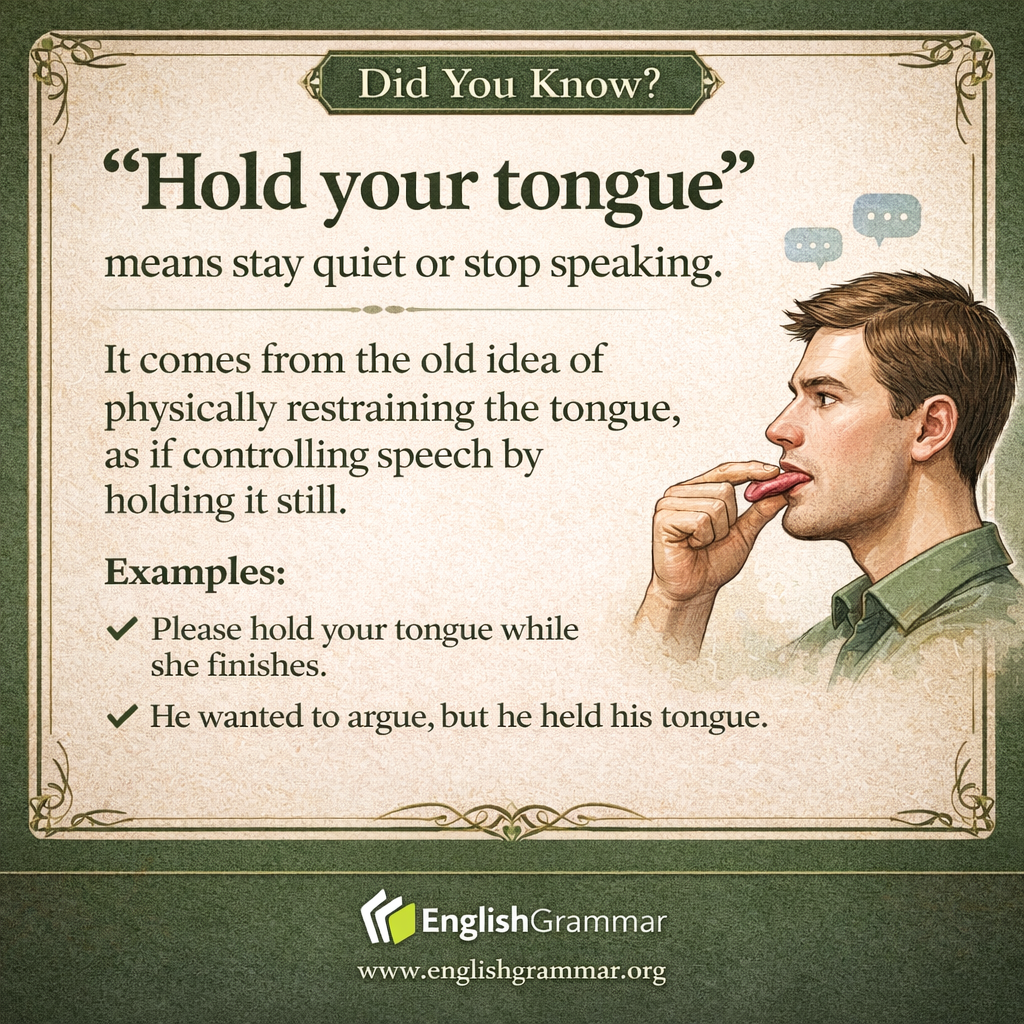
“Hold your tongue” means to stay quiet or to stop speaking, especially when you are angry, upset, or tempted to say something sharp.
The expression comes from an old physical image. In earlier English, the tongue often stood for speech itself. So telling someone to hold it suggested controlling speech as if you could restrain the tongue and keep words from coming out. That image made the phrase easy to understand, and it remained in the language as an idiom.
Today, the expression usually sounds firm, old fashioned, or dramatic. It can be used as a command, but it can also describe self control.
- Command: “Hold your tongue while she explains what happened.”
- Self control: “I disagreed with him, but I held my tongue.”
It is close in meaning to be quiet, keep quiet, or bite your tongue, but the tone is a little different. Bite your tongue often suggests stopping yourself from saying something unwise, while hold your tongue can sound more direct and more concerned with silence itself.