
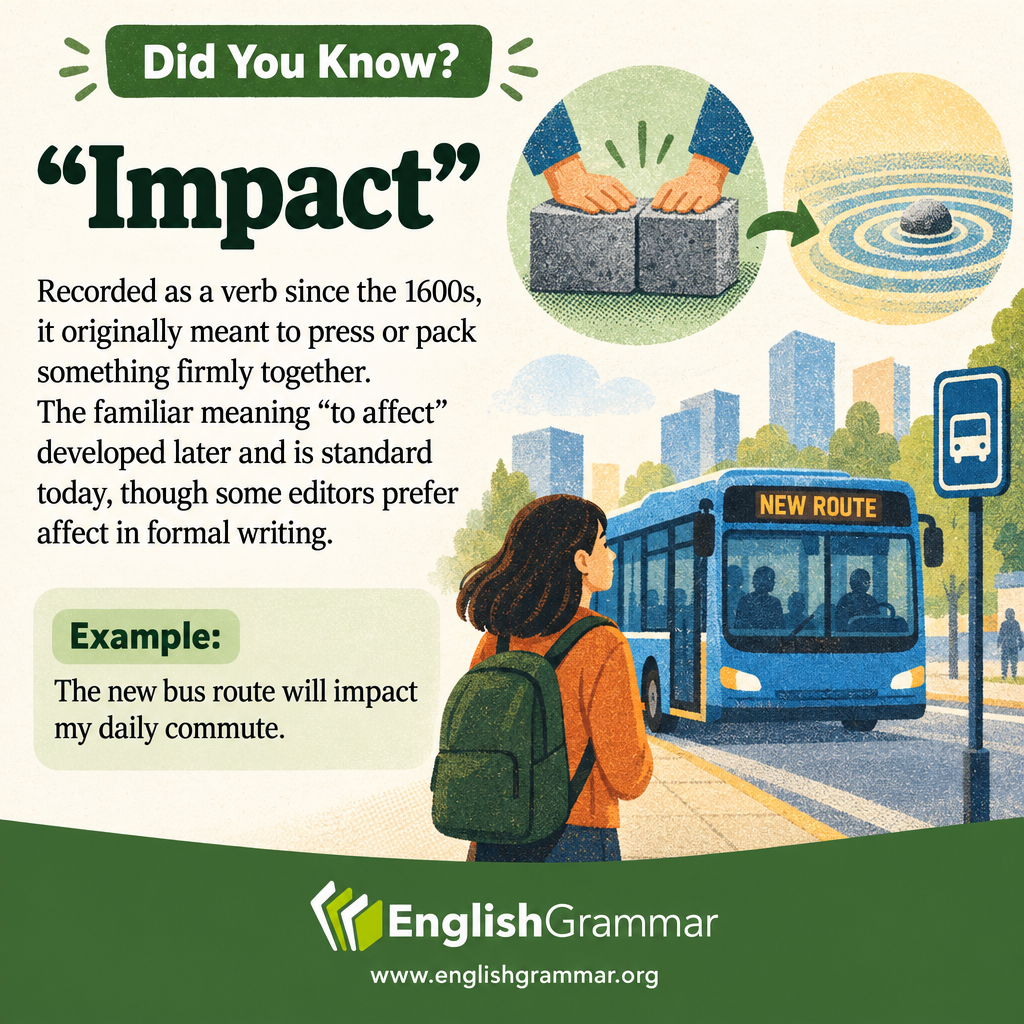
“Impact” has been used as a verb since the 1600s. It is not a recent invention, although its early meaning was different from the one many people use today.
Originally, the verb meant to press or pack something firmly together. That was a physical meaning, involving things being forced closely together. The familiar meaning to affect or influence developed much later.
Today, this newer meaning is standard English. You can use the verb to explain that something changes a person, situation, or result. It does not automatically mean that the change is harmful: the surrounding sentence tells the reader whether the effect is positive, negative, or neutral.
- Higher food prices impact our weekly budget.
- The extra tutoring has positively impacted her confidence.
In both examples, the verb connects a cause with something that feels its effect. Food prices change what a family can afford; tutoring changes how confident a student feels.
What about formal writing? Some editors and style guides prefer affect when that is the intended meaning. For example, “The road closure will affect local businesses” is a straightforward alternative to “The road closure will impact local businesses.” Both are grammatical, but the first may better suit an editor’s preferences.
If you are writing for a class, publication, or workplace, check its style guidance rather than assuming that a long-established verb is always the preferred choice.