
• Skip to primary navigation
  • Skip to main content
  • Skip to primary sidebar
Home of English Grammar
  • Home
  • Course
  • Exercises
  • Grammar Rules
  • Matches
  • Posts
  • Tools
    • Grammar Checker
    • Very Replacer
    • Word Counter
  • Vocabulary Lists
  • Archives
    • Social Media Posts
    • Writing Guides
  • Join free

The origin of “on the lam”

October 28, 2026

The origin of "on the lam"

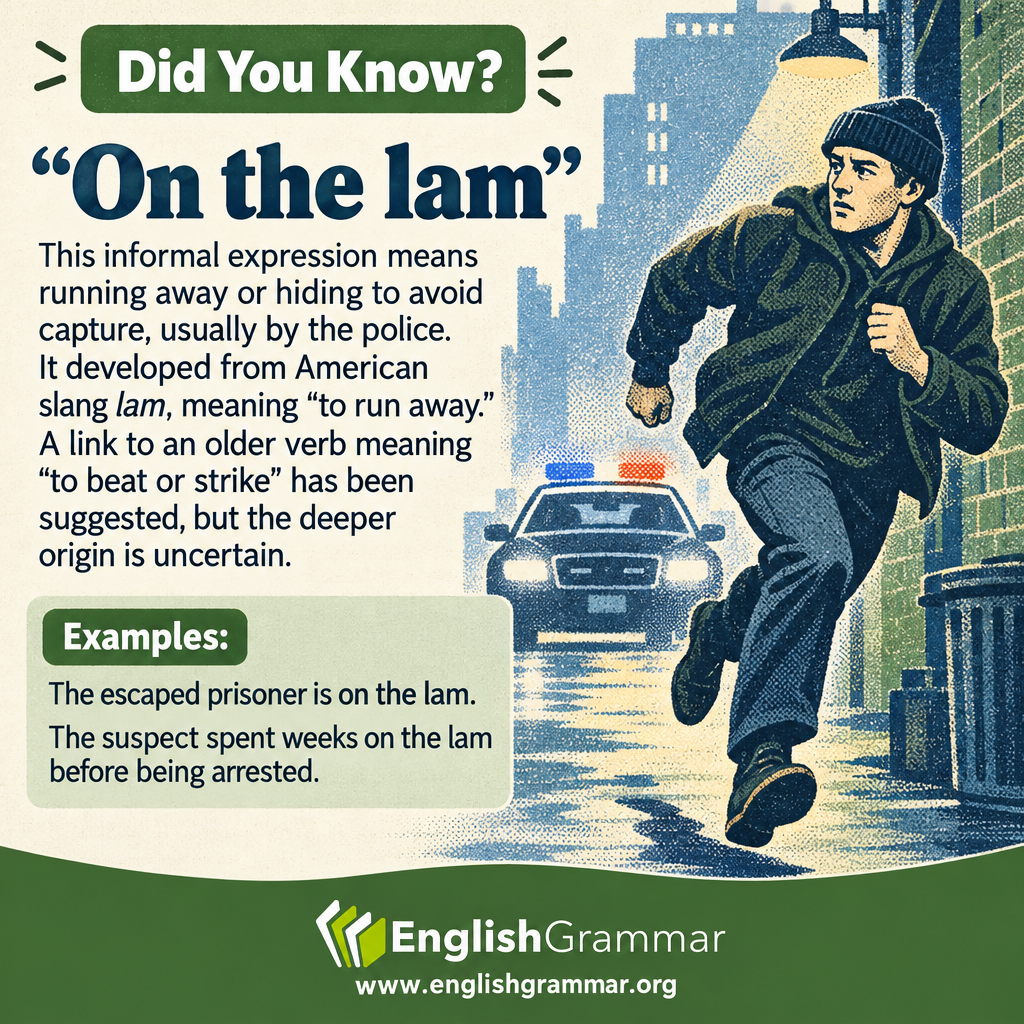
“On the lam” means running away or hiding to avoid capture, usually by the police. It is an informal expression often found in crime stories, news reports, and conversations about fugitives—people who are escaping arrest or imprisonment.

The expression developed from American slang: lam was used as a verb meaning “to run away” or “to escape.” In the familiar phrase, it functions as a noun after on the.

The deeper history is less certain. The escape sense is often linked to an older verb lam, meaning “to beat” or “to strike.” However, that connection is not firmly established. It is safer to explain the known slang meaning than to present a neat story about how hitting became fleeing.

Examples:

  • The bank robber was on the lam for three months.
  • Police believe the escaped inmate is still on the lam.

You may also hear the expression used jokingly when someone is avoiding a much smaller consequence: “After stealing a sausage, the dog went on the lam.” The humor comes from describing the dog as though it were a wanted criminal.

For ordinary travel or leaving a place, choose a simpler expression such as away or out of town. Saying someone is on the lam suggests escape or concealment, not just absence. In formal writing, fleeing arrest or in hiding may be clearer, depending on the situation.

Improve your English grammar, vocabulary and writing

We take you step by step from beginner to advanced, even if you struggled with English at school or have always had trouble remembering the rules.

  • 10 modules, 112 lessons and 730 questions
  • Just log in and learn anytime and anywhere
  • Your progress is saved in your account
  • Download the 2027 Grammar Guide (PDF)
Join free

Already have an account? Sign in

See what’s in the course

Primary Sidebar

2.4M761.4K165.8K

Free 2027 Grammar Guide

  • Download Grammar Guide (PDF)
  • Online grammar course, A1 to C2
  • Weekly exercises and vocabulary
  • Join over 3 million English learners

We respect your privacy. Unsubscribe anytime.

Already have an account? Sign in

Grammar Checker - Try Now

Latest Posts

  • The origin of “on the lam” October 28, 2026
  • 100 Best Synonyms for “Crestfallen” October 28, 2026
  • 100 Best Synonyms for “Taught” October 28, 2026
  • 100 Best Synonyms for “Funny” October 28, 2026
  • Fudgel, goldbrick, sham, shirk, skive and slack: choosing the right verb October 28, 2026
  • 100 Best Synonyms for “Reading” October 28, 2026
  • Practical vs. practicable: useful or possible? October 28, 2026
  • 100 Best Synonyms for “Tasks” October 28, 2026
  • 100 Best Synonyms for “Overwrought” October 28, 2026
  • 100 Best Synonyms for “Fostering” October 28, 2026
Home of English Grammar

Free English grammar exercises, rules and vocabulary lists, with new exercises every week. Join the leading English grammar site with over 3 million followers.

Join free

Learn

  • Exercises
  • Matches
  • Grammar rules
  • Vocabulary lists
  • Writing guides
  • Online tools

More

  • Top social media posts
  • Various posts
  • Contact

Account

  • Join free
  • Grammar Course
  • Free grammar guide (PDF)

Copyright © 2026 EnglishGrammar.org

  • Disclaimer
  • Privacy policy
  • Terms
  • Sitemap