
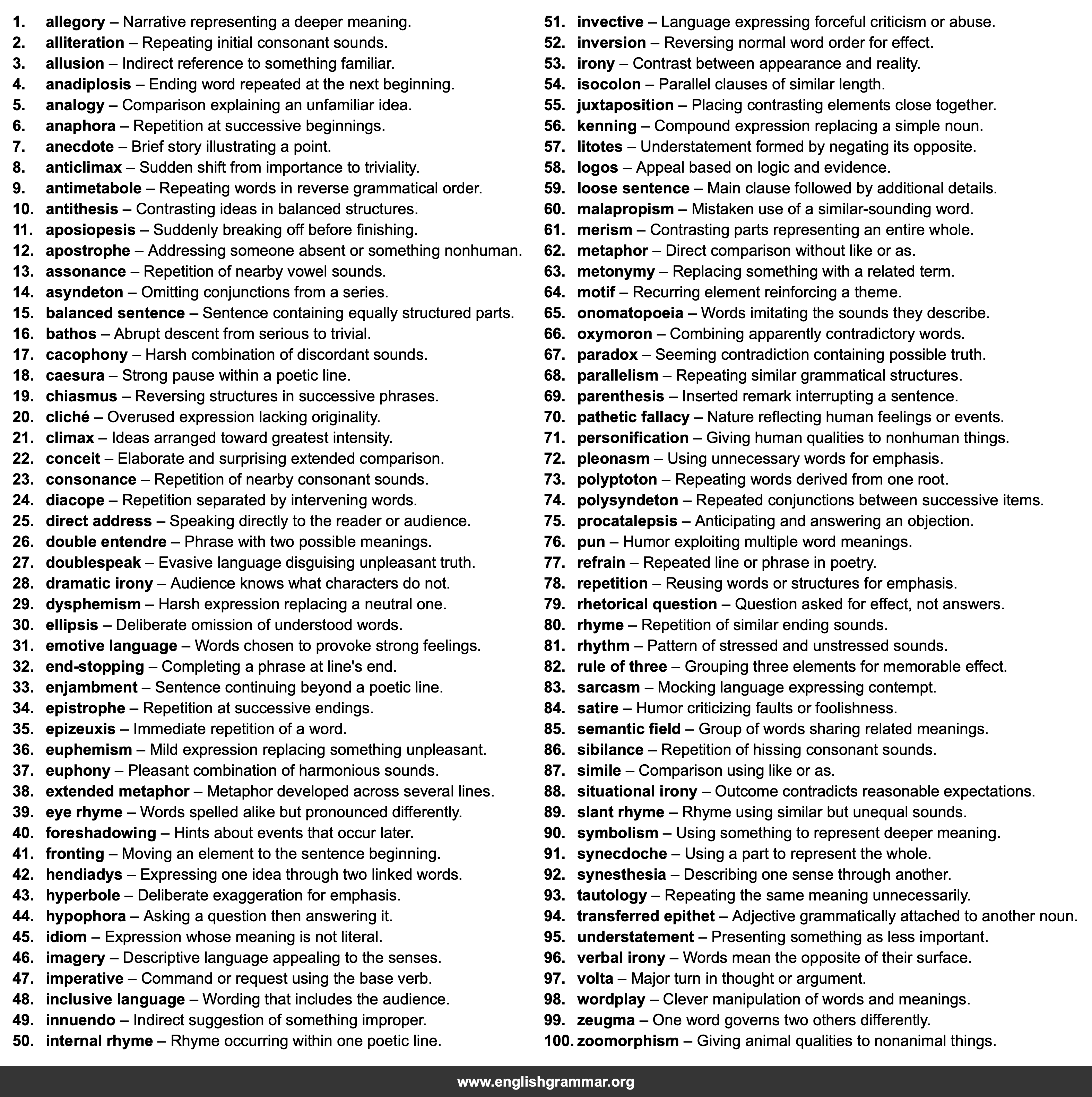
| No. | Item | Definition |
|---|---|---|
| 1. | allegory | Narrative representing a deeper meaning. |
| 2. | alliteration | Repeating initial consonant sounds. |
| 3. | allusion | Indirect reference to something familiar. |
| 4. | anadiplosis | Ending word repeated at the next beginning. |
| 5. | analogy | Comparison explaining an unfamiliar idea. |
| 6. | anaphora | Repetition at successive beginnings. |
| 7. | anecdote | Brief story illustrating a point. |
| 8. | anticlimax | Sudden shift from importance to triviality. |
| 9. | antimetabole | Repeating words in reverse grammatical order. |
| 10. | antithesis | Contrasting ideas in balanced structures. |
| 11. | aposiopesis | Suddenly breaking off before finishing. |
| 12. | apostrophe | Addressing someone absent or something nonhuman. |
| 13. | assonance | Repetition of nearby vowel sounds. |
| 14. | asyndeton | Omitting conjunctions from a series. |
| 15. | balanced sentence | Sentence containing equally structured parts. |
| 16. | bathos | Abrupt descent from serious to trivial. |
| 17. | cacophony | Harsh combination of discordant sounds. |
| 18. | caesura | Strong pause within a poetic line. |
| 19. | chiasmus | Reversing structures in successive phrases. |
| 20. | cliché | Overused expression lacking originality. |
| 21. | climax | Ideas arranged toward greatest intensity. |
| 22. | conceit | Elaborate and surprising extended comparison. |
| 23. | consonance | Repetition of nearby consonant sounds. |
| 24. | diacope | Repetition separated by intervening words. |
| 25. | direct address | Speaking directly to the reader or audience. |
| 26. | double entendre | Phrase with two possible meanings. |
| 27. | doublespeak | Evasive language disguising unpleasant truth. |
| 28. | dramatic irony | Audience knows what characters do not. |
| 29. | dysphemism | Harsh expression replacing a neutral one. |
| 30. | ellipsis | Deliberate omission of understood words. |
| 31. | emotive language | Words chosen to provoke strong feelings. |
| 32. | end-stopping | Completing a phrase at line’s end. |
| 33. | enjambment | Sentence continuing beyond a poetic line. |
| 34. | epistrophe | Repetition at successive endings. |
| 35. | epizeuxis | Immediate repetition of a word. |
| 36. | euphemism | Mild expression replacing something unpleasant. |
| 37. | euphony | Pleasant combination of harmonious sounds. |
| 38. | extended metaphor | Metaphor developed across several lines. |
| 39. | eye rhyme | Words spelled alike but pronounced differently. |
| 40. | foreshadowing | Hints about events that occur later. |
| 41. | fronting | Moving an element to the sentence beginning. |
| 42. | hendiadys | Expressing one idea through two linked words. |
| 43. | hyperbole | Deliberate exaggeration for emphasis. |
| 44. | hypophora | Asking a question then answering it. |
| 45. | idiom | Expression whose meaning is not literal. |
| 46. | imagery | Descriptive language appealing to the senses. |
| 47. | imperative | Command or request using the base verb. |
| 48. | inclusive language | Wording that includes the audience. |
| 49. | innuendo | Indirect suggestion of something improper. |
| 50. | internal rhyme | Rhyme occurring within one poetic line. |
| 51. | invective | Language expressing forceful criticism or abuse. |
| 52. | inversion | Reversing normal word order for effect. |
| 53. | irony | Contrast between appearance and reality. |
| 54. | isocolon | Parallel clauses of similar length. |
| 55. | juxtaposition | Placing contrasting elements close together. |
| 56. | kenning | Compound expression replacing a simple noun. |
| 57. | litotes | Understatement formed by negating its opposite. |
| 58. | logos | Appeal based on logic and evidence. |
| 59. | loose sentence | Main clause followed by additional details. |
| 60. | malapropism | Mistaken use of a similar-sounding word. |
| 61. | merism | Contrasting parts representing an entire whole. |
| 62. | metaphor | Direct comparison without like or as. |
| 63. | metonymy | Replacing something with a related term. |
| 64. | motif | Recurring element reinforcing a theme. |
| 65. | onomatopoeia | Words imitating the sounds they describe. |
| 66. | oxymoron | Combining apparently contradictory words. |
| 67. | paradox | Seeming contradiction containing possible truth. |
| 68. | parallelism | Repeating similar grammatical structures. |
| 69. | parenthesis | Inserted remark interrupting a sentence. |
| 70. | pathetic fallacy | Nature reflecting human feelings or events. |
| 71. | personification | Giving human qualities to nonhuman things. |
| 72. | pleonasm | Using unnecessary words for emphasis. |
| 73. | polyptoton | Repeating words derived from one root. |
| 74. | polysyndeton | Repeated conjunctions between successive items. |
| 75. | procatalepsis | Anticipating and answering an objection. |
| 76. | pun | Humor exploiting multiple word meanings. |
| 77. | refrain | Repeated line or phrase in poetry. |
| 78. | repetition | Reusing words or structures for emphasis. |
| 79. | rhetorical question | Question asked for effect, not answers. |
| 80. | rhyme | Repetition of similar ending sounds. |
| 81. | rhythm | Pattern of stressed and unstressed sounds. |
| 82. | rule of three | Grouping three elements for memorable effect. |
| 83. | sarcasm | Mocking language expressing contempt. |
| 84. | satire | Humor criticizing faults or foolishness. |
| 85. | semantic field | Group of words sharing related meanings. |
| 86. | sibilance | Repetition of hissing consonant sounds. |
| 87. | simile | Comparison using like or as. |
| 88. | situational irony | Outcome contradicts reasonable expectations. |
| 89. | slant rhyme | Rhyme using similar but unequal sounds. |
| 90. | symbolism | Using something to represent deeper meaning. |
| 91. | synecdoche | Using a part to represent the whole. |
| 92. | synesthesia | Describing one sense through another. |
| 93. | tautology | Repeating the same meaning unnecessarily. |
| 94. | transferred epithet | Adjective grammatically attached to another noun. |
| 95. | understatement | Presenting something as less important. |
| 96. | verbal irony | Words mean the opposite of their surface. |
| 97. | volta | Major turn in thought or argument. |
| 98. | wordplay | Clever manipulation of words and meanings. |
| 99. | zeugma | One word governs two others differently. |
| 100. | zoomorphism | Giving animal qualities to nonanimal things. |