
• Skip to primary navigation
  • Skip to main content
  • Skip to primary sidebar
Home of English Grammar
  • Home
  • Exercises
  • Matches
  • Posts
  • Rules
  • Social Media Archive
  • Tools
    • Grammar Checker
    • Very Replacer
    • Word Counter
  • Vocabulary
  • Writing Guides
  • Pro

Why “Let’s eat Grandma” needs a comma

April 7, 2026 pdf

“Let’s eat Grandma” vs. Let’s eat, Grandma”

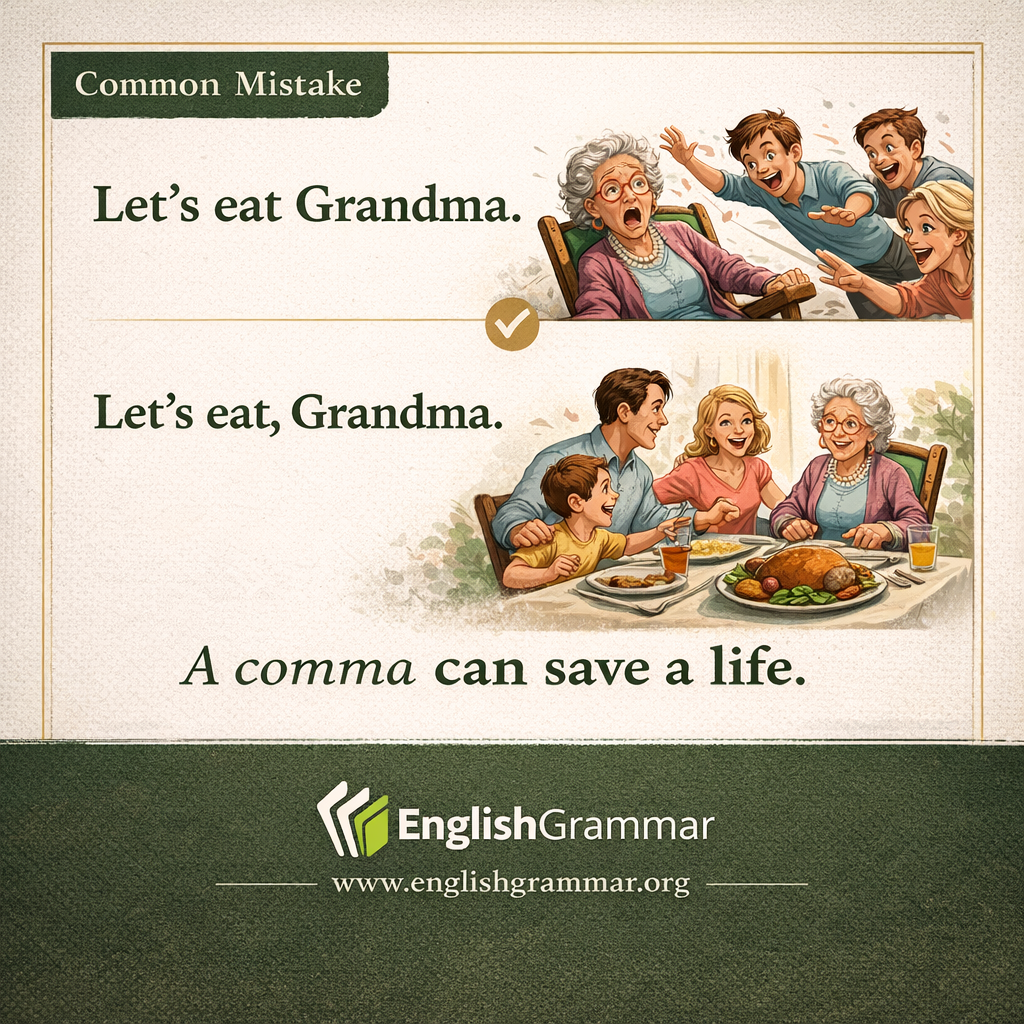
The difference between “Let’s eat Grandma” and “Let’s eat, Grandma” is a single comma, but the meaning changes completely.

In “Let’s eat, Grandma”, Grandma is the person being addressed. This is called direct address, and English usually separates it with a comma. The sentence means you are speaking to Grandma and suggesting that both of you eat.

In “Let’s eat Grandma”, there is no comma, so Grandma becomes the object of eat. That creates a very different, and unintentionally funny, meaning.

This mistake happens because writers often skip commas in short, casual sentences. But commas are important when you name the person you are talking to.

  • Correct: “Thanks, Maya.”
  • Correct: “Can we go, Dad?”
  • Wrong meaning: “Can we go Dad?”

To avoid this error, check whether a name is being spoken to directly. If it is, add a comma before, after, or around the name as needed.

Small punctuation marks can do big jobs. In this case, the comma makes your meaning clear and keeps Grandma safely at the table.

  • Share
  • Post
  • Post
  • Reddit
  • Email
  • WhatsApp
NEW: Try Matches, our daily vocabulary challenge. Pick a topic and level and match words with definitions to boost your vocabulary.

Primary Sidebar

2,485,429 
761,532 
Improve Your English
  • Download 2026 Grammar Guide (PDF)
  • Free Weekly Exercises & Vocabulary
  • Join over 3 Million English Learners
We respect your privacy. Unsubscribe anytime.
Grammar Checker - Try Now

Latest Posts

  • 100 Best Synonyms for “Purity” October 12, 2026
  • Strategic Recommendation Language Exercise October 12, 2026
  • 100 Best Synonyms for “Attempt” October 12, 2026
  • Should have vs. should of: which is correct? October 12, 2026
  • Appointments Vocabulary Exercise October 12, 2026
  • 100 Best Synonyms for “Provoked” October 12, 2026
  • 100 Best Synonyms for “Stranded” October 12, 2026
  • The surprisingly old roots of “newfangled” October 12, 2026
  • 100 Best Synonyms for “Answer” October 12, 2026
  • 100 Best Synonyms for “Prove” October 12, 2026
Home of English Grammar

Free English grammar exercises, rules and vocabulary lists, with new exercises every week. Join the leading English grammar site with over 3 million followers.

Pro

Learn

  • Exercises
  • Matches
  • Grammar rules
  • Vocabulary lists
  • Writing guides
  • Online tools

More

  • Top social media posts
  • Various posts
  • Free grammar guide (PDF)
  • Contact

Pro

  • What is Pro?
  • Pro account
  • Pro exercises

Copyright © 2026 EnglishGrammar.org

  • Disclaimer
  • Privacy policy
  • Refund policy
  • Terms
  • Sitemap
Improve Your English
  • Download 2026 Grammar Guide (PDF)
  • Free Weekly Exercises & Vocabulary
  • Join over 3 Million English Learners
We respect your privacy. Unsubscribe anytime.