
• Skip to primary navigation
  • Skip to main content
  • Skip to primary sidebar
Home of English Grammar
  • Home
  • Course
  • Exercises
  • Grammar Rules
  • Matches
  • Posts
  • Tools
    • Grammar Checker
    • Very Replacer
    • Word Counter
  • Vocabulary Lists
  • Archives
    • Social Media Posts
    • Writing Guides
  • Join free

What “in the long run” means, and where it came from

August 11, 2026

The origin of "in the long run"

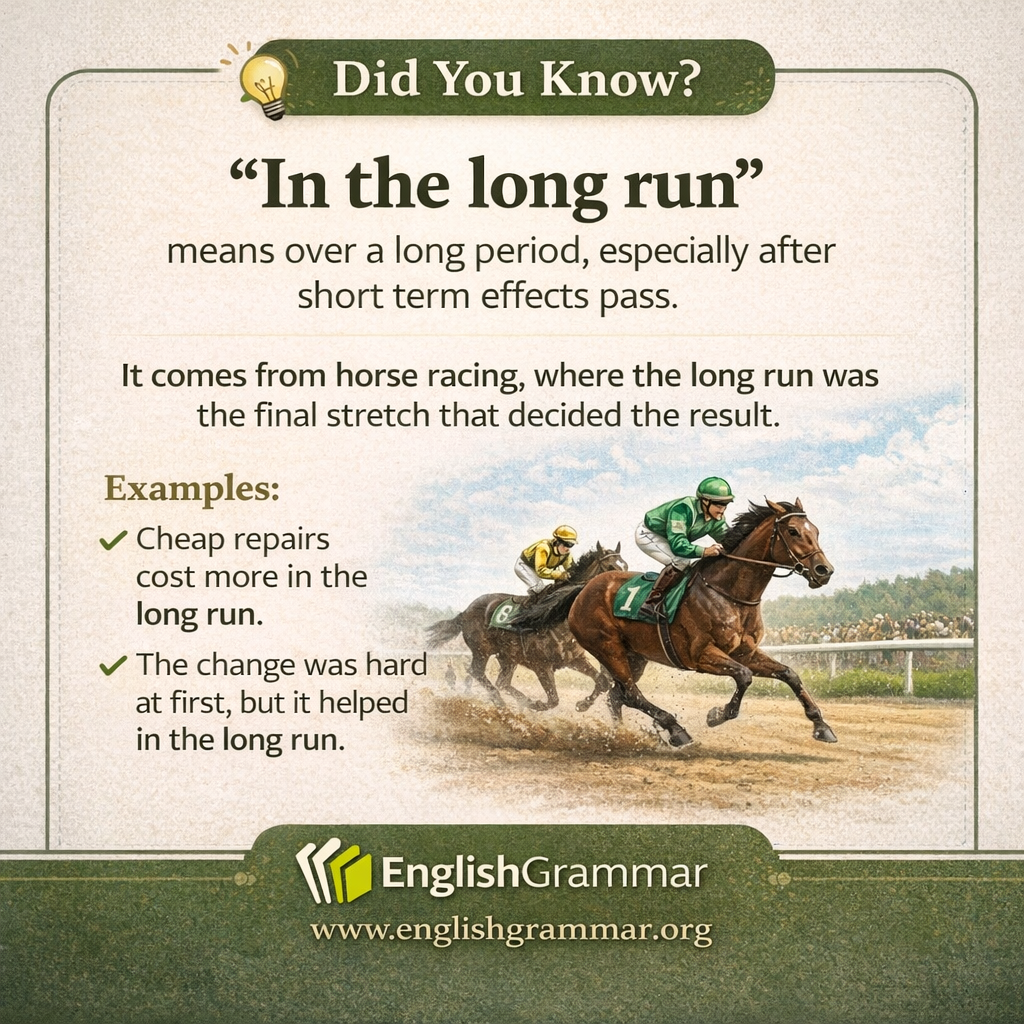
In the long run means over a long period of time, especially after immediate problems, costs, or feelings have passed. People use it when they want to focus on the final result instead of the short term situation.

The phrase is generally linked to horse racing. The long run referred to the final stretch of a race, the part that often determined the outcome. That idea later widened into everyday English: what matters most is how things turn out over time.

Today, the phrase is common in discussions about money, work, health, and decision making. It often contrasts with what seems easier, cheaper, or better right now.

  • Buying a durable chair costs more now, but it saves money in the long run.
  • Daily exercise can feel tiring at first, but it improves your health in the long run.

A useful contrast is in the short term or in the long term. In the long run is slightly more idiomatic and often sounds more natural when talking about eventual results.

Improve your English grammar, vocabulary and writing

We take you step by step from beginner to advanced, even if you struggled with English at school or have always had trouble remembering the rules.

  • 10 modules, 105 lessons and 688 questions
  • Just log in and learn anytime and anywhere
  • Your progress is saved in your account
  • Download the 2027 Grammar Guide (PDF)
Join free

Already have an account? Sign in

See what’s in the course

Primary Sidebar

2.4M761.4K165.8K

Free 2027 Grammar Guide

  • Download Grammar Guide (PDF)
  • Online grammar course, A1 to C2
  • Weekly exercises and vocabulary
  • Join over 3 million English learners

We respect your privacy. Unsubscribe anytime.

Already have an account? Sign in

Grammar Checker - Try Now

Latest Posts

  • Modal Verbs of Obligation Exercise October 21, 2026
  • 100 Best Synonyms for “Demand” October 20, 2026
  • 100 Words Every Pitmaster Should Know October 20, 2026
  • 100 Best Synonyms for “Smile” October 20, 2026
  • 100 Best Synonyms for “Appalling” October 20, 2026
  • Go and Come Collocations Exercise October 20, 2026
  • 100 Best Synonyms for “Prior” October 20, 2026
  • 100 English Phrases for Buying Furniture in English October 20, 2026
  • The origin of “not my cup of tea” October 20, 2026
  • Emphasize, stress, highlight, underline, underscore, and accentuate: how to choose October 20, 2026
Home of English Grammar

Free English grammar exercises, rules and vocabulary lists, with new exercises every week. Join the leading English grammar site with over 3 million followers.

Join free

Learn

  • Exercises
  • Matches
  • Grammar rules
  • Vocabulary lists
  • Writing guides
  • Online tools

More

  • Top social media posts
  • Various posts
  • Contact

Account

  • Join free
  • Grammar Course
  • Free grammar guide (PDF)

Copyright © 2026 EnglishGrammar.org

  • Disclaimer
  • Privacy policy
  • Terms
  • Sitemap