
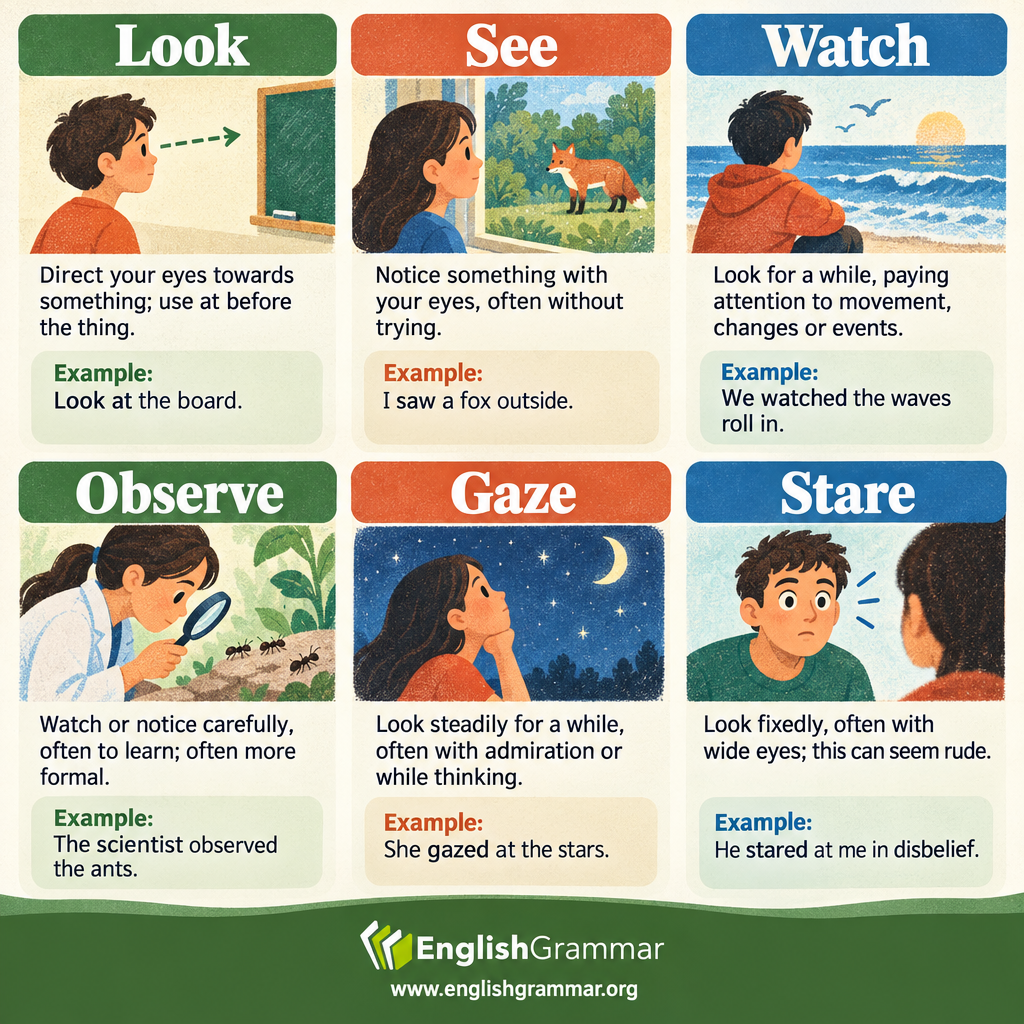
These six verbs describe different ways of using your eyes. The best choice depends on your attention, purpose and sometimes the feeling you want to express.
- Look means to direct your eyes towards something. Use at before the thing: “Look at this photo.” The action does not guarantee that you notice every detail.
- See means to notice something with your eyes, often without trying: “I can see a boat in the distance.” It focuses on what enters your vision rather than the effort to look.
- Watch means to look at something for a while, paying attention to movement, changes or events: “We watched the children play.”
- Observe means to watch or notice carefully, often to learn or gather information: “The students observed how the ice melted.” It often sounds more formal than the other everyday choices.
- Gaze means to look steadily for a while, often with admiration or while thinking: “He gazed at the mountains.”
- Stare means to look fixedly, often with wide eyes because of surprise or strong interest: “She stared at the enormous spider.” Staring at people can seem rude.
Compare “I looked at the tree” with “I saw a bird in the tree.” The first describes directing your eyes; the second describes noticing something.
Context matters too. Both “We watched a film” and “We saw a film” are natural. The first emphasizes the activity; the second can simply report the experience.