
• Skip to primary navigation
  • Skip to main content
  • Skip to primary sidebar
Home of English Grammar
  • Home
  • Course
  • Exercises
  • Grammar Rules
  • Matches
  • Posts
  • Tools
    • Grammar Checker
    • Very Replacer
    • Word Counter
  • Vocabulary Lists
  • Archives
    • Social Media Posts
    • Writing Guides
  • Join free

What “lose your marbles” means, and where it likely comes from

September 28, 2026

The origin of "lose your marbles"

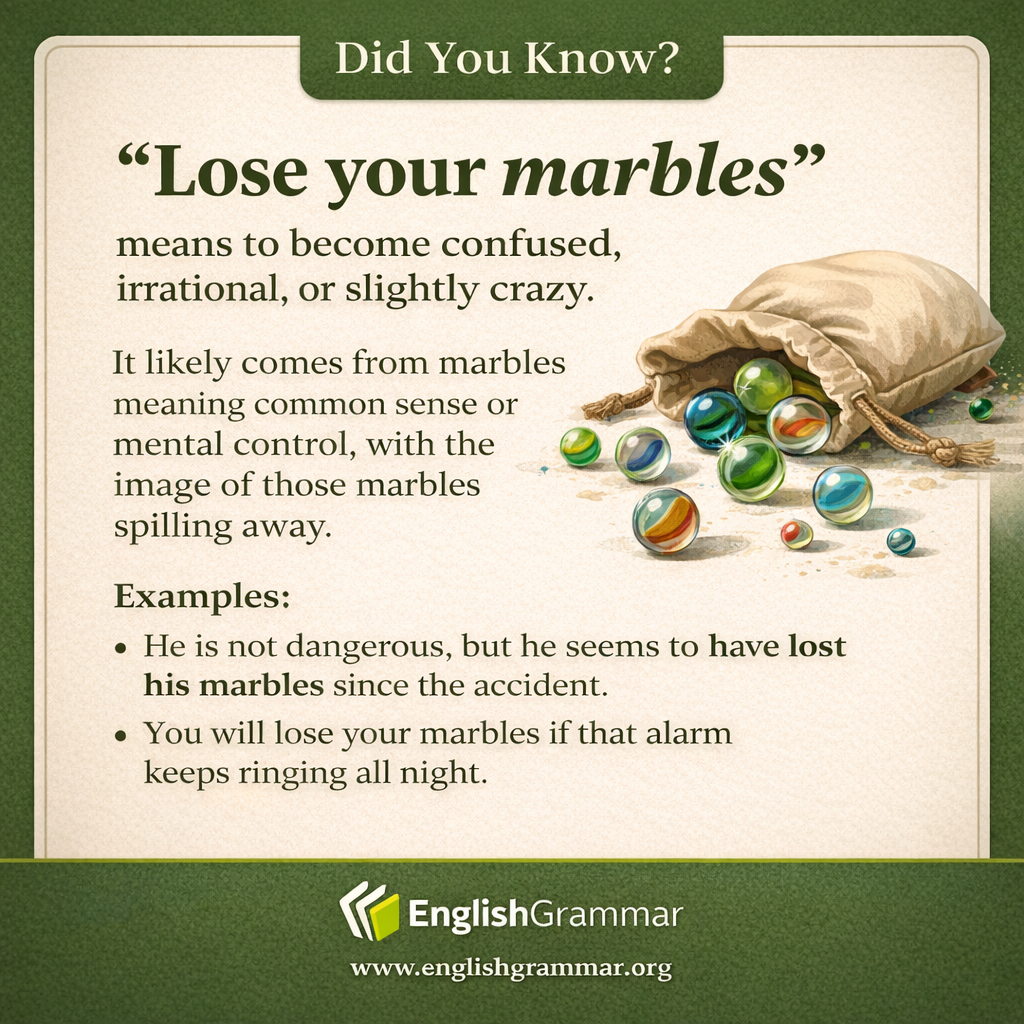
“Lose your marbles” means to become confused, irrational, or mentally unbalanced. In everyday English, people often use it informally and sometimes humorously, not always as a serious statement about mental illness.

The exact origin is not fully certain, but the most likely explanation is that marbles once referred to a person’s good sense, self control, or mental faculties. The picture is simple: if your marbles spill away, your clear thinking goes with them.

This helps explain why the expression sounds so vivid. It turns an abstract idea, losing mental control, into a physical image that is easy to imagine.

People usually use the phrase in two common ways:

  • For real confusion or odd behavior: After the long fever, his family worried he had lost his marbles.
  • For exaggeration or humor: If the neighbors keep playing drums at midnight, I will lose my marbles.

Because the expression is informal, it fits conversation and light writing better than formal or medical contexts. In serious situations, clearer phrases such as became confused or was not thinking clearly are usually better.

Improve your English grammar, vocabulary and writing

We take you step by step from beginner to advanced, even if you struggled with English at school or have always had trouble remembering the rules.

  • 10 modules, 105 lessons and 688 questions
  • Just log in and learn anytime and anywhere
  • Your progress is saved in your account
  • Download the 2026 Grammar Guide (PDF)
Join free

Already have an account? Sign in

See what’s in the course

Primary Sidebar

2.4M761.4K165.8K

Free 2026 Grammar Guide

  • Download Grammar Guide (PDF)
  • Online grammar course, A1 to C2
  • Weekly exercises and vocabulary
  • Join over 3 million English learners

We respect your privacy. Unsubscribe anytime.

Already have an account? Sign in

Grammar Checker - Try Now

Latest Posts

  • Crash blossoms: when headlines suggest the wrong meaning October 16, 2026
  • 100 Best Synonyms for “Remind” October 16, 2026
  • 100 Best Synonyms for “Unkind” October 16, 2026
  • 100 Best Synonyms for “Changing” October 16, 2026
  • 100 Best Synonyms for “Platitude” October 15, 2026
  • 100 Best Synonyms for “Reluctant” October 15, 2026
  • “&c.”: an older abbreviation for “et cetera” October 15, 2026
  • 100 Best Synonyms for “Causing” October 15, 2026
  • 100 Best Synonyms for “Relief” October 15, 2026
  • Reported Speech and Reporting Verbs Exercise October 15, 2026
Home of English Grammar

Free English grammar exercises, rules and vocabulary lists, with new exercises every week. Join the leading English grammar site with over 3 million followers.

Join free

Learn

  • Exercises
  • Matches
  • Grammar rules
  • Vocabulary lists
  • Writing guides
  • Online tools

More

  • Top social media posts
  • Various posts
  • Contact

Account

  • Join free
  • Grammar Course
  • Free grammar guide (PDF)

Copyright © 2026 EnglishGrammar.org

  • Disclaimer
  • Privacy policy
  • Terms
  • Sitemap