
• Skip to primary navigation
  • Skip to main content
  • Skip to primary sidebar
Home of English Grammar
  • Home
  • Course
  • Exercises
  • Grammar Rules
  • Matches
  • Posts
  • Tools
    • Grammar Checker
    • Very Replacer
    • Word Counter
  • Vocabulary Lists
  • Archives
    • Social Media Posts
    • Writing Guides
  • Join free

What “lost in the shuffle” means and where it comes from

September 28, 2026

The origin of "lost in the shuffle"

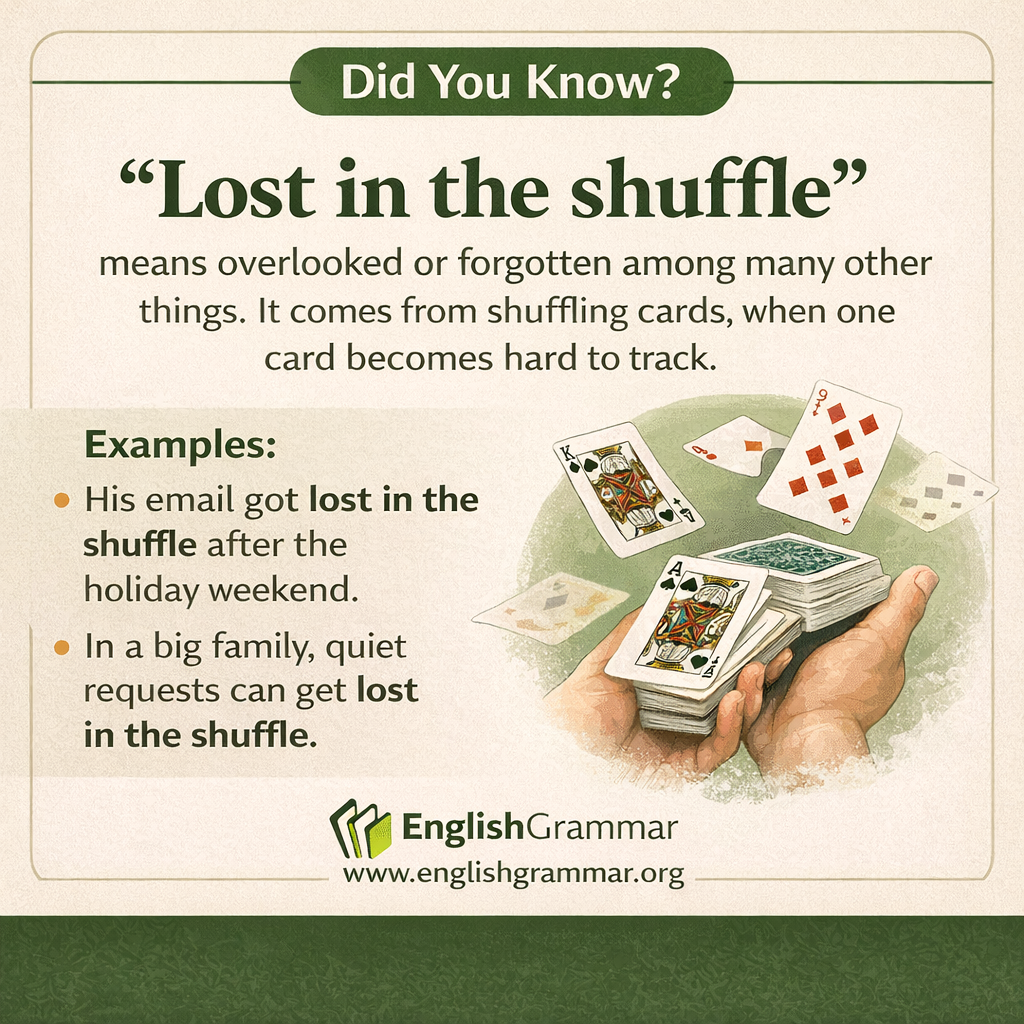
Lost in the shuffle means that something was overlooked, forgotten, or not noticed because there were many other things happening at the same time.

The image behind the expression comes from shuffling cards. When cards are mixed together, it becomes difficult to keep track of one particular card. That idea later became a useful way to talk about modern situations where a message, task, or person is missed in the middle of a busy group of items.

People often use this expression for work, school, family life, and administration. It usually suggests that the thing was not ignored on purpose. Instead, it disappeared among many competing messages, tasks, or requests.

  • Her application got lost in the shuffle when the office moved.
  • During the busy launch week, a few customer questions were lost in the shuffle.

You can also use it for people, not just paperwork. For example, a quiet student in a large class might feel lost in the shuffle if the teacher has too many students to notice every concern right away.

Improve your English grammar, vocabulary and writing

We take you step by step from beginner to advanced, even if you struggled with English at school or have always had trouble remembering the rules.

  • 10 modules, 112 lessons and 730 questions
  • Just log in and learn anytime and anywhere
  • Your progress is saved in your account
  • Download the 2027 Grammar Guide (PDF)
Join free

Already have an account? Sign in

See what’s in the course

Primary Sidebar

2.4M761.4K165.8K

Free 2027 Grammar Guide

  • Download Grammar Guide (PDF)
  • Online grammar course, A1 to C2
  • Weekly exercises and vocabulary
  • Join over 3 million English learners

We respect your privacy. Unsubscribe anytime.

Already have an account? Sign in

Grammar Checker - Try Now

Latest Posts

  • 100 Best Synonyms for “Propositive” October 23, 2026
  • 100 Best Synonyms for “Emphasizing” October 23, 2026
  • 100 Best Synonyms for “Communicative” October 23, 2026
  • Icky vs. gross vs. nasty vs. disgusting vs. revolting vs. vile October 23, 2026
  • Comparatives Exercise October 23, 2026
  • 100 Best Synonyms for “Proposition” October 23, 2026
  • 100 Best Synonyms for “Stagnation” October 23, 2026
  • 100 Best Synonyms for “Dumb” October 23, 2026
  • The origin and meaning of “off the cuff” October 23, 2026
  • 100 Phrases for Declining Requests at Work Politely October 23, 2026
Home of English Grammar

Free English grammar exercises, rules and vocabulary lists, with new exercises every week. Join the leading English grammar site with over 3 million followers.

Join free

Learn

  • Exercises
  • Matches
  • Grammar rules
  • Vocabulary lists
  • Writing guides
  • Online tools

More

  • Top social media posts
  • Various posts
  • Contact

Account

  • Join free
  • Grammar Course
  • Free grammar guide (PDF)

Copyright © 2026 EnglishGrammar.org

  • Disclaimer
  • Privacy policy
  • Terms
  • Sitemap