
• Skip to primary navigation
  • Skip to main content
  • Skip to primary sidebar
Home of English Grammar
  • Home
  • Course
  • Exercises
  • Grammar Rules
  • Matches
  • Posts
  • Tools
    • Grammar Checker
    • Very Replacer
    • Word Counter
  • Vocabulary Lists
  • Archives
    • Social Media Posts
    • Writing Guides
  • Join free

Maybe, perhaps, possibly, conceivably, probably and definitely: How to choose

October 23, 2026

Maybe vs. Perhaps vs. Possibly vs. Conceivably vs. Probably vs. Definitely

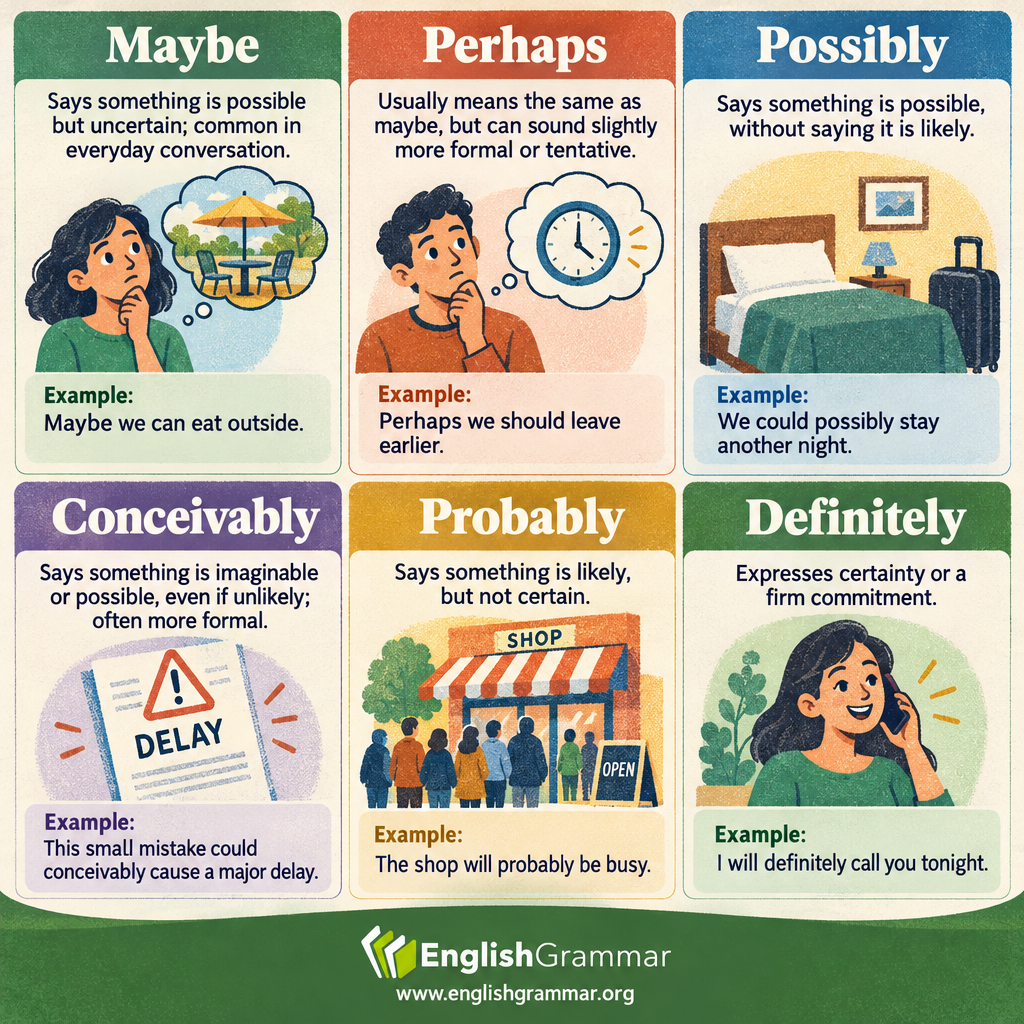
These six words help you express possibility or confidence. They do not form a precise probability scale: context and tone matter, and several overlap.

  • Maybe is a common, neutral way to say that something is possible but uncertain. Maybe the café is still open. It is especially common in everyday conversation.
  • Perhaps usually means the same thing, but can sound slightly more formal or tentative. Perhaps we should ask for directions. It can make a suggestion feel less direct.
  • Possibly also expresses possibility without saying that something is likely. The repairs could possibly take a week. It often works naturally with could or might, though it can also stand alone as an answer.
  • Conceivably means that something is imaginable or possible, even if it seems unlikely. One missing file could conceivably delay the whole project. It often sounds more formal and emphasizes considering a possibility.
  • Probably means that you think something is likely, while allowing room for doubt. Ravi will probably arrive before noon. You expect this outcome rather than merely considering it possible.
  • Definitely expresses certainty or a firm commitment. I will definitely send the form today. It presents the speaker as sure; it does not independently prove that a statement is true.

Compare: Maybe I can help leaves the question open. I can probably help suggests that help is likely. I can definitely help gives a firm assurance. Choose according to your confidence, then consider how formal or tentative you want to sound.

Improve your English grammar, vocabulary and writing

We take you step by step from beginner to advanced, even if you struggled with English at school or have always had trouble remembering the rules.

  • 10 modules, 105 lessons and 688 questions
  • Just log in and learn anytime and anywhere
  • Your progress is saved in your account
  • Download the 2027 Grammar Guide (PDF)
Join free

Already have an account? Sign in

See what’s in the course

Primary Sidebar

2.4M761.4K165.8K

Free 2027 Grammar Guide

  • Download Grammar Guide (PDF)
  • Online grammar course, A1 to C2
  • Weekly exercises and vocabulary
  • Join over 3 million English learners

We respect your privacy. Unsubscribe anytime.

Already have an account? Sign in

Grammar Checker - Try Now

Latest Posts

  • Maybe, perhaps, possibly, conceivably, probably and definitely: How to choose October 23, 2026
  • Endemic vs. pandemic: what is the difference? October 23, 2026
  • What Clauses Exercise October 23, 2026
  • 100 Best Synonyms for “Clunky” October 23, 2026
  • 100 Best Synonyms for “Stagnant” October 23, 2026
  • 100 Best Synonyms for “Proposal” October 23, 2026
  • 100 Best Synonyms for “Due to” October 23, 2026
  • 100 Best Synonyms for “Clingy” October 23, 2026
  • 100 Words Every Deli Worker Should Know October 23, 2026
  • 100 Best Synonyms for “Grouping” October 23, 2026
Home of English Grammar

Free English grammar exercises, rules and vocabulary lists, with new exercises every week. Join the leading English grammar site with over 3 million followers.

Join free

Learn

  • Exercises
  • Matches
  • Grammar rules
  • Vocabulary lists
  • Writing guides
  • Online tools

More

  • Top social media posts
  • Various posts
  • Contact

Account

  • Join free
  • Grammar Course
  • Free grammar guide (PDF)

Copyright © 2026 EnglishGrammar.org

  • Disclaimer
  • Privacy policy
  • Terms
  • Sitemap