
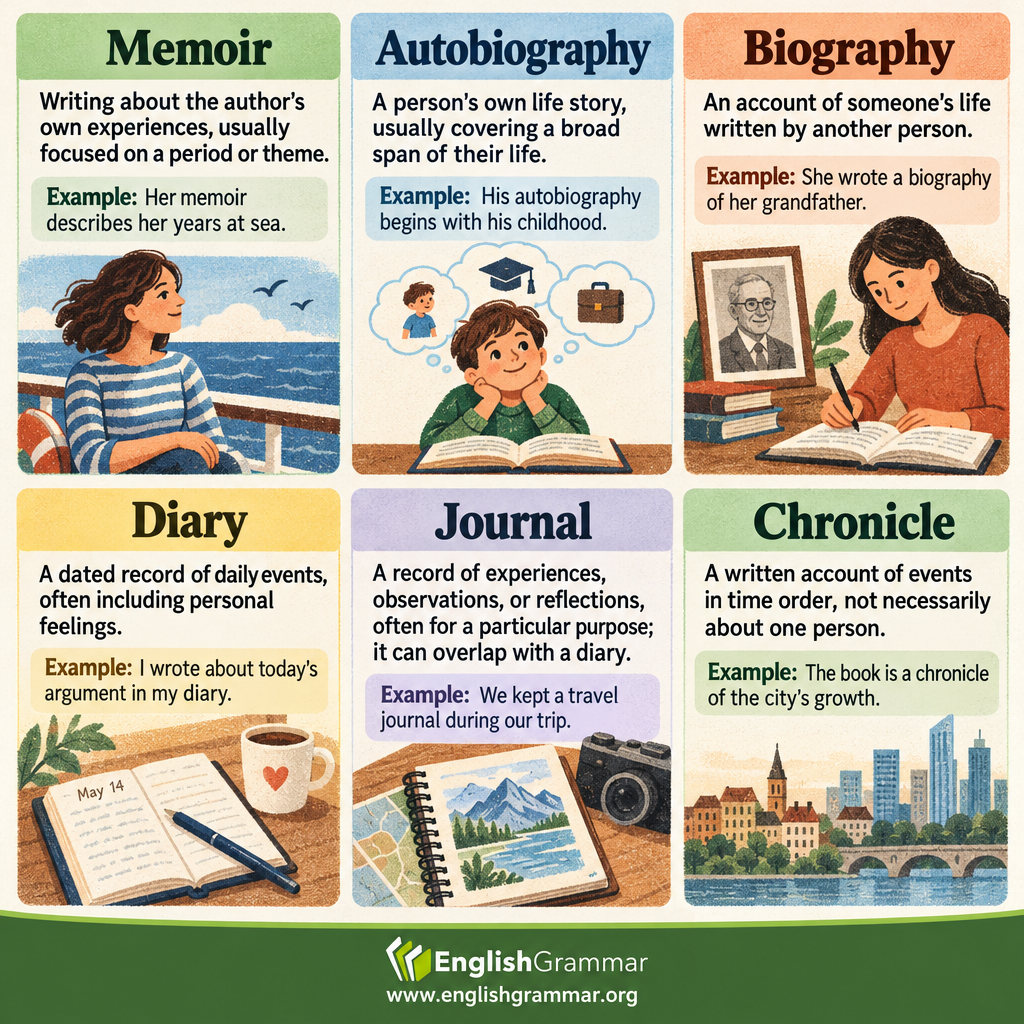
These six words describe different ways to write about lives, experiences, and events. The best choice depends on who writes, what the writing covers, and how it is organized.
- Memoir: A writer looks back on personal experiences, usually focusing on a particular period or theme. Her memoir explores the years she spent caring for her father.
- Autobiography: Someone tells their own life story, usually covering a broader span than a memoir. His autobiography follows his life from childhood through retirement.
- Biography: A writer tells someone else’s life story. The journalist wrote a biography of a local inventor. A biography can cover a whole life or focus on part of it.
- Diary: Someone keeps dated entries about daily events, often including personal feelings. She described her first week at college in her diary. Entries need not be written every day.
- Journal: Someone records experiences, observations, or reflections, often around an activity or purpose. He keeps a gardening journal to track what grows well. It can also be personal and dated, so it overlaps with a diary.
- Chronicle: A written account presents events in time order. The book is a chronicle of the town’s recovery after the flood. Its subject need not be one person’s life.
These are useful tendencies, not rigid boundaries. A personal record may reasonably be called either a diary or a journal, and life-writing categories sometimes overlap.