
• Skip to primary navigation
  • Skip to main content
  • Skip to primary sidebar
Home of English Grammar
  • Home
  • Course
  • Exercises
  • Grammar Rules
  • Matches
  • Posts
  • Tools
    • Grammar Checker
    • Very Replacer
    • Word Counter
  • Vocabulary Lists
    • My Word Lists
  • For Teachers
  • Archives
    • Social Media Posts
    • Writing Guides
  • Sign in
  • Join free

Metaphor, simile, analogy, allegory, symbolism and personification explained

November 14, 2026

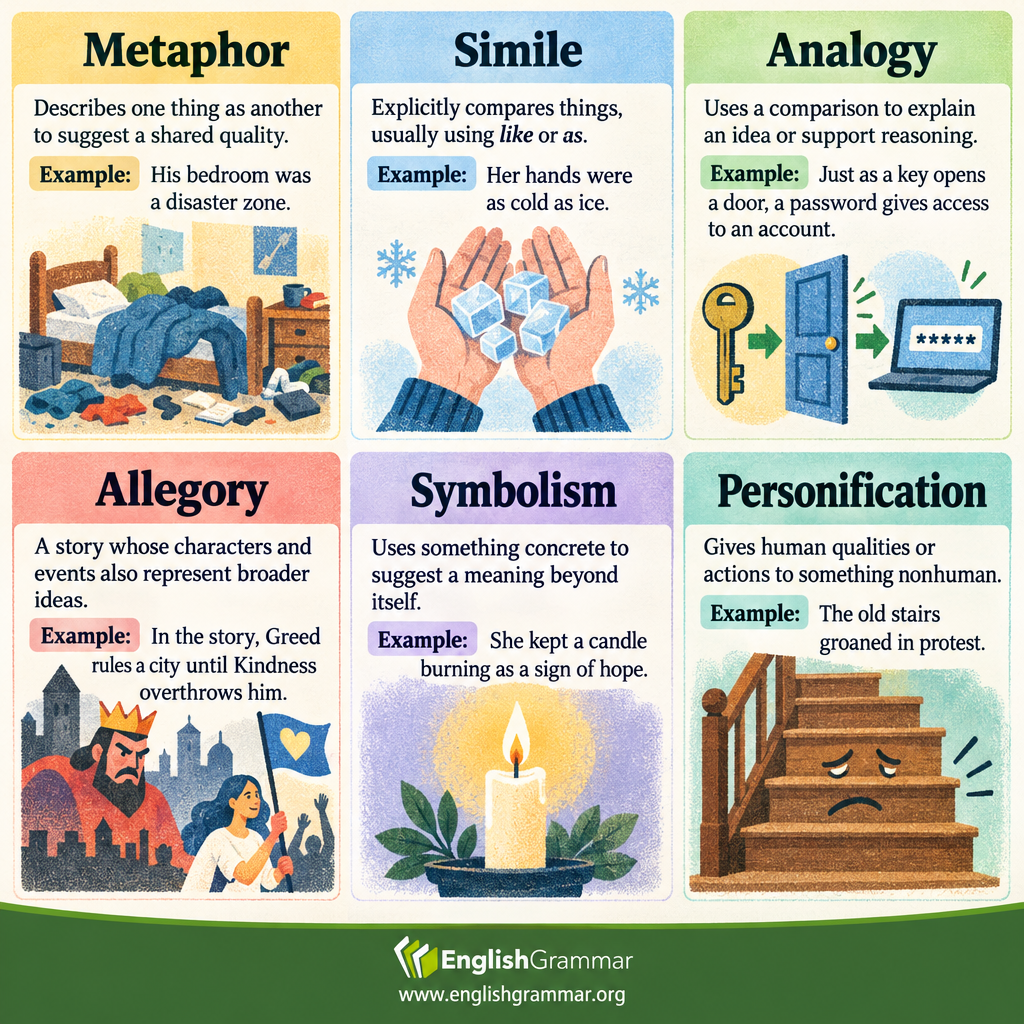
Metaphor vs. Simile vs. Analogy vs. Allegory vs. Symbolism vs. Personification

These six terms describe ways to make language vivid or communicate ideas indirectly. They can overlap, but each draws attention to something different.

  • Metaphor: Describes one thing as another to suggest a shared quality. Her voice was warm honey. The voice is not literally honey; the comparison suggests sweetness or richness.
  • Simile: Explicitly compares things, usually with like or as. The lake shone like a mirror. Choose this when you want to state the similarity openly. Not every use of these words creates a comparison.
  • Analogy: Uses a comparison to explain something or support reasoning. Just as a recipe guides a cook, an algorithm guides a computer through a task. Its main purpose is understanding, not just vivid description.
  • Allegory: Tells a story whose characters and events also represent broader ideas. A journey through a dangerous forest might represent a person’s struggle to live honestly. Look for a connected second level of meaning across the story.
  • Symbolism: Uses something concrete to suggest a meaning beyond itself. A locked gate in a story might suggest lost opportunity. The meaning depends on context, not a fixed universal code.
  • Personification: Gives human qualities or actions to something nonhuman. The wind complained outside my window. The wind receives a human action.

These are not six sealed boxes. An analogy may include a simile, and an allegory often uses symbolism. Identify the feature you want to discuss rather than assuming every passage has only one correct label.

Improve your English grammar, vocabulary and writing

We take you step by step from beginner to advanced, even if you struggled with English at school or have always had trouble remembering the rules.

  • 11 modules, 124 lessons and 819 questions
  • Just log in and learn anytime and anywhere
  • Your progress is saved in your account
  • Download the 2027 Grammar Guide (PDF)
Join free

Already have an account? Sign in

See what’s in the course

Primary sidebar

2.4M760.9K165.9K

Free 2027 Grammar Guide

  • Download Grammar Guide (PDF)
  • Online grammar course, A1 to C2
  • Weekly exercises and vocabulary
  • Join over 3 million English learners

We respect your privacy. Unsubscribe anytime.

Already have an account? Sign in

Grammar Checker - Try Now

Rankings

Home of English Grammar

Free exercises, a step-by-step grammar course, rules and vocabulary lists, with new exercises every week. Join the leading English grammar site with over 3 million followers.

Join free

Learn

  • Exercises
  • Grammar course
  • Level test
  • Matches
  • Grammar rules
  • Vocabulary lists
  • Writing guides
  • Online tools

More

  • Top social media posts
  • Various posts
  • For teachers
  • Contact

Account

  • Join free
  • My word lists
  • Free grammar guide (PDF)

Copyright © 2026 EnglishGrammar.org

  • Disclaimer
  • Privacy policy
  • Terms
  • Sitemap