
• Skip to primary navigation
  • Skip to main content
  • Skip to primary sidebar
Home of English Grammar
  • Home
  • Course
  • Exercises
  • Grammar Rules
  • Matches
  • Posts
  • Tools
    • Grammar Checker
    • Very Replacer
    • Word Counter
  • Vocabulary Lists
    • My Word Lists
  • For Teachers
  • Archives
    • Social Media Posts
    • Writing Guides
  • Sign in
  • Join free

Misunderstand, mistake, misread, misinterpret, misconstrue and misapprehend: how to choose

November 23, 2026

Misunderstand vs. Mistake vs. Misread vs. Misinterpret vs. Misconstrue vs. Misapprehend

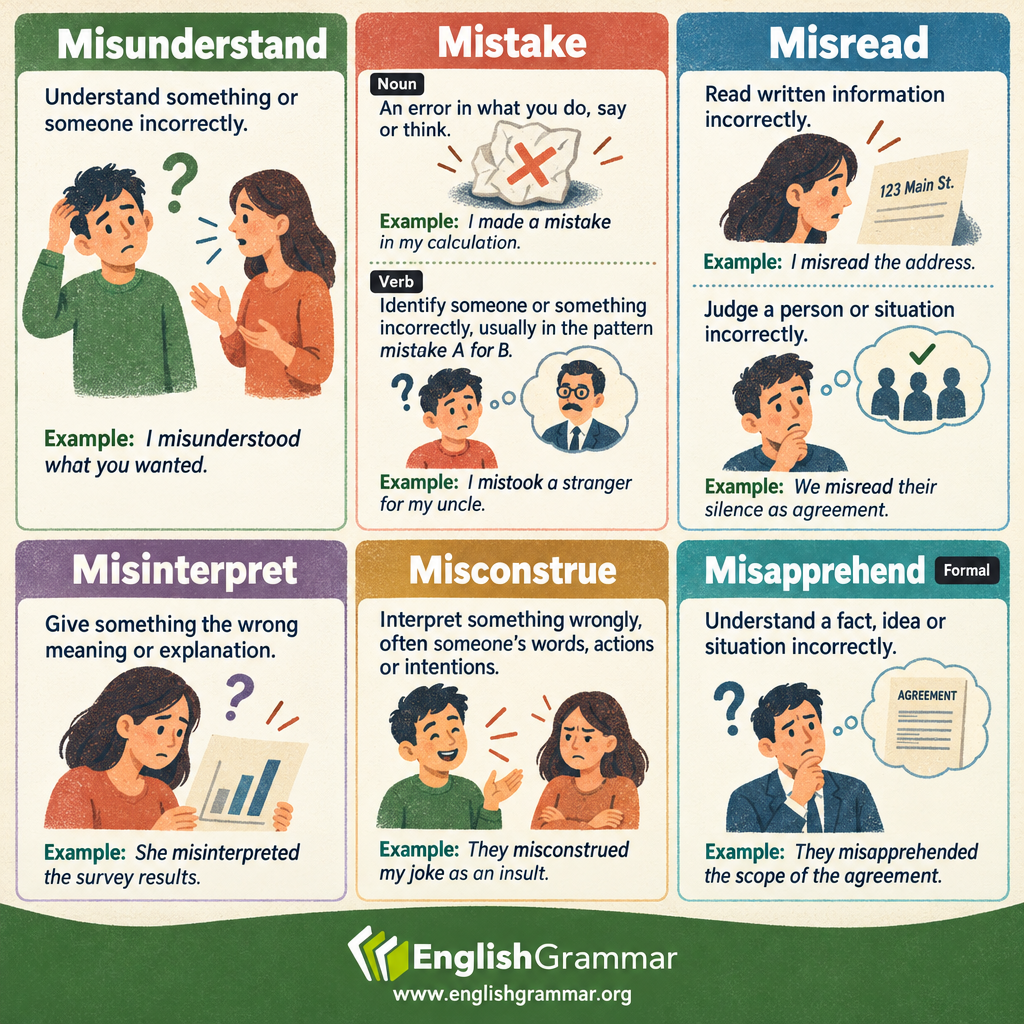
These six words overlap, but they are not interchangeable in every sentence. Choose according to what went wrong and how formal you want to sound.

  • Misunderstand is the broad, everyday choice for understanding something incorrectly. I misunderstood the instructions and completed the wrong page. It can also describe failing to understand someone’s feelings or intentions.
  • Mistake commonly works as a noun meaning an error: There is a mistake in the total. As a verb, it often follows the pattern mistake A for B, meaning to identify A incorrectly as B: She mistook my coat for hers.
  • Misread can mean reading written information incorrectly: I misread the price as fifteen dollars. It also means judging a person or situation incorrectly: The manager misread the team’s mood. It does not always involve written words.
  • Misinterpret means giving something the wrong meaning or explanation: They misinterpreted the results as evidence of improvement. It is useful for messages, behavior, evidence and other information.
  • Misconstrue is more formal and often concerns someone’s words, actions or intentions: He misconstrued her advice as criticism. It overlaps strongly with misinterpret, rather than naming a completely separate kind of error.
  • Misapprehend is formal and less common in everyday conversation. It means understanding a fact, idea or situation incorrectly: The committee misapprehended the purpose of the proposal. In ordinary conversation, misunderstand is usually more natural.

Context matters more than rigid categories. Several of these verbs may fit the same event, while drawing attention to different aspects of it.

Improve your English grammar, vocabulary and writing

We take you step by step from beginner to advanced, even if you struggled with English at school or have always had trouble remembering the rules.

  • 11 modules, 124 lessons and 819 questions
  • Just log in and learn anytime and anywhere
  • Your progress is saved in your account
  • Download the 2027 Grammar Guide (PDF)
Join free

Already have an account? Sign in

See what’s in the course

Primary sidebar

2.4M760.9K165.9K

Free 2027 Grammar Guide

  • Download Grammar Guide (PDF)
  • Online grammar course, A1 to C2
  • Weekly exercises and vocabulary
  • Join over 3 million English learners

We respect your privacy. Unsubscribe anytime.

Already have an account? Sign in

Grammar Checker - Try Now

Rankings

Home of English Grammar

Free exercises, a step-by-step grammar course, rules and vocabulary lists, with new exercises every week. Join the leading English grammar site with over 3 million followers.

Join free

Learn

  • Exercises
  • Grammar course
  • Level test
  • Matches
  • Grammar rules
  • Vocabulary lists
  • Writing guides
  • Online tools

More

  • Top social media posts
  • Various posts
  • For teachers
  • Contact

Account

  • Join free
  • My word lists
  • Free grammar guide (PDF)

Copyright © 2026 EnglishGrammar.org

  • Disclaimer
  • Privacy policy
  • Terms
  • Sitemap