
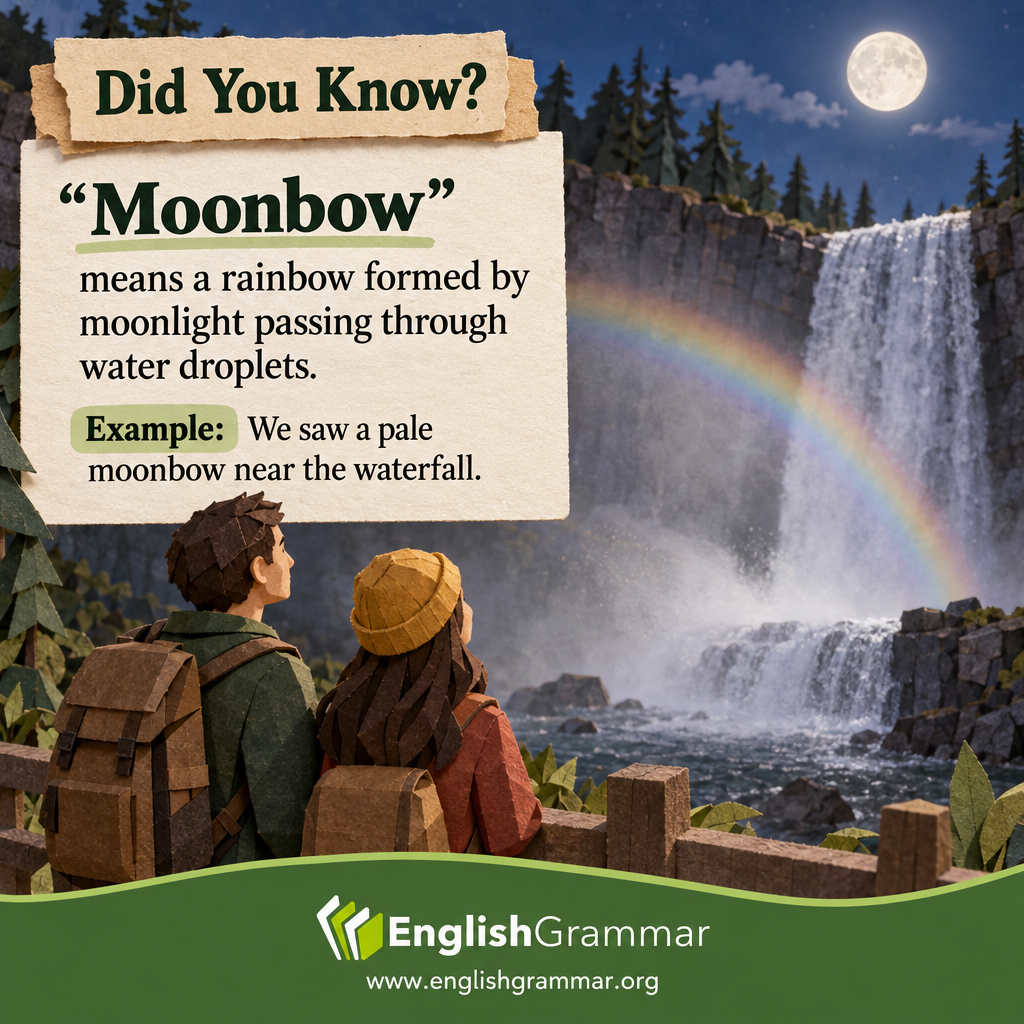
A moonbow is an arc of colored light produced when moonlight passes through water droplets in the air. It forms through the same basic process as a rainbow, but its light comes from the Moon rather than directly from the Sun.
The word is a compound noun: moon tells us the source of the light, while bow describes the curved shape. Here, bow is related to the arc-shaped meaning found in rainbow; it does not refer to bending at the waist. The word is normally written as one word.
Moonbows are uncommon because several conditions need to come together. The Moon must be bright, the sky opposite it must be dark, and water droplets must be present. Mist from a waterfall can provide those droplets. To human eyes, a moonbow may look faint or nearly white because moonlight is much dimmer than sunlight, although a camera may record more color.
In a sentence, moonbow works as a countable noun, so it can follow a or take the plural moonbows:
- We spotted a moonbow above the misty waterfall.
- Bright moonbows are easier to photograph than to see clearly.
Compare it with halo. A halo looks like a ring around the Moon, while a moonbow appears opposite the Moon, where water droplets redirect its light toward the viewer. The terms describe different optical effects, so they are not interchangeable.