
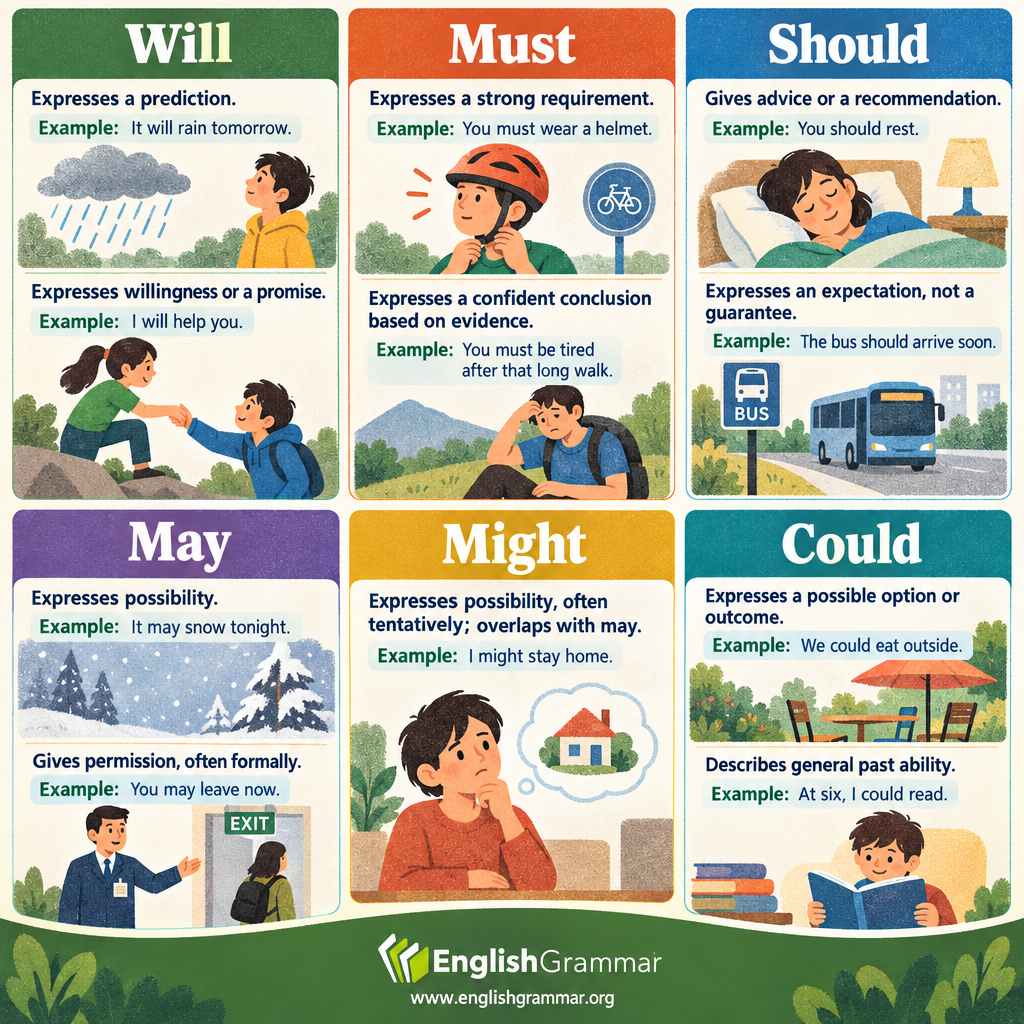
Modal verbs come before a base verb, such as go or help. They show how a speaker presents an action: as a prediction, a requirement, advice or a possibility. Choose according to your intended meaning, not a fixed scale of certainty.
- Will commonly expresses a prediction: The shop will be busy tomorrow. It also expresses willingness or a promise: I will send you the notes.
- Must expresses a strong requirement: Visitors must show identification. It can also mark a confident conclusion based on evidence: The lights are on, so someone must be home. This is a deduction, not an instruction.
- Should commonly gives advice: You should take a break. It also describes an expected outcome: The parcel should arrive on Friday. That expectation is not a guarantee.
- May expresses possibility: The meeting may finish early. It also gives permission, often formally: You may begin the test.
- Might expresses possibility, often tentatively: We might order pizza tonight. It frequently overlaps with may; neither word represents a fixed probability.
- Could expresses a possible option or outcome: We could take the train. It also describes general past ability: At ten, I could swim well.
Compare You must leave with You should leave: the first presents leaving as necessary; the second recommends it. Context matters, especially when several forms can express possibility.