
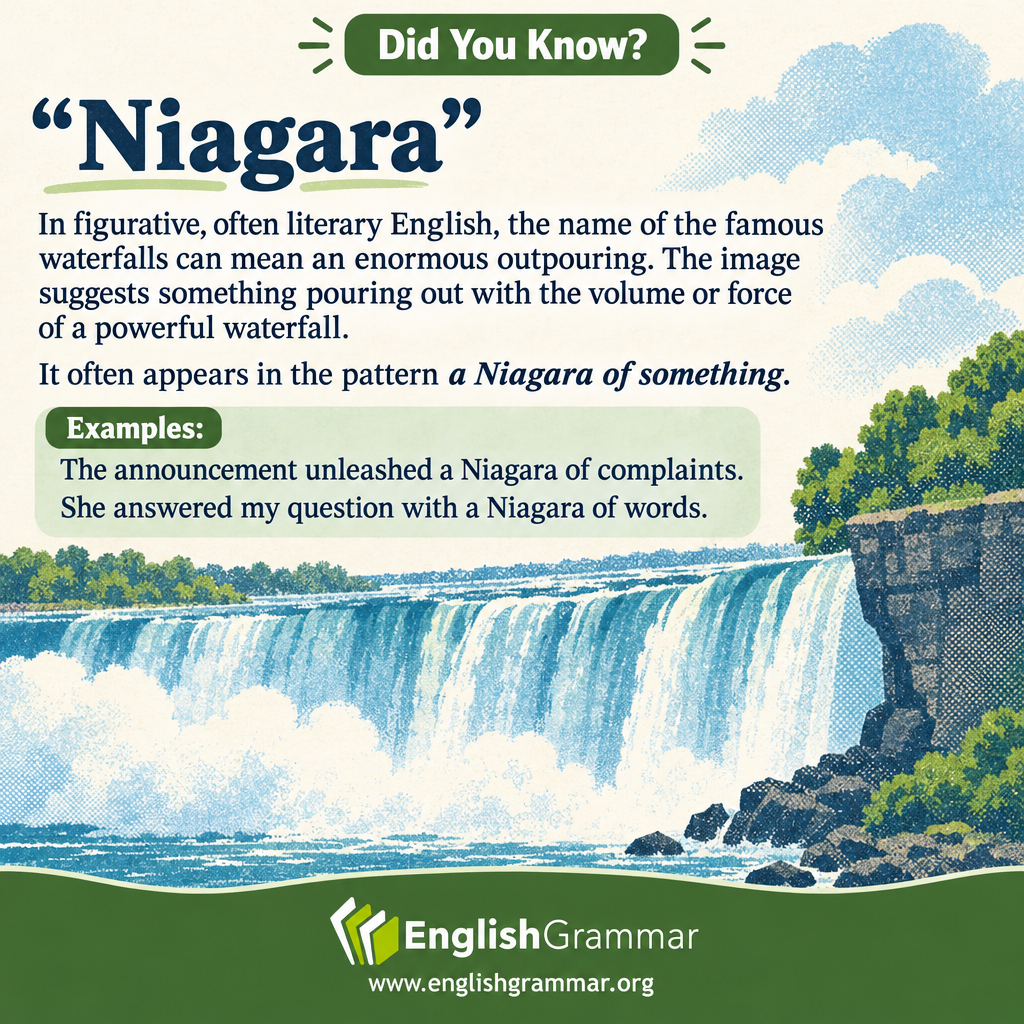
“Niagara” is not only a place name. In figurative English, it can mean an enormous outpouring: something arriving or flowing in overwhelming amounts. This use is vivid and often literary, rather than a common choice in everyday conversation.
The image comes from the famous waterfalls on the border between Canada and the United States. Their tremendous flow of water provides a comparison for anything that seems to pour out with similar volume or force. You do not need to know the original meaning of the place name to understand this use.
A useful pattern is a Niagara of + a noun. The noun tells the reader what is pouring out. It might be words, tears, complaints, or something else that can be imagined as a powerful flood.
- Her simple question brought forth a Niagara of words. The response was an overwhelming stream of speech.
- After the announcement, the office received a Niagara of complaints. The office received a huge number of complaints, presented as a flood.
For a more neutral sentence, you could say a flood of complaints or simply many complaints. The waterfall comparison adds drama and emphasizes scale; it is not an exact measurement.
This is a figurative use of a proper name, not a claim that the place name literally translates as “an enormous outpouring.” Keep that distinction in mind when explaining the expression.