
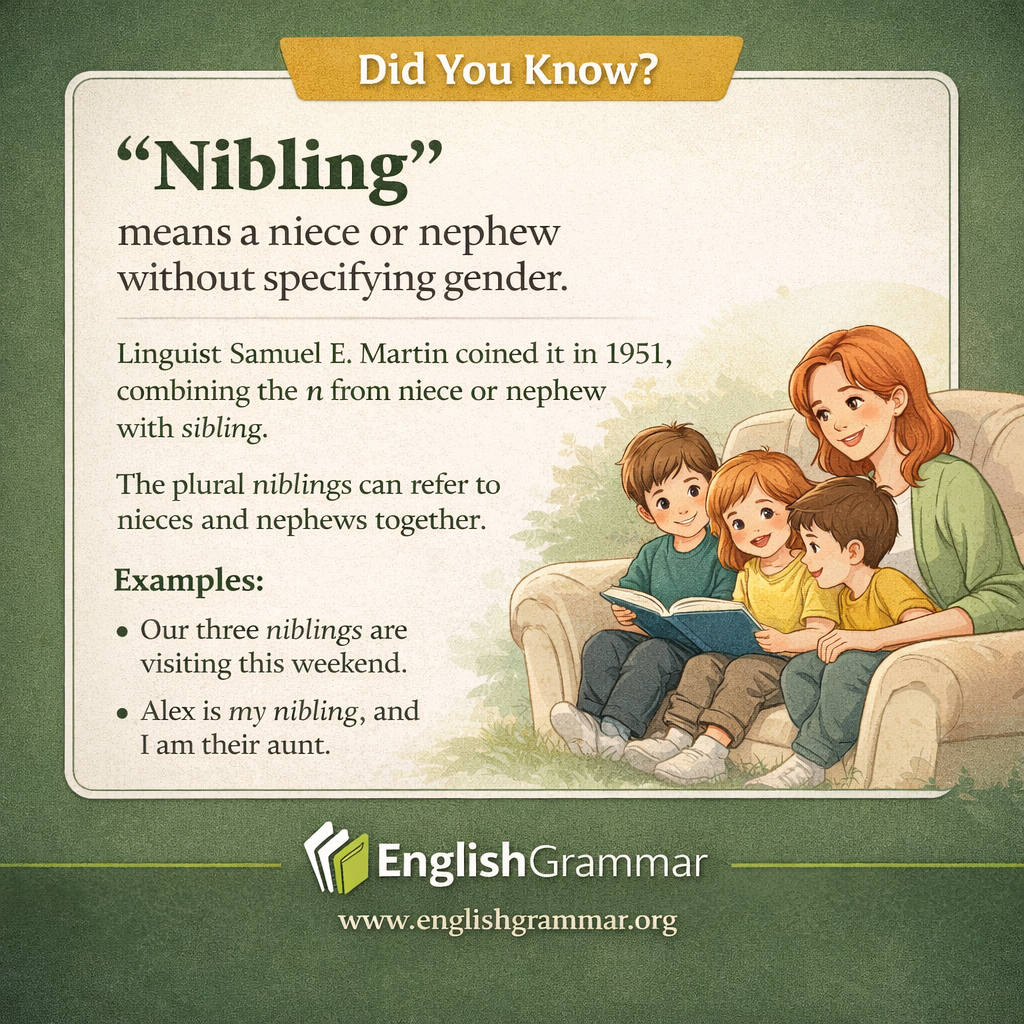
Nibling is a gender neutral kinship term for a niece or nephew. Its plural, niblings, can refer to several nieces and nephews as one group. It works much like sibling, which can mean either a sister or a brother.
Linguist Samuel E. Martin coined the word in 1951. He formed it from the initial n associated with niece and nephew, plus ibling from sibling. Although the word is decades old and now appears in major dictionaries, some readers and listeners may not know it. In formal writing or a first conversation, a brief explanation can help.
The term is useful in several situations:
- when speaking about a mixed group of nieces and nephews
- when a person’s gender is unknown, irrelevant, or private
- when a relative prefers a term that does not mark them as a niece or nephew
Singular and plural forms follow ordinary noun patterns. You can write, “My nibling starts college this fall”, or “All my niblings came to dinner.” The possessive forms are also regular: “my nibling’s coat” and “my niblings’ gifts.”
Nibling is not limited to nonbinary people. It can name any niece or nephew when specifying gender is unnecessary. As with other personal terms, use the word a person prefers for themself.