
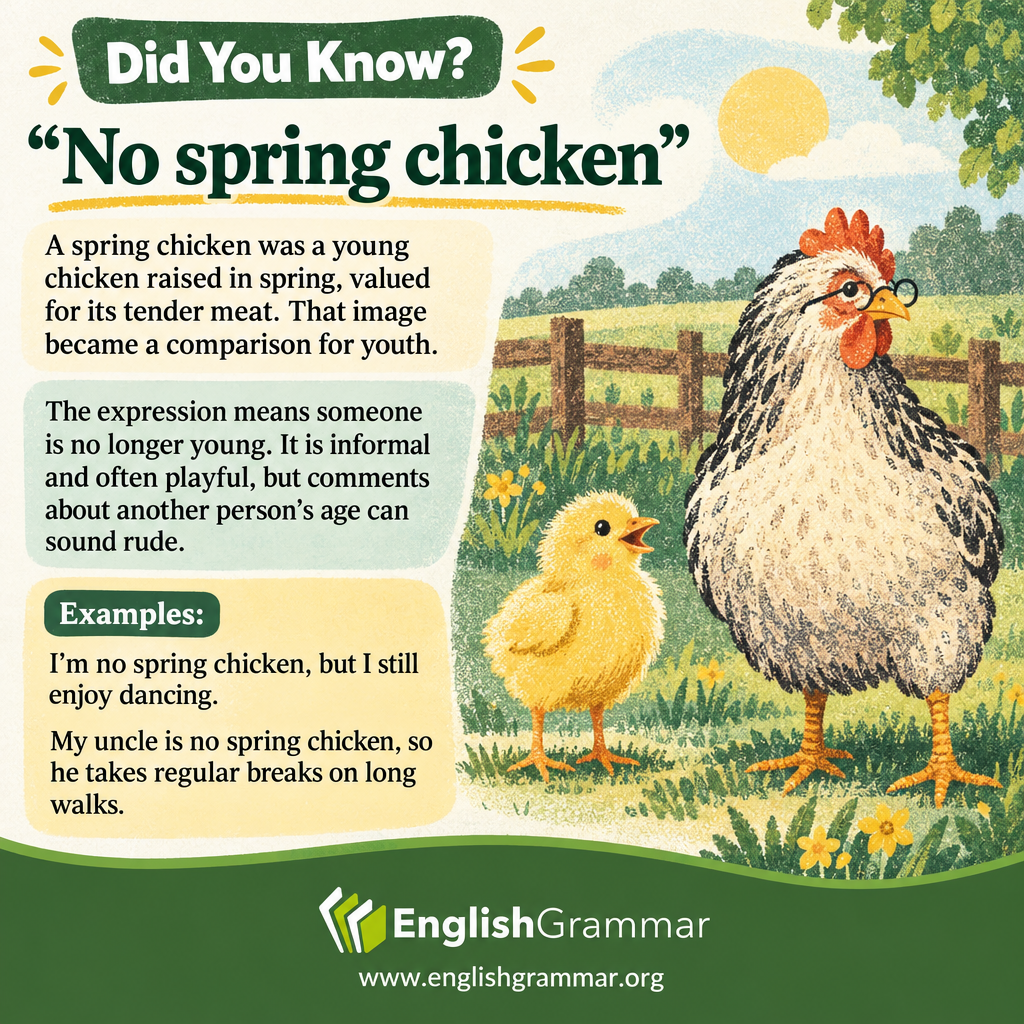
“No spring chicken” means that someone is no longer young. It does not give an exact age: what counts as young depends on the situation. The expression is informal and often humorous, especially when people use it about themselves.
The image comes from farming and food. A spring chicken was a young chicken raised in spring, valued for its tender meat. The name became a way to describe a young person. Saying that someone is not one turns that comparison around: the person is past their youth.
You do not need to know the farming background to understand the expression today. People generally use it to acknowledge age, sometimes while pointing out that they are still active or capable.
- Talking about yourself: “I’m no spring chicken, so I need a rest after a long hike.”
- Contrasting age with ability: “Our coach is no spring chicken, but she can still outrun most of us.”
Be careful when talking about someone else. Even a playful comment about age can sound rude if the person does not welcome it. It is usually safer as a joke about yourself or with someone you know well.
In a formal introduction or professional description, choose more direct wording if age is relevant, such as “an older adult.” If you mean that someone has useful skills, say “experienced” instead; age and experience are not the same thing.