
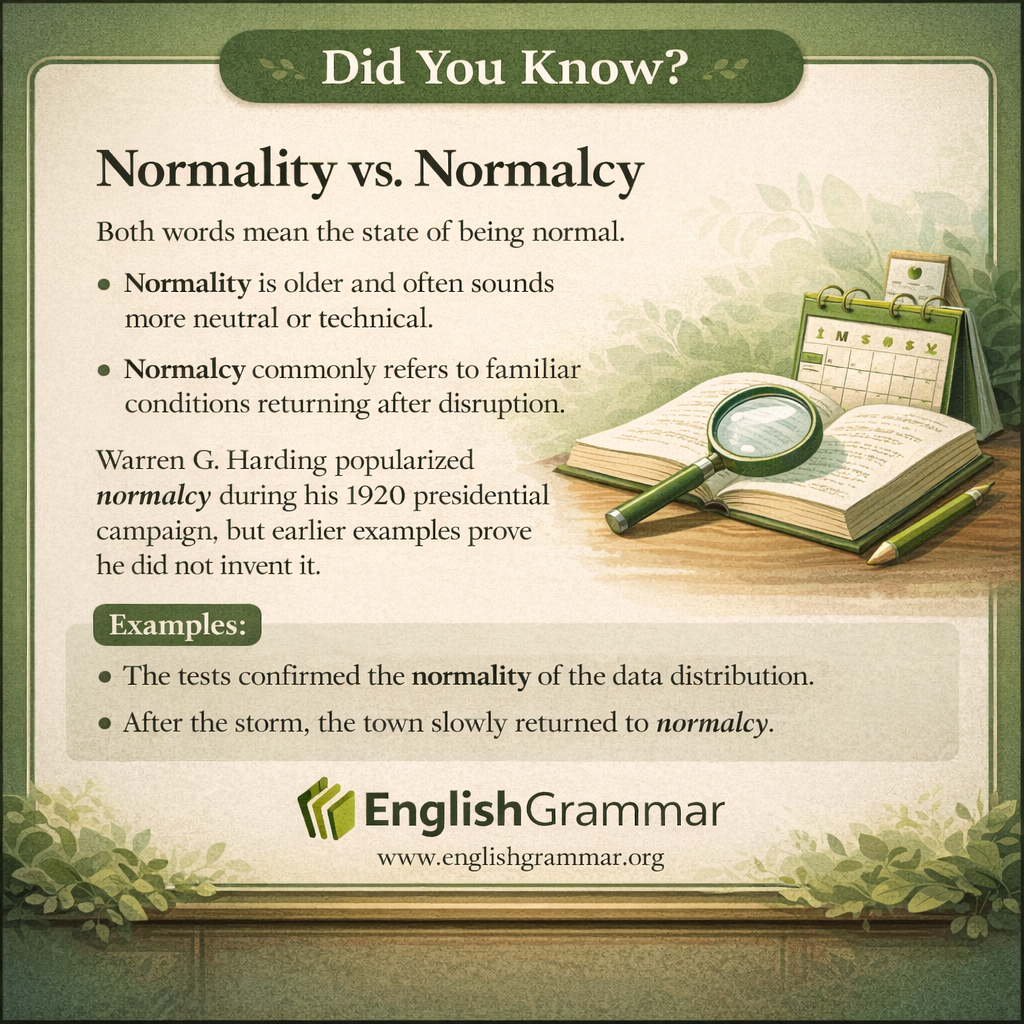
Normality and normalcy are both standard English nouns meaning the state or condition of being normal. In many sentences, either word can be used correctly. The main differences involve tone, context, and history.
Normality is the older word and often has a neutral, formal, or technical quality. It appears naturally in academic and scientific writing. In statistics, for example, normality describes how closely data follow a normal distribution.
The researchers tested the normality of the data before continuing their analysis.
Normalcy is especially common when people talk about ordinary life returning after a war, disaster, crisis, or major change. It often suggests the restoration of familiar routines and conditions.
Businesses reopened, and residents hoped for a quick return to normalcy.
The word became widely known through Warren G. Harding, who promoted a “return to normalcy” during his 1920 presidential campaign. Harding is sometimes said to have invented the word, but that claim is incorrect. Written examples of normalcy existed decades before his campaign. His repeated use simply made it much more prominent.
In general, choose according to context:
- Use normality when the tone is neutral, formal, or technical.
- Use normalcy when emphasizing recovery or the return of familiar routines.
These are tendencies rather than strict rules. Both words are legitimate, and their meanings overlap considerably.