
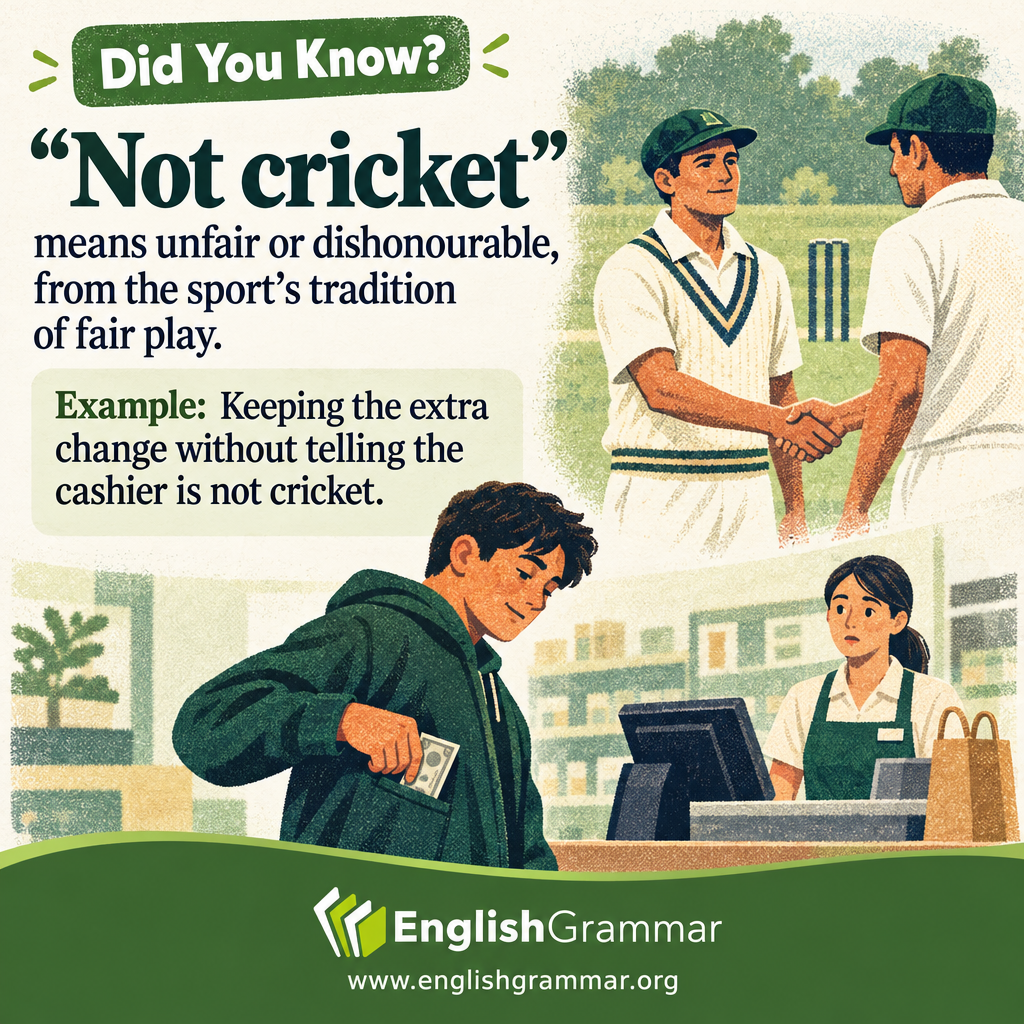
You can describe something as “not cricket” even when nobody is playing a sport. This mainly British expression means that an action is unfair or dishonourable.
The expression comes from cricket’s traditional association with fair play and sportsmanship. Players were expected not only to follow the rules but also to behave honourably towards their opponents. That ideal gave the sport’s name a wider meaning: a standard of proper behaviour.
So, when someone says an action is not cricket, they are usually criticising how someone has behaved. The action does not have to break a law or a written rule. It may simply go against what people consider fair.
- “Taking all the credit for your colleague’s work is not cricket.” Here, the speaker objects to someone claiming praise they have not earned.
- “They changed the terms after we agreed. That’s not cricket.” Here, the speaker thinks the change breaks an expectation of fair dealing.
Compare that with “This is tennis, not cricket.” In that sentence, the words identify which sport is being played. There is no criticism of anyone’s behaviour.
The idiom can sound rather old-fashioned, and speakers sometimes use it humorously. In everyday English, “That’s unfair” is a more direct alternative. Understanding the sporting connection helps you recognise the expression in conversation, books, or commentary without mistaking it for a literal reference to a match.