
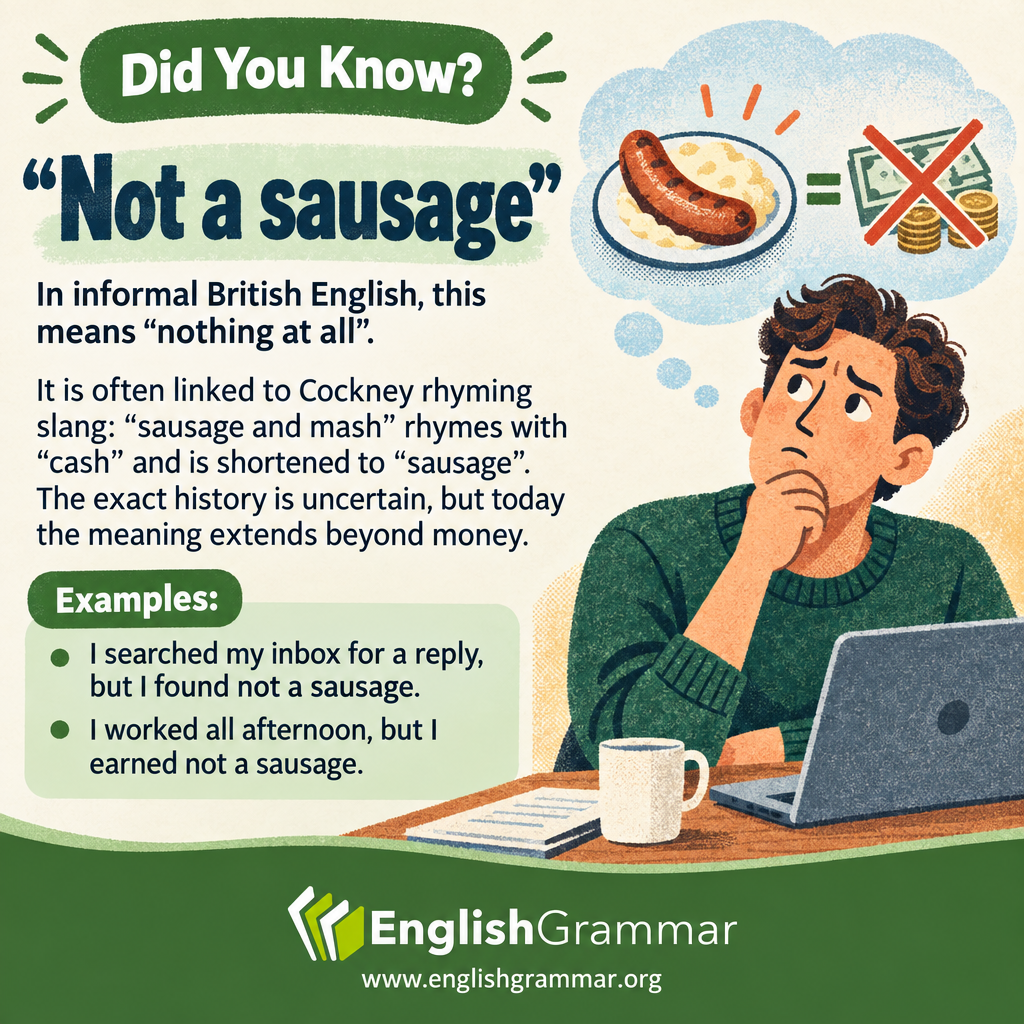
“Not a sausage” means nothing at all in informal British English. It adds a playful emphasis: you are not simply saying that there was very little, but that there was absolutely nothing.
The expression is often linked to Cockney rhyming slang, a way of replacing a word with a phrase that rhymes with it. In this explanation, sausage and mash stands for cash. The phrase is shortened to sausage, hiding the part that supplies the rhyme. Having no “sausage” would therefore mean having no money. This is a commonly given explanation, though the expression’s exact history is uncertain.
Today, the meaning is broader than money. You can use it when you receive nothing, find nothing or know nothing about something. The surrounding sentence tells the listener what is missing.
- “I checked every drawer, but I found not a sausage.” Here, the speaker found nothing.
- “Do you know anything about the new manager?” “Not a sausage.” Here, the reply means the speaker knows nothing about that person.
- “We sold a few things, but we earned not a sausage.” Here, the speaker says they made no money.
Keep this expression for casual conversation or relaxed writing. In a formal report, nothing, no information or no money will usually be clearer. Outside a familiar British context, some readers may take the sausage reference literally.