
• Skip to primary navigation
  • Skip to main content
  • Skip to primary sidebar
Home of English Grammar
  • Home
  • Course
  • Exercises
  • Grammar Rules
  • Matches
  • Posts
  • Tools
    • Grammar Checker
    • Very Replacer
    • Word Counter
  • Vocabulary Lists
  • Archives
    • Social Media Posts
    • Writing Guides
  • Join free

The origin of “not to be sneezed at”

October 21, 2026

The origin of "not to be sneezed at"

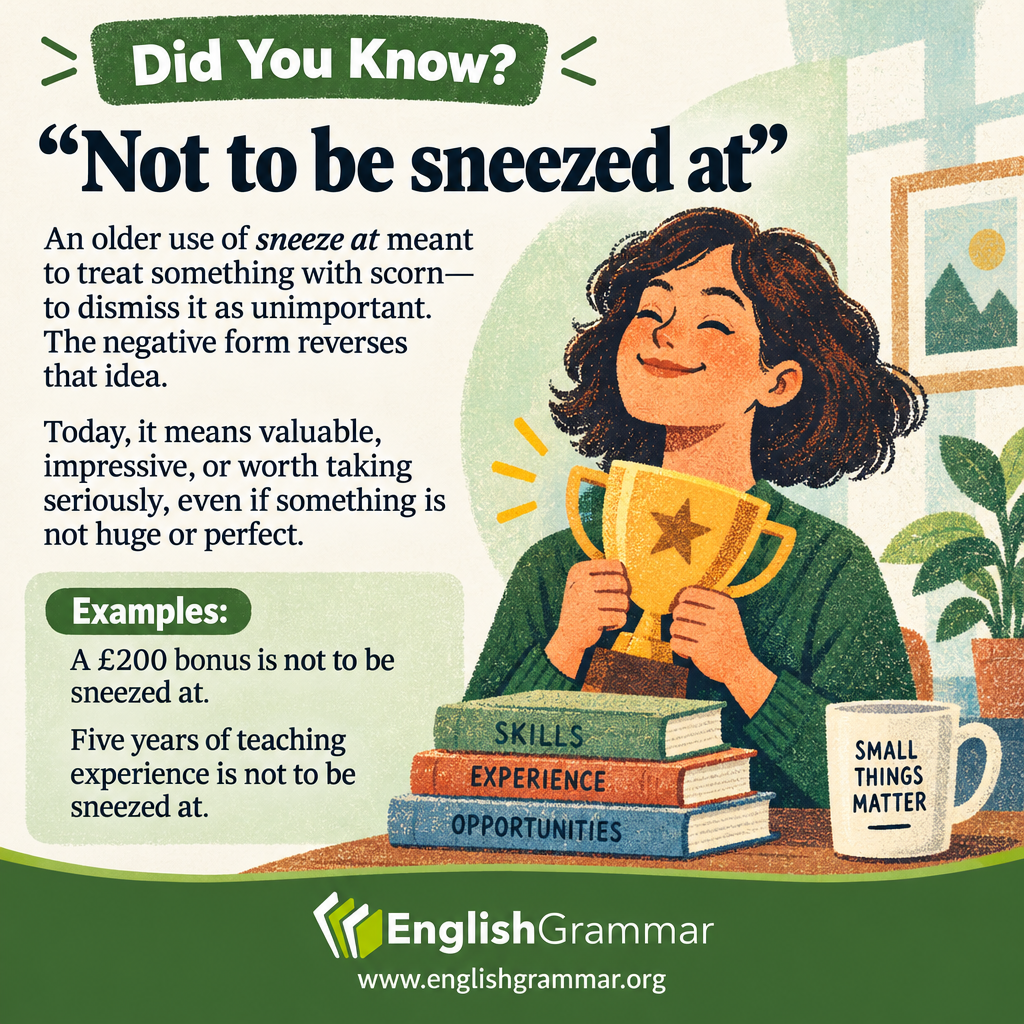
“Not to be sneezed at” means worth taking seriously: something is valuable, impressive, or useful enough that you should not dismiss it.

The expression comes from an older figurative use of sneeze at, meaning to treat something with scorn or contempt. In simpler words, it meant looking down on something as unimportant. Adding not turns that idea around: this is something you should not look down on.

Today, the expression often describes money, achievements, advantages, and opportunities. It can acknowledge that something is worthwhile even if it is not enormous or perfect. The wording is figurative; it has nothing to do with whether something actually makes you sneeze.

  • “A ten per cent discount is not to be sneezed at.” The saving is worth having, even if the price is still fairly high.
  • “Finishing third in a national competition is not to be sneezed at.” Third place is an achievement that deserves respect.
  • “The job includes free accommodation, which is not to be sneezed at.” The accommodation is a useful benefit worth considering.

You may also see the shorter form not to be sneezed at after a noun: “That is a benefit not to be sneezed at.” Both patterns express the same idea. In everyday conversation, simpler alternatives include worth considering, quite impressive, or nothing to dismiss, depending on the situation.

Improve your English grammar, vocabulary and writing

We take you step by step from beginner to advanced, even if you struggled with English at school or have always had trouble remembering the rules.

  • 10 modules, 105 lessons and 688 questions
  • Just log in and learn anytime and anywhere
  • Your progress is saved in your account
  • Download the 2027 Grammar Guide (PDF)

Related lesson in the course The verb be: am, is and are Module 01: Sentence foundations · Lesson 2

Join free

Already have an account? Sign in

See what’s in the course

Primary Sidebar

2.4M761.4K165.8K

Free 2027 Grammar Guide

  • Download Grammar Guide (PDF)
  • Online grammar course, A1 to C2
  • Weekly exercises and vocabulary
  • Join over 3 million English learners

We respect your privacy. Unsubscribe anytime.

Already have an account? Sign in

Grammar Checker - Try Now

Latest Posts

  • The origin of “not to be sneezed at” October 21, 2026
  • 100 Best Synonyms for “Prize” October 21, 2026
  • Modal Verbs of Obligation Exercise October 21, 2026
  • 100 Best Synonyms for “Demand” October 20, 2026
  • 100 Words Every Pitmaster Should Know October 20, 2026
  • 100 Best Synonyms for “Smile” October 20, 2026
  • 100 Best Synonyms for “Appalling” October 20, 2026
  • Go and Come Collocations Exercise October 20, 2026
  • 100 Best Synonyms for “Prior” October 20, 2026
  • 100 English Phrases for Buying Furniture in English October 20, 2026
Home of English Grammar

Free English grammar exercises, rules and vocabulary lists, with new exercises every week. Join the leading English grammar site with over 3 million followers.

Join free

Learn

  • Exercises
  • Matches
  • Grammar rules
  • Vocabulary lists
  • Writing guides
  • Online tools

More

  • Top social media posts
  • Various posts
  • Contact

Account

  • Join free
  • Grammar Course
  • Free grammar guide (PDF)

Copyright © 2026 EnglishGrammar.org

  • Disclaimer
  • Privacy policy
  • Terms
  • Sitemap