
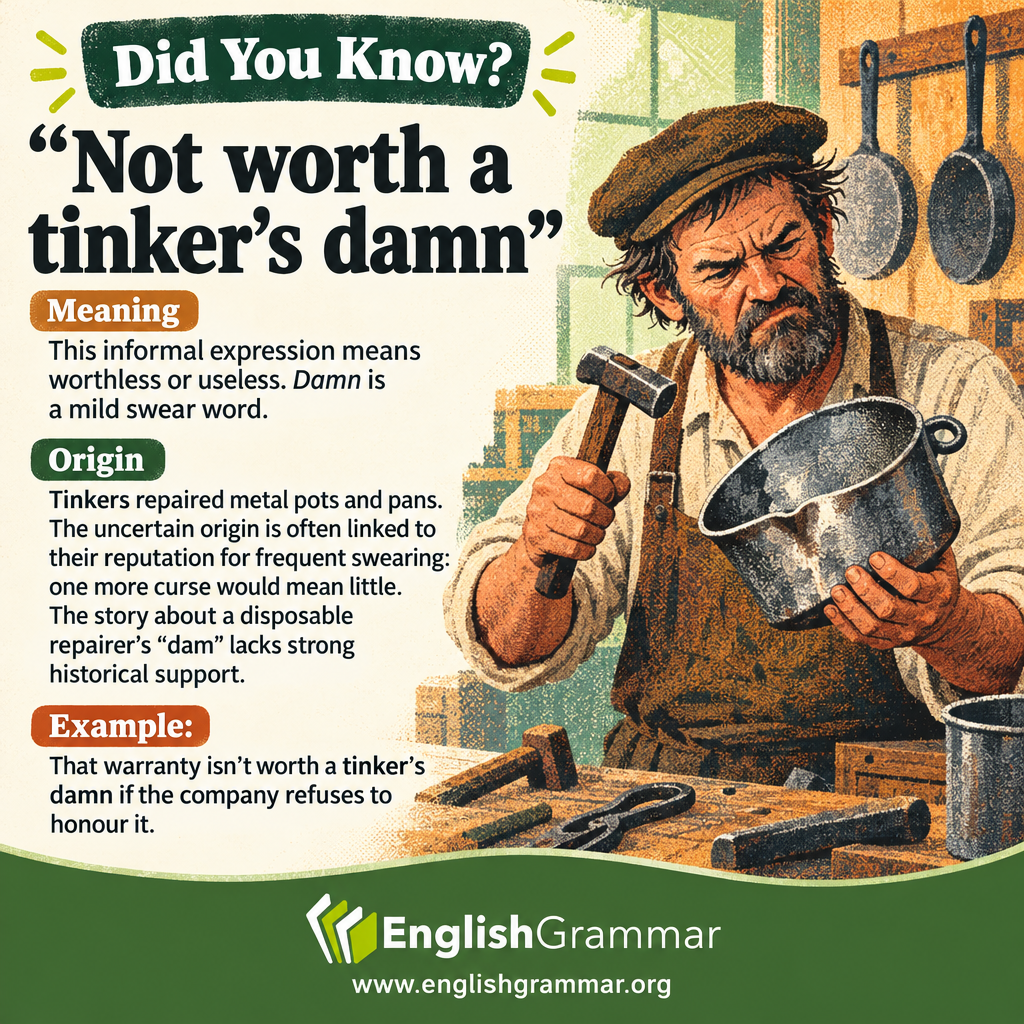
“Not worth a tinker’s damn” means that something has little or no value. It is an informal, emphatic way to call something worthless or useless. Because damn is a mild swear word, the expression is best avoided in polite or formal writing.
A tinker was a worker who repaired metal household items, especially pots and pans, often travelling from place to place. The expression’s exact origin is uncertain. A common explanation connects it with tinkers’ reputation for frequent swearing: if a tinker said damn constantly, any single curse would count for very little. This explains the link with worthlessness, but it should not be presented as a settled historical fact.
You may also encounter a story about a tinker’s dam: a temporary barrier used during a repair and then discarded. According to that story, the discarded material gave the expression its meaning. However, this explanation lacks strong historical support. It is not a good reason to claim that dam is the original or correct spelling.
Modern examples:
- That warranty isn’t worth a tinker’s damn if the company refuses to honour it.
- Without accurate figures, this report isn’t worth a tinker’s damn.
Both examples judge something’s practical usefulness, not simply its price. For a neutral alternative, say “That warranty is worthless” or “This report is no use without accurate figures.”