
• Skip to primary navigation
  • Skip to main content
  • Skip to primary sidebar
Home of English Grammar
  • Home
  • Course
  • Exercises
  • Grammar Rules
  • Matches
  • Posts
  • Tools
    • Grammar Checker
    • Very Replacer
    • Word Counter
  • Vocabulary Lists
  • Archives
    • Social Media Posts
    • Writing Guides
  • Join free

Notice, realize, recognize, perceive, discern, and detect: How to choose

October 24, 2026

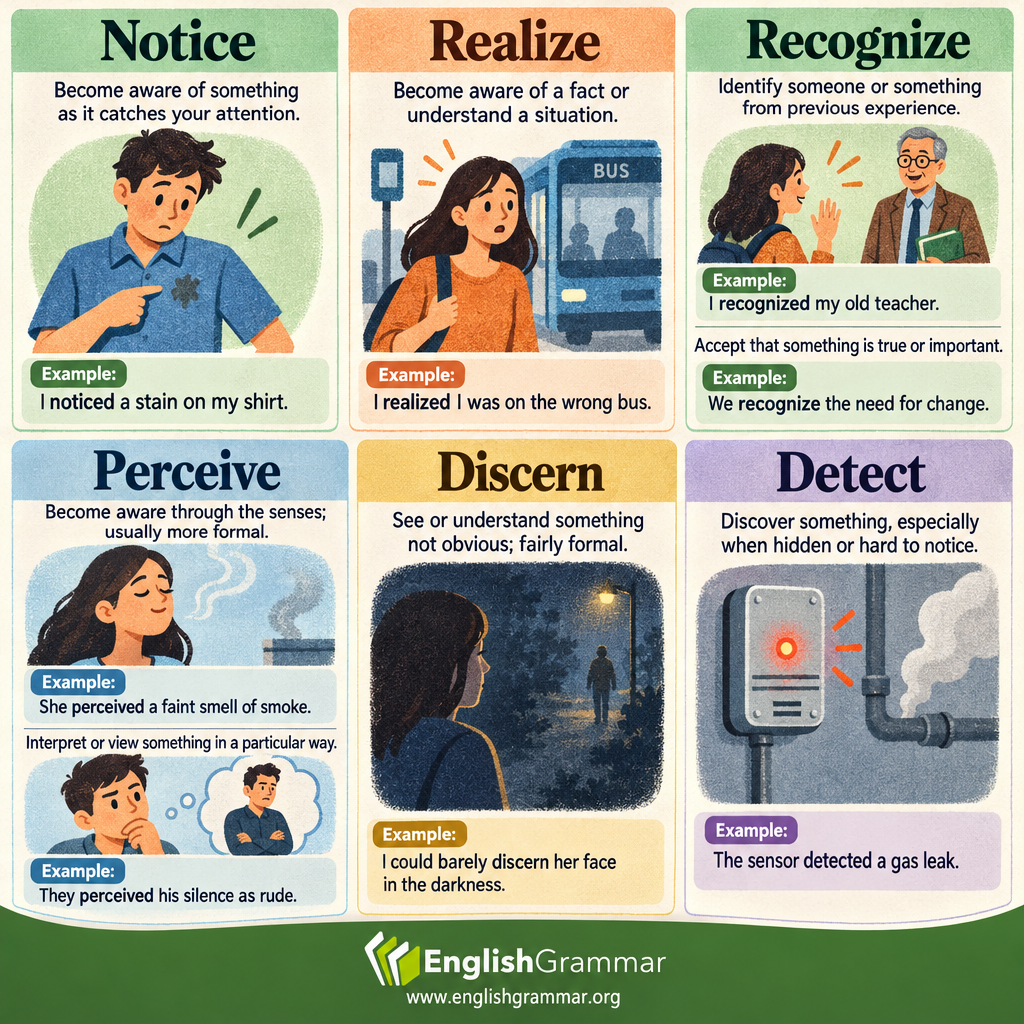
Notice vs. Realize vs. Recognize vs. Perceive vs. Discern vs. Detect

These six verbs can describe becoming aware of something, but they emphasize different parts of the experience. Their meanings overlap, so more than one may fit a situation.

  • Notice means that something comes to your attention, often through sight or hearing. I noticed a crack in the window. The focus is on becoming aware, not necessarily understanding why it matters.
  • Realize means to become aware of a fact or understand a situation. She realized that she had left her wallet at home. The focus is on understanding, rather than simply seeing or hearing.
  • Recognize often means identifying someone or something from previous experience. I recognized his voice immediately. It can also mean accepting that something is true or important: They recognize the need for better training.
  • Perceive can mean becoming aware through the senses, usually in more formal language. He perceived a faint movement nearby. It also describes interpretation: Some customers perceive the new packaging as wasteful.
  • Discern means managing to see or understand something that is not obvious. It is fairly formal. I could barely discern the path in the fog.
  • Detect means finding or discovering something, especially something hidden or difficult to notice. The test detected an infection. People, animals, and devices can all do this.

Compare I noticed her expression with I realized she was upset: the first highlights attention; the second highlights understanding. Choose according to what you want to emphasize, not a rigid rule about the situation.

Improve your English grammar, vocabulary and writing

We take you step by step from beginner to advanced, even if you struggled with English at school or have always had trouble remembering the rules.

  • 10 modules, 112 lessons and 730 questions
  • Just log in and learn anytime and anywhere
  • Your progress is saved in your account
  • Download the 2027 Grammar Guide (PDF)
Join free

Already have an account? Sign in

See what’s in the course

Primary Sidebar

2.4M761.4K165.8K

Free 2027 Grammar Guide

  • Download Grammar Guide (PDF)
  • Online grammar course, A1 to C2
  • Weekly exercises and vocabulary
  • Join over 3 million English learners

We respect your privacy. Unsubscribe anytime.

Already have an account? Sign in

Grammar Checker - Try Now

Latest Posts

  • Notice, realize, recognize, perceive, discern, and detect: How to choose October 24, 2026
  • Sensuous vs. sensual: choosing the right word October 24, 2026
  • 100 Best Synonyms for “Competitive” October 24, 2026
  • 100 Words to Describe Customer Experience October 24, 2026
  • Present Continuous Picture Sentences Exercise October 24, 2026
  • 100 Best Synonyms for “Prospered” October 24, 2026
  • 100 Best Synonyms for “Enable” October 24, 2026
  • 100 Best Synonyms for “Statement” October 24, 2026
  • 100 Best Synonyms for “Propriety” October 24, 2026
  • 100 Best Synonyms for “Evocative” October 24, 2026
Home of English Grammar

Free English grammar exercises, rules and vocabulary lists, with new exercises every week. Join the leading English grammar site with over 3 million followers.

Join free

Learn

  • Exercises
  • Matches
  • Grammar rules
  • Vocabulary lists
  • Writing guides
  • Online tools

More

  • Top social media posts
  • Various posts
  • Contact

Account

  • Join free
  • Grammar Course
  • Free grammar guide (PDF)

Copyright © 2026 EnglishGrammar.org

  • Disclaimer
  • Privacy policy
  • Terms
  • Sitemap