
• Skip to primary navigation
  • Skip to main content
  • Skip to primary sidebar
Home of English Grammar
  • Home
  • Course
  • Exercises
  • Grammar Rules
  • Matches
  • Posts
  • Tools
    • Grammar Checker
    • Very Replacer
    • Word Counter
  • Vocabulary Lists
  • Archives
    • Social Media Posts
    • Writing Guides
  • Join free

The origin and meaning of “off the cuff”

October 23, 2026

The origin of "off the cuff"

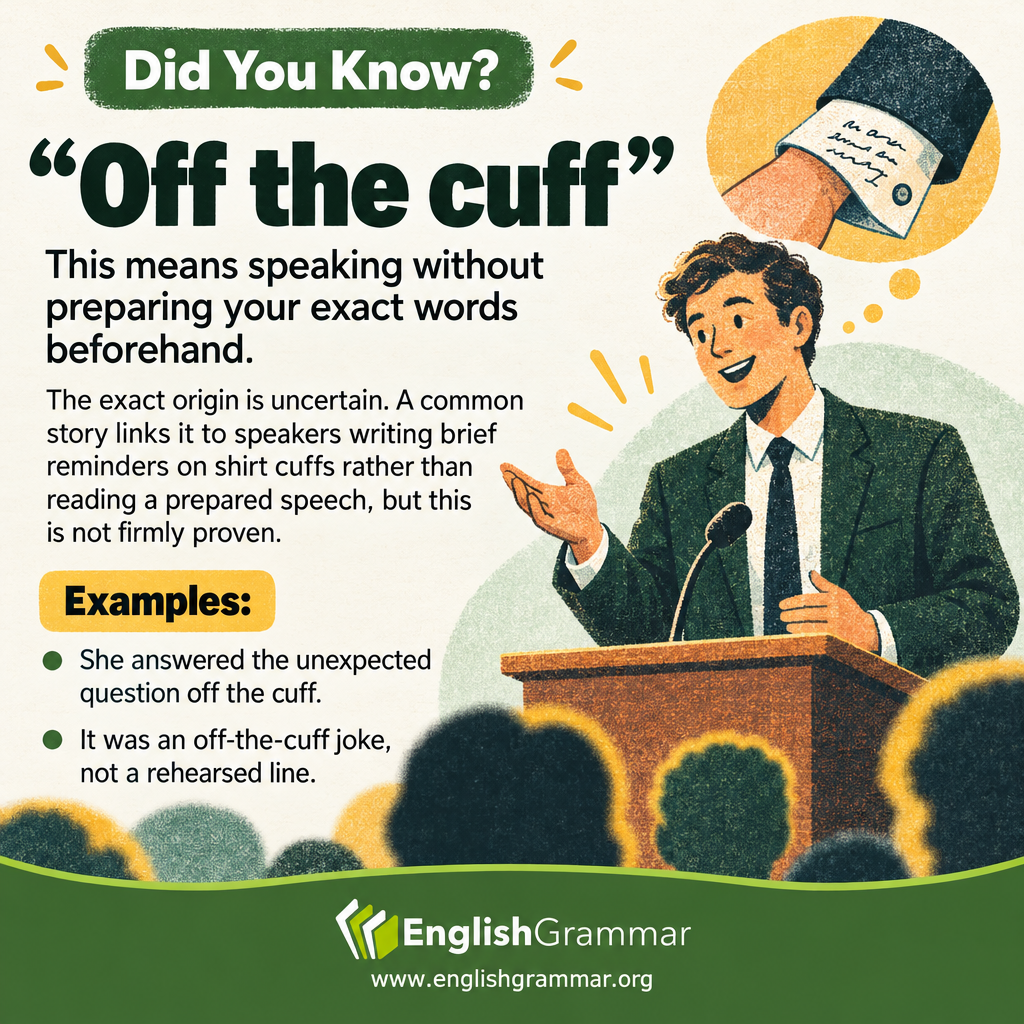
“Off the cuff” means speaking without preparing your exact words beforehand. You might use it for an unexpected answer, a spontaneous joke, or a short speech you have not rehearsed. It does not necessarily mean you know nothing about the subject.

Where does the expression come from? Its exact origin is uncertain. A common explanation connects it to speakers writing brief reminders on their shirt cuffs. In that story, someone could glance at a cuff for a prompt instead of reading a fully prepared speech. That provides an understandable link to informal, unrehearsed speaking, but the story should not be presented as a firmly proven origin.

In modern English, the expression describes how someone speaks, not anything they actually write on their clothing.

  • When the interviewer asked about her hobbies, she answered off the cuff.
  • He made an off-the-cuff comment about the new office layout.

Notice the spelling. Use off the cuff without hyphens after a verb, as in answered off the cuff. Before a noun, the words are usually joined with hyphens: an off-the-cuff comment or an off-the-cuff speech.

The expression does not automatically suggest that the words are careless or incorrect. An expert can give a thoughtful answer without rehearsing it. Context tells you whether the spontaneous remark was helpful, funny, awkward, or unwise.

Improve your English grammar, vocabulary and writing

We take you step by step from beginner to advanced, even if you struggled with English at school or have always had trouble remembering the rules.

  • 10 modules, 105 lessons and 688 questions
  • Just log in and learn anytime and anywhere
  • Your progress is saved in your account
  • Download the 2027 Grammar Guide (PDF)
Join free

Already have an account? Sign in

See what’s in the course

Primary Sidebar

2.4M761.4K165.8K

Free 2027 Grammar Guide

  • Download Grammar Guide (PDF)
  • Online grammar course, A1 to C2
  • Weekly exercises and vocabulary
  • Join over 3 million English learners

We respect your privacy. Unsubscribe anytime.

Already have an account? Sign in

Grammar Checker - Try Now

Latest Posts

  • The origin and meaning of “off the cuff” October 23, 2026
  • 100 Phrases for Declining Requests at Work Politely October 23, 2026
  • 100 Best Synonyms for “Plausible” October 23, 2026
  • Maybe, perhaps, possibly, conceivably, probably and definitely: How to choose October 23, 2026
  • Endemic vs. pandemic: what is the difference? October 23, 2026
  • What Clauses Exercise October 23, 2026
  • 100 Best Synonyms for “Clunky” October 23, 2026
  • 100 Best Synonyms for “Stagnant” October 23, 2026
  • 100 Best Synonyms for “Proposal” October 23, 2026
  • 100 Best Synonyms for “Due to” October 23, 2026
Home of English Grammar

Free English grammar exercises, rules and vocabulary lists, with new exercises every week. Join the leading English grammar site with over 3 million followers.

Join free

Learn

  • Exercises
  • Matches
  • Grammar rules
  • Vocabulary lists
  • Writing guides
  • Online tools

More

  • Top social media posts
  • Various posts
  • Contact

Account

  • Join free
  • Grammar Course
  • Free grammar guide (PDF)

Copyright © 2026 EnglishGrammar.org

  • Disclaimer
  • Privacy policy
  • Terms
  • Sitemap